

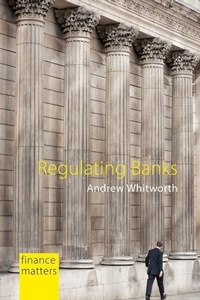
Regulating Banks
The Politics of Instability
Published on 10. December 2021
Book
Hardback
208 pages
978-1-78821-404-9 (ISBN)
Description
Banks have been at the heart of economic activity for centuries, but since the 2008 financial crisis scrutiny of their activities and regulation of their actions has become the focus of fervent academic, policy and political activity. This focus takes for granted the existence and nature of banks.
In Regulating Banks, Andrew Whitworth looks one stage deeper to question what a bank really is, and what the implications of that are. He argues that the institutional form of a bank represents the political compromise of a specific time and place - and can therefore change. This has implications for financial stability. Far from creating stability, he argues, the regulatory impulse of policy-makers inevitably leads to greater financial instability.
Whitworth examines the postwar period of UK banking to show how regulation influences the nature of banks as much as their behaviour. Regulation, by changing the nature of what is regulated, encourages banks and other actors over time to alter their behaviour, which leads to future boom and bust cycles. These cycles then require further regulation to rein in the disruption their new pattern of behaviour inevitably instigates.
Regulating Banks reveals the cyclical nature of banking regulation, the inherent mismatch between political impulses and market reactions, and the price banks, banking and society pay for such instability.
In Regulating Banks, Andrew Whitworth looks one stage deeper to question what a bank really is, and what the implications of that are. He argues that the institutional form of a bank represents the political compromise of a specific time and place - and can therefore change. This has implications for financial stability. Far from creating stability, he argues, the regulatory impulse of policy-makers inevitably leads to greater financial instability.
Whitworth examines the postwar period of UK banking to show how regulation influences the nature of banks as much as their behaviour. Regulation, by changing the nature of what is regulated, encourages banks and other actors over time to alter their behaviour, which leads to future boom and bust cycles. These cycles then require further regulation to rein in the disruption their new pattern of behaviour inevitably instigates.
Regulating Banks reveals the cyclical nature of banking regulation, the inherent mismatch between political impulses and market reactions, and the price banks, banking and society pay for such instability.
Reviews / Votes
Succinctly and expertly, Whitworth builds a case in which regulatory changes (often initiated as part of a political process) change what a bank is. His argument is very powerful. The reader is treated to an exceptionally well-researched and well-written discourse on key events in British banking history. The scope of the analysis is impressive and leaves no doubt that the task of regulating banks in a competitive international system, while ensuring financial stability in the face of political and geopolitical pressures, is challenging though fundamental to the success of the financial sector and the wider economy. -- Jonathan Williams, Professor of Banking and Finance, Bangor UniversityMore details
Series
Language
English
Place of publication
United Kingdom
Publishing group
Edinburgh University Press
Target group
College/higher education
Professional and scholarly
Product notice
Laminated cover
Dimensions
Height: 234 mm
Width: 156 mm
Thickness: 13 mm
Weight
470 gr
ISBN-13
978-1-78821-404-9 (9781788214049)
Copyright in bibliographic data and cover images is held by Nielsen Book Services Limited or by the publishers or by their respective licensors: all rights reserved.
Schweitzer Classification
Other editions
Additional editions
E-Book
12/2021
1st Edition
Agenda Publishing
from
€197.99
Available for download
E-Book
12/2021
1st Edition
Agenda Publishing
€197.99
Available for download
Person
Andrew is a policy and regulatory expert specialising in financial technology. He is the founder of Global Policy LTD, Visiting Fellow at the European University Institute in Florence, and an Adjunct Professor at IE University in Madrid. Andrew brings in-house policy director expertise from crypto, payments and fintech companies like Ripple and Curve, with a particular focus on the UK, EU and Middle East. Previously he served as an official at the Bank of England, developing its policy for fintech, stablecoins, CBDCs and crypto. He researches and teaches on the international political economy of financial innovation.
Content
1. Introduction: what is a bank?
2. The financial-regulatory cycle
3. Other ways of banking: the UK experience, 1945-70
4. Competition and Credit Control (C&CC) and the secondary banking crisis
5. The Banking Act 1979 and Johnson Matthey Bankers
6. Returning to the question: how the financial-regulatory cycle creates financial instability
7. The City revolution, 1987 Banking Act and two international bank failures
8. New Labour reforms and the 2008 financial crisis
9: The post-crisis response
10: Conclusion: banking regimes
2. The financial-regulatory cycle
3. Other ways of banking: the UK experience, 1945-70
4. Competition and Credit Control (C&CC) and the secondary banking crisis
5. The Banking Act 1979 and Johnson Matthey Bankers
6. Returning to the question: how the financial-regulatory cycle creates financial instability
7. The City revolution, 1987 Banking Act and two international bank failures
8. New Labour reforms and the 2008 financial crisis
9: The post-crisis response
10: Conclusion: banking regimes