

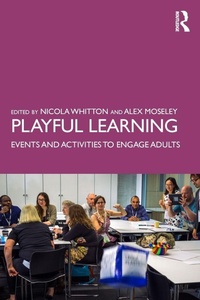
Playful Learning
Events and Activities to Engage Adults
1st Edition
Published on 22. April 2019
Book
Paperback/Softback
188 pages
978-1-138-49644-6 (ISBN)
Description
Offering an innovative and dynamic approach to adult learning, Playful Learning explores the potential of play in adulthood with the goal of helping educators, corporate trainers and event designers incorporate play-based activities for adults into both educational and work settings.
Through a comprehensive overview of the value of play in adulthood, this book responds to the growing popularity of playful events for adults in academic and business settings designed to promote higher levels of engagement. Drawing on the authors' own decades of experience at the forefront of the field, this helpful reference incorporates strategies and techniques for bringing play into any learning design. Examples and case studies of successful playful design at conferences, training events, and in higher education illustrate what effective playful event design looks like in practice.
With a multi-sector appeal that spans business, education and entertainment while bringing together practice and theory in an accessible manner, Playful Learning is a must-have resource for researchers, practitioners, managers and administrators alike.
Through a comprehensive overview of the value of play in adulthood, this book responds to the growing popularity of playful events for adults in academic and business settings designed to promote higher levels of engagement. Drawing on the authors' own decades of experience at the forefront of the field, this helpful reference incorporates strategies and techniques for bringing play into any learning design. Examples and case studies of successful playful design at conferences, training events, and in higher education illustrate what effective playful event design looks like in practice.
With a multi-sector appeal that spans business, education and entertainment while bringing together practice and theory in an accessible manner, Playful Learning is a must-have resource for researchers, practitioners, managers and administrators alike.
More details
Language
English
Place of publication
London
United Kingdom
Publishing group
Taylor & Francis Ltd
Target group
Professional and scholarly
Professional and Professional Practice & Development
Illustrations
14 s/w Tabellen, 26 s/w Abbildungen, 25 s/w Photographien bzw. Rasterbilder, 1 s/w Zeichnung
14 Tables, black and white; 1 Line drawings, black and white; 25 Halftones, black and white; 26 Illustrations, black and white
Dimensions
Height: 229 mm
Width: 152 mm
Thickness: 11 mm
Weight
307 gr
ISBN-13
978-1-138-49644-6 (9781138496446)
Copyright in bibliographic data and cover images is held by Nielsen Book Services Limited or by the publishers or by their respective licensors: all rights reserved.
Schweitzer Classification
Other editions
Additional editions

Book
04/2019
1st Edition
Routledge
€206.10
Shipment within 10-20 days
E-Book
04/2019
Routledge
€41.99
Available for download
E-Book
04/2019
1st Edition
Routledge
€41.99
Available for download
Persons
Nicola Whitton is Director of the Durham Centre for Academic Development and Professor of Education at Durham University, UK.
Alex Moseley is a National Teaching Fellow and Head of Curriculum Enhancement at the University of Leicester's Learning Institute, UK.
Alex Moseley is a National Teaching Fellow and Head of Curriculum Enhancement at the University of Leicester's Learning Institute, UK.
Content
Part I: Introduction 1: Introducing playful learning events Part II: Designing playful experiences 2: Play and learning in adulthood 3: Designing playful events 4: Play for different audiences Part III: Creating playful spaces 5: Playful interludes 6: Playful training 7: Running a playful event Part IV: Engaging people playfully 8: Creating immersive experiences 9: Building playful partnerships 10: Designing conference games Part V: Playful practice 11: Playful presentations 12: Playful tools and technologies 13: Playful evaluation Part VI: Conclusion 14: Future play