

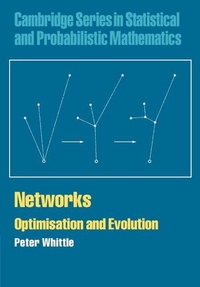
Networks
Optimisation and Evolution
Published on 12. April 2007
Book
Hardback
282 pages
978-0-521-87100-6 (ISBN)
Description
Point-to-point vs hub-and-spoke. Questions of network design are real and involve many billions of dollars. Yet little is known about optimising design - nearly all work concerns optimising flow assuming a given design. This foundational book tackles optimisation of network structure itself, deriving comprehensible and realistic design principles. With fixed material cost rates, a natural class of models implies the optimality of direct source-destination connections, but considerations of variable load and environmental intrusion then enforce trunking in the optimal design, producing an arterial or hierarchical net. Its determination requires a continuum formulation, which can however be simplified once a discrete structure begins to emerge. Connections are made with the masterly work of Bendsoe and Sigmund on optimal mechanical structures and also with neural, processing and communication networks, including those of the Internet and the World Wide Web. Technical appendices are provided on random graphs and polymer models and on the Klimov index.
Reviews / Votes
Review of the hardback: '... a remarkable book ... a pleasure to read ... plenty of interesting results, ideas and inspiration.' Hartmut Noltemeier, Zentralblatt MATHMore details
Series
Language
English
Place of publication
Cambridge
United Kingdom
Target group
Professional and scholarly
Dimensions
Height: 250 mm
Width: 175 mm
Thickness: 20 mm
Weight
670 gr
ISBN-13
978-0-521-87100-6 (9780521871006)
Copyright in bibliographic data and cover images is held by Nielsen Book Services Limited or by the publishers or by their respective licensors: all rights reserved.
Schweitzer Classification
Other editions
Person
Peter Whittle is Professor Emeritus at the University of Cambridge. From 1973 to 1986 he was Director of the Statistical Laboratory, Cambridge. He is a Fellow of the Royal Society and this is his 11th book.
Content
Tour d'horizon; Part I. Distribution Networks: 1. Simple flows; 2. Continuum formulations; 3. Multi-class and destination-specific flows; 4. Design optimality under variable loading; 5. Concave costs and hierarchical structure; 6. Road networks; 7. Structural optimisation: Michell structures; 8. Structures: computational experience of evolutionary algorithms; 9. Structure design for variable loading; Part II. Artificial Neural Networks: 10. Models and learning; 11. Some particular nets; 12. Oscillatory operation; Part III. Processing Networks: 13. Queuing networks; 14. Time-sharing networks; Part IV. Communication Networks: 15. Loss networks: optimality and robustness; 16. Loss networks: stochastics and self-regulation; 17. Operation of the Internet; 18. Evolving networks and the World-wide Web; Appendix 1. Spatial integrals for the telephone problem; Appendix 2. Bandit and tax processes; Appendix 3. Random graphs and polymer models; References; Index.