

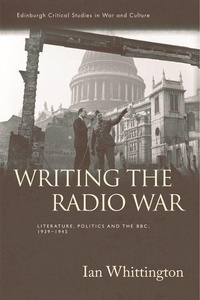
Writing the Radio War
Literature, Politics, and the BBC, 1939-1945
Published on 5. March 2018
Book
Hardback
224 pages
978-1-4744-1359-6 (ISBN)
Description
Wartime British writers took to the airwaves to reshape the nation and the Empire
Writing the Radio War positions the Second World War as a critical moment in the history of cultural mediation in Britain. Through chapters focusing on the middlebrow radicalism of J.B. Priestley, ground-breaking works by Louis MacNeice and James Hanley at the BBC Features Department, frontline reporting by Denis Johnston, and the emergence of a West Indian literary identity in the broadcasts of Una Marson, Writing the Radio War explores how these writers capitalised on the particularities of the sonic medium to communicate their visions of wartime and postwar Britain and its empire. By combining literary aesthetics with the acoustics of space, accent, and dialect, writers created aural communities that at times converged, and at times contended, with official wartime versions of Britain and Britishness.
Key Features
Merges the fields of sound studies, radio studies, and Second World War literary studies through considerations of both major and marginalized figures of wartime broadcastingBrings substantial but underused archival material (from the BBC Written Archives Centre, the Harry Ransom Humanities Research Center, the British Library, and other archives) to bear on the cultural importance of radio during the warForegrounds the role of radio in bridging literary movements from the highbrow to the middlebrow, and from the regional to the imperialDraws on Listener Research Reports, listener correspondence, newspaper coverage, and surveys by Mass Observation and the Wartime Social Survey in order to capture listeners' responses to wartime broadcasting in general as well as specific programsFills a gap in accounts of literary radio broadcasting, between Todd Avery's Radio Modernism (which ends at 1939) and postwar accounts of the Third Programme (by Humphrey Carpenter and Kate Whitehead) and individual writer-broadcasters
Writing the Radio War positions the Second World War as a critical moment in the history of cultural mediation in Britain. Through chapters focusing on the middlebrow radicalism of J.B. Priestley, ground-breaking works by Louis MacNeice and James Hanley at the BBC Features Department, frontline reporting by Denis Johnston, and the emergence of a West Indian literary identity in the broadcasts of Una Marson, Writing the Radio War explores how these writers capitalised on the particularities of the sonic medium to communicate their visions of wartime and postwar Britain and its empire. By combining literary aesthetics with the acoustics of space, accent, and dialect, writers created aural communities that at times converged, and at times contended, with official wartime versions of Britain and Britishness.
Key Features
Merges the fields of sound studies, radio studies, and Second World War literary studies through considerations of both major and marginalized figures of wartime broadcastingBrings substantial but underused archival material (from the BBC Written Archives Centre, the Harry Ransom Humanities Research Center, the British Library, and other archives) to bear on the cultural importance of radio during the warForegrounds the role of radio in bridging literary movements from the highbrow to the middlebrow, and from the regional to the imperialDraws on Listener Research Reports, listener correspondence, newspaper coverage, and surveys by Mass Observation and the Wartime Social Survey in order to capture listeners' responses to wartime broadcasting in general as well as specific programsFills a gap in accounts of literary radio broadcasting, between Todd Avery's Radio Modernism (which ends at 1939) and postwar accounts of the Third Programme (by Humphrey Carpenter and Kate Whitehead) and individual writer-broadcasters
Reviews / Votes
Whittington intricately explores the way his key figures negotiate their own political beliefs within the wartime exigencies of the BBC... As well as being a fascinating study in the processes behind artistic endeavour these tensions also expose wider discomfort with certain parts of the war, and its meanings, for the British establishment. -- Linsey Robb * Cercles * Gracefully written and unfailingly astute, attuned to the nuances of text, sound and institution, Writing the Radio War illuminates the complexly mediated construction of British nationhood during wartime, and in the process makes a compelling case for the vitality and durability of literary radio studies. * Debra Rae Cohen, University of South Carolina *More details
Series
Language
English
Place of publication
Edinburgh
United Kingdom
Target group
Professional and scholarly
Product notice
sewn/stitched
Cloth over boards
Dimensions
Height: 236 mm
Width: 155 mm
Thickness: 18 mm
Weight
458 gr
ISBN-13
978-1-4744-1359-6 (9781474413596)
Copyright in bibliographic data and cover images is held by Nielsen Book Services Limited or by the publishers or by their respective licensors: all rights reserved.
Schweitzer Classification
Other editions
Additional editions
E-Book
02/2018
1st Edition
Edinburgh University Press
€0.00
Available for download
Person
Ian Whittington is Associate Professor of English at the University of Mississippi. He is the author of Writing the Radio War: Literature, Politics and the BBC, 1939-1945 (Edinburgh University Press, 2018) as well as a number of essays on radio studies and twentieth-century British, Irish, and Anglophone literature.
Content
Introduction: Projecting Britain.....................................................................1
Chapter 1: Out of the People: J.B. Priestley's Broadbrow Radicalism....................... 45
Chapter 2: James Hanley and the Shape of the Wartime Features Department............. 96
Chapter 3: To Build the Falling Castle: Louis MacNeice and the Drama of Form........ 123
Chapter 4: Versions of Neutrality: Denis Johnston's War Reports......................... 175
Chapter 5: Calling the West Indies: Una Marson's Wireless Black Atlantic............... 230
Coda: Coronation.................................................................................. 278
Bibliography........................................................................................ 289
Chapter 1: Out of the People: J.B. Priestley's Broadbrow Radicalism....................... 45
Chapter 2: James Hanley and the Shape of the Wartime Features Department............. 96
Chapter 3: To Build the Falling Castle: Louis MacNeice and the Drama of Form........ 123
Chapter 4: Versions of Neutrality: Denis Johnston's War Reports......................... 175
Chapter 5: Calling the West Indies: Una Marson's Wireless Black Atlantic............... 230
Coda: Coronation.................................................................................. 278
Bibliography........................................................................................ 289