

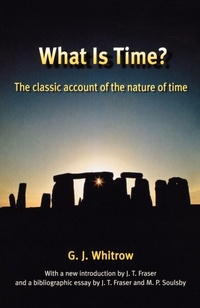
What is Time?
The classic account of the nature of time
Published on 11. December 2003
Book
Paperback/Softback
186 pages
978-0-19-860781-6 (ISBN)
Description
G. J. Whitrow (1912-2000) begins this classic exploration of the nature of time with a story about a Russian poet, visiting London before the First World War. The poet's English was not too good and when he asked a man in the street, 'Please, what is time?' he received the response, 'But that's a philosophical question. Why ask me?'.
Starting from this simple anecdote, Professor Whitrow takes us on a good-humoured and wide-ranging tour of the thing that clocks keep (more or less). He discusses how our ideas of time originated; how far they are inborn in plants and animals; how time has been measured, from sundial and hourglass to the caesium clock, and whether time possesses a beginning, a direction, and an end. He coaxes the diffident layman to contemplate with pleasure the differences between cyclic, linear, biological, cosmic, and space-time, and he provides frequent diversions into fascinating topics such as the Mayan calendar, the migration of birds, the dances of bees, precognition, and the short, crowded lives of mu-mesons, particles produced by cosmic-ray showers that exist for just two millionths of a second.
This reissue of the classic and authoritative What is Time? includes a new introduction by Dr J. T. Fraser, founder of the International Society for the Study of Time, and a bibliographic essay by Dr Fraser and Professor M. P. Soulsby of the Pennsylvania State University.
Starting from this simple anecdote, Professor Whitrow takes us on a good-humoured and wide-ranging tour of the thing that clocks keep (more or less). He discusses how our ideas of time originated; how far they are inborn in plants and animals; how time has been measured, from sundial and hourglass to the caesium clock, and whether time possesses a beginning, a direction, and an end. He coaxes the diffident layman to contemplate with pleasure the differences between cyclic, linear, biological, cosmic, and space-time, and he provides frequent diversions into fascinating topics such as the Mayan calendar, the migration of birds, the dances of bees, precognition, and the short, crowded lives of mu-mesons, particles produced by cosmic-ray showers that exist for just two millionths of a second.
This reissue of the classic and authoritative What is Time? includes a new introduction by Dr J. T. Fraser, founder of the International Society for the Study of Time, and a bibliographic essay by Dr Fraser and Professor M. P. Soulsby of the Pennsylvania State University.
More details
Language
English
Place of publication
Oxford
United Kingdom
Target group
College/higher education
Professional and scholarly
General readers with an interest in time, mathematicians, scientists, students.
Illustrations
numerous line drawings/ tables
Dimensions
Height: 198 mm
Width: 129 mm
Thickness: 10 mm
Weight
205 gr
ISBN-13
978-0-19-860781-6 (9780198607816)
Copyright in bibliographic data and cover images is held by Nielsen Book Services Limited or by the publishers or by their respective licensors: all rights reserved.
Schweitzer Classification
Persons
G. J. Whitrow was the first President of the International Society for the Study of Time and held the same position in numerous other scientific societies. He was a frequent broadcaster on radio and his many books include 'Time in History', 'Atoms and the Universe' (with G.O. Jones and J. Rotblat) and 'Einstein: The Man and His Achievement'.
Dr J. T. Fraser is the founder of the International Society for the Study of Time and author of several books including 'Time, Conflict, and Human Values' . He is widely acknowledged as the world's foremost expert on the study of time.
Professor Marlene P. Soulsby is Associate Professor in German and Comparative Literature at Pennsylvania State University.
Dr J. T. Fraser is the founder of the International Society for the Study of Time and author of several books including 'Time, Conflict, and Human Values' . He is widely acknowledged as the world's foremost expert on the study of time.
Professor Marlene P. Soulsby is Associate Professor in German and Comparative Literature at Pennsylvania State University.
Content
Introduction ; 1. The Origin of Our Idea of Time ; 2. Time and Ourselves ; 3. Biological Clocks ; 4. The Measurement of Time ; 5. Time and Relativity ; 6. Time, Gravitation and the Universe ; 7. The Origin and Arrow of Time ; 8. The Significance of Time ; Appendix: Temporal Order in Special Relativity ; Bibliography ; Index