

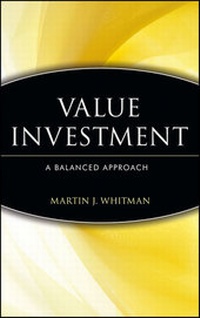
Value Investing
A Balanced Approach
Published on 22. April 1999
Book
Hardback
274 pages
978-0-471-16292-6 (ISBN)
Description
Provides a modern analytical framework for assessing a company's true value
Written by a true value investor known for his ability to buy undervalued companies and re-sell them at a substantial profit, Value Investing provides an analytical framework that evaluates the impact of real events-including restructuring, regulations, mergers and acquisitions, and other important factors-on a company's value.
Well-known for his success with distressed corporations and value investing, author Martin Whitman wages a controversial attack on the modern financial practice of focusing on price movements and short-term trading. In Value Investing, Whitman identifies fundamental factors affecting the value of companies and entire markets from the ground up and takes value investing one step further by demonstrating how industry movement and public policy decisions can lead to greater returns. He also highlights the shortcomings of all the popularly applied analytical techniques.
More details
Product info
gebunden
Series
Edition
1. Auflage
Language
English
Place of publication
New York
United States
Target group
Professional and scholarly
Product notice
sewn/stitched
Dimensions
Height: 235 mm
Width: 157 mm
Thickness: 22 mm
Weight
630 gr
ISBN-13
978-0-471-16292-6 (9780471162926)
Schweitzer Classification
Other editions
Additional editions
Book
10/2000
Wiley
€33.00
Shipment within 10-20 days
Person
MARTIN J. WHITMAN, CFA, is Chairman, CEO, and portfolio manager of the successful Third Avenue Value Fund and the Third Avenue Small Cap Value Fund. A leader in value investing, he is a Management Fellow at the Yale University School of Management.
Content
DIFFERENT APPROACHES TO THE INVESTMENT PROCESS.
What is Value Investing?
Academic Finance: Efficient Market Hypothesis and Efficient Portfolio Theory.
Graham and Dodd Fundamentalism.
Broker-Dealer Research Departments and Conventional Money Managers.
REAL-WORLD CONSIDERATIONS.
Corporate Valuation.
The Substantive Characteristics of Securities.
Capital Structure.
Promoters' and Professionals' Compensations.
Uses and Limitations of Financial Accounting.
Uses and Limitations of Narrative Disclosures.
Semantics Counts.
RESOURCE CONVERSION.
A Simplified Example.
Acquiring Securities in Bulk.
Restructuring Troubled Companies.
Other Resource Conversion Topics.
Epilogue: The Values of Value Investing.
Index.