

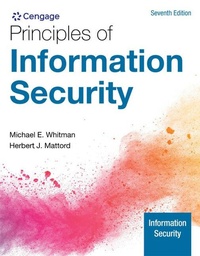
Principles of Information Security
7th Edition
Published on 27. June 2021
Book
Paperback/Softback
752 pages
978-0-357-50643-1 (ISBN)
Description
Discover the latest trends, developments and technology in information security with Whitman/Mattord's market-leading PRINCIPLES OF INFORMATION SECURITY, 7th Edition. Designed specifically to meet the needs of information systems students like you, this edition's balanced focus addresses all aspects of information security, rather than simply offering a technical control perspective. This overview explores important terms and examines what is needed to manage an effective information security program. A new module details incident response and detection strategies. In addition, current, relevant updates highlight the latest practices in security operations as well as legislative issues, information management toolsets, digital forensics and the most recent policies and guidelines that correspond to federal and international standards. MindTap digital resources offer interactive content to further strength your success as a business decision-maker.
More details
Edition
7th edition
Language
English
Place of publication
Boston, MA
United States
Publishing group
Cengage Learning, Inc
Target group
College/higher education
Dimensions
Height: 278 mm
Width: 216 mm
Thickness: 25 mm
Weight
1206 gr
ISBN-13
978-0-357-50643-1 (9780357506431)
Copyright in bibliographic data and cover images is held by Nielsen Book Services Limited or by the publishers or by their respective licensors: all rights reserved.
Schweitzer Classification
Other editions
Previous edition
Michael Whitman | Herbert Mattord
Principles of Information Security
Book
03/2017
6th Edition
Course Technology Inc
€95.47
Shipment within 10-15 days
Persons
Michael E. Whitman, Ph.D., C.I.S.M., C.I.S.S.P., is the executive director of the Institute for Cybersecurity Workforce Development and a professor of information security at Kennesaw State University. In 2004, 2007, 2012 and 2015, under Dr. Whitman's direction, the Center for Information Security Education spearheaded K.S.U.'s successful bid for the prestigious National Center of Academic Excellence recognitions (CAE/IAE and CAE/CDE), awarded jointly by the Department of Homeland Security and the National Security Agency. Dr. Whitman is also the editor-in-chief of the Journal of Cybersecurity Education and Research and Practice and director of the Southeast Collegiate Cyber Defense Competition. Dr. Whitman is an active researcher and author in information security policy, threats, curriculum development and ethical computing. He currently teaches graduate and undergraduate courses in information security. Dr. Whitman has several information security textbooks currently in print, including "Principles of Information Security," "Principles of Incident Response and Disaster Recovery," "Management of Information Security," "Readings and Cases in the Management of Information Security, Volumes I and II, "The Hands-On Information Security Lab Manual," "The Guide to Network Security" and "The Guide to Firewalls and Network Security." He has published articles in Information Systems Research, the Communications of the ACM, the Journal of International Business Studies, Information and Management and the Journal of Computer Information Systems. Dr. Whitman is a member of the Information Systems Security Association, ISACA and the Association for Information Systems. Previously, Dr. Whitman served the U.S. Army as an armored cavalry officer with additional duties as the automated data processing system security officer (ADPSSO). Herbert Mattord, Ph.D., C.I.S.M., C.I.S.S.P., completed 24 years of IT industry experience as an application developer, database administrator, project manager and information security practitioner before joining the faculty at Kennesaw State University, where he serves as a professor of information security and assurance and cybersecurity. Dr. Mattord currently teaches graduate and undergraduate courses. He is also a senior editor of the Journal of Cybersecurity Education, Research and Practice. He and Dr. Michael Whitman have authored "Principles of Information Security," "Principles of Incident Response and Disaster Recovery," "Management of Information Security," "Readings and Cases in the Management of Information Security," "The Guide to Network Security" and "The Hands-On Information Security Lab Manual." Dr. Mattord is an active researcher, author and consultant in information security management and related topics. He has published articles in the Information Resources Management Journal, Journal of Information Security Education, the Journal of Executive Education and the International Journal of Interdisciplinary Telecommunications and Networking. Dr. Mattord is a member of the Information Systems Security Association, ISACA and the Association for Information Systems. During his career as an IT practitioner, Dr. Mattord was an adjunct professor at Kennesaw State University, Southern Polytechnic State University, Austin Community College and Texas State University: San Marcos. He was formerly the manager of corporate information technology security at Georgia-Pacific Corporation, where he acquired much of the practical knowledge found in this and his other textbooks.
Content
1. Introduction to Information Security.
2. The Need for Security.
3. Legal, Ethical, and Professional Issues in Information Security.
4. Security Management.
5. Incident Response and Contingency Planning.
6. Risk Management.
7. Security Technology: Firewalls, VPNs, and Wireless.
8. Security Technology: Intrusion Detection and Prevention Systems and Other Security Tools.
9. Cryptography.
10. Implementing Information Security.
11. Security and Personnel.
12. Information Security Maintenance.
2. The Need for Security.
3. Legal, Ethical, and Professional Issues in Information Security.
4. Security Management.
5. Incident Response and Contingency Planning.
6. Risk Management.
7. Security Technology: Firewalls, VPNs, and Wireless.
8. Security Technology: Intrusion Detection and Prevention Systems and Other Security Tools.
9. Cryptography.
10. Implementing Information Security.
11. Security and Personnel.
12. Information Security Maintenance.