

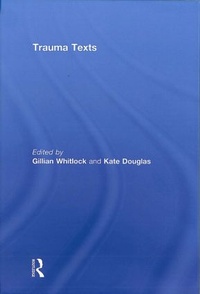
Trauma Texts
1st Edition
Published on 6. April 2009
Book
Hardback
208 pages
978-0-415-48300-1 (ISBN)
Description
These chapters gathered from two special issues of the journal Life Writing take up a major theme of recent work in the Humanities: Trauma. Autobiography has had a major role to play in this 'age of trauma', and these essays turn to diverse contexts that have received little attention to date: partition narratives in India, Cambodian and Iranian rap, refugee letters from Nauru, graffiti in Tanzania, and the silent spaces of trauma in Chile and Guantanamo. The contexts and media of these autobiographical trauma texts are diverse, yet they are linked by attention to questions of who gets to speak/write/inscribe autobiographically and how and where and why, and how can silences in the wake of traumatic experiences be read. These essays deliberately set out to establish some new fields for research in trauma studies by reaching out to a broader global context, into various texts, media and artifacts, representing diverse histories with specific attention to different voices, bodies, memories and subjectivities. This collection addresses the contemporary circuits of trauma story, and the media and icons and narratives that carry trauma story to political effect and emotional affect.
This book was previously published as two special issues of Life Writing.
This book was previously published as two special issues of Life Writing.
More details
Series
Language
English
Place of publication
London
United Kingdom
Publishing group
Taylor & Francis Ltd
Target group
College/higher education
Product notice
Paper over boards
Dimensions
Height: 246 mm
Width: 174 mm
Weight
540 gr
ISBN-13
978-0-415-48300-1 (9780415483001)
Copyright in bibliographic data and cover images is held by Nielsen Book Services Limited or by the publishers or by their respective licensors: all rights reserved.
Schweitzer Classification
Other editions
Additional editions
Gillian Whitlock | Kate Douglas
Trauma Texts
E-Book
05/2018
1st Edition
Routledge
€64.49
Available for download
Gillian Whitlock | Kate Douglas
Trauma Texts
E-Book
05/2018
1st Edition
Routledge
€64.49
Available for download
Gillian Whitlock | Kate Douglas
Trauma Texts
Book
08/2015
1st Edition
Routledge
€71.60
Shipment within 15-20 days
Persons
Gillian Whitlock is Professor in English Media Studies and Art History at the University of Queensland. He specialises in comparative and postcolonial approaches to life writing.
Kate Douglas is Lecturer in English, Creative Writing and Australian Studies at the Flinders University of South Australia who specialises in life writing, trauma and memory theory.
Kate Douglas is Lecturer in English, Creative Writing and Australian Studies at the Flinders University of South Australia who specialises in life writing, trauma and memory theory.
Content
1. Trauma Texts: Reading Trauma in the Twenty-First Century Kate Douglas and Gillian Whitlock 2. A Transnational Hip Hop Nation: praCh, Cambodia, and Memorialising the Killing Fields Cathy Schlund-Vials 3. Karibu Mwanza: Drawings by Tanzanian Street Children Marcus Wiencke 4. Testimonio and Telling Women's Narratives of Genocide, Torture and Political Imprisonment in Post-Suharto Indonesia Annie Pohlman 5. Fifty Years On: Melancholic (Re)collections and Women's Voices from the Partition of India Terri Tomsky 6. 'I Must Know': Re-membering Native Women in the CAVNET_IW Community Jane Haladay 7. Putting Site Back into Trauma Studies: A Study of Five Detention and Torture Centres in Santiago, Chile Peter Read and Marivic Wyndham 8. Textual Traumata: Letters to Lindy Chamberlain Deborah Staines 9. Vulnerable Children, Disposable Mothers: Holocaust and Stolen Generations Memoirs of Childhood Rosanne Kennedy 10. Letters from Nauru Gillian Whitlock 11. Hostile Witness: Torture Testimony in the War on Terror Nina Philadelphoff-Puren 12. From Grief to Grievance: Ethics and Politics in the Testimony of Anti-War Mothers Cynthia G. Franklin and Laura E. Lyons