

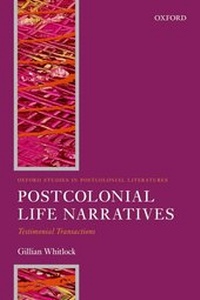
Postcolonial Life Narratives
Testimonial Transactions
Published on 2. April 2015
Book
Paperback/Softback
252 pages
978-0-19-956062-2 (ISBN)
Description
The Oxford Studies in Postcolonial Literatures series offers stimulating and accessible introductions to definitive topics and key genres and regions within the rapidly diversifying field of postcolonial literary studies in English.
Postcolonial Life Narrative draws together two dynamic fields of contemporary literature and criticism, postcolonialism and life narrative, to create a new assemblage: postcolonial life narrative. Focusing in particular on testimonial narrative, from slave narrative in the late eighteenth century to contemporary Anglophone life narrative from Africa, Australia, the Caribbean, Palestine, North America, and India, this study follows texts on the move through adaptation, appropriation, and remediation. For postcolonial subjects life narrative offers extraordinary opportunities to present accounts of social injustice and oppression, of violence and social suffering. Testimonial narrative can reach across cultures to produce intimate attachments between those who testify and those who bear witness to legacies of apartheid, slavery, rape warfare, genocide, and dispossession. Thresholds of testimony are subject to change and for some, for example refugees and asylum seekers, opportunities to engage a witnessing public and inspire campaigns for social justice on their behalf are curtailed--these are the 'ends of testimony'. The production, circulation, and reception of testimonial life narrative connects directly to the most fundamental questions of who counts as human, what rights follow from this, and what makes for grievable life. Postcolonial life narrative is a dynamic field of literature and criticism, and this book presents a series of proximate readings that outline its distinctive imaginative geographies.
Postcolonial Life Narrative draws together two dynamic fields of contemporary literature and criticism, postcolonialism and life narrative, to create a new assemblage: postcolonial life narrative. Focusing in particular on testimonial narrative, from slave narrative in the late eighteenth century to contemporary Anglophone life narrative from Africa, Australia, the Caribbean, Palestine, North America, and India, this study follows texts on the move through adaptation, appropriation, and remediation. For postcolonial subjects life narrative offers extraordinary opportunities to present accounts of social injustice and oppression, of violence and social suffering. Testimonial narrative can reach across cultures to produce intimate attachments between those who testify and those who bear witness to legacies of apartheid, slavery, rape warfare, genocide, and dispossession. Thresholds of testimony are subject to change and for some, for example refugees and asylum seekers, opportunities to engage a witnessing public and inspire campaigns for social justice on their behalf are curtailed--these are the 'ends of testimony'. The production, circulation, and reception of testimonial life narrative connects directly to the most fundamental questions of who counts as human, what rights follow from this, and what makes for grievable life. Postcolonial life narrative is a dynamic field of literature and criticism, and this book presents a series of proximate readings that outline its distinctive imaginative geographies.
Reviews / Votes
The introduction of Gillian Whitlocks Postcolonial Life Narratives: Testimonial Transactions immediately alerts readers to its impressive scope. The book successfully draws connections between life writing produced and read in disparate places at disparate times by disparate audiences in order to demonstrate the ways in which life writing can articulate the impact of conflicted human subjecthood on bodies, lives, and peoples. * Richard Moran, English Studies in Canada * Postcolonial Life Narratives makes a truly eye-opening read * Kerry-Jane Wallart, Commonwealth Essays and Studies *More details
Series
Language
English
Place of publication
Oxford
United Kingdom
Target group
College/higher education
Dimensions
Height: 200 mm
Width: 130 mm
Thickness: 14 mm
Weight
292 gr
ISBN-13
978-0-19-956062-2 (9780199560622)
Copyright in bibliographic data and cover images is held by Nielsen Book Services Limited or by the publishers or by their respective licensors: all rights reserved.
Schweitzer Classification
Other editions
Additional editions
Book
04/2015
Oxford University Press
€102.75
Shipment within 15-20 days
Whitlock Gillian | Gillian Whitlock
Postcolonial Life Narratives: Testimonial Transactions
Testimonial Transactions
E-Book
01/2015
1st Edition
Oxford University Press, USA
€24.99
Available for download
Person
Gillian Whitlock is an Australian Research Council professorial fellow at the University of Queensland, where she is currently working on archives of asylum seeker testimony and a new project called 'The Testimony of Things'. She is a graduate of Queen's University and the University of Queensland with a long-standing interest in the 'intimate empire' of postcolonial life writing. Her last book, Soft Weapons is a study of life narrative and the war on terror. She is a member of the Australian Academy of Humanities, and a board member of the Australia India Council.
Content
PART 1: COLONIAL TESTIMONIAL 1789-1852; PART 2: THE PASSAGES OF TESTIMONY: CONTEMPORARY STUDIES; SALVAGE