

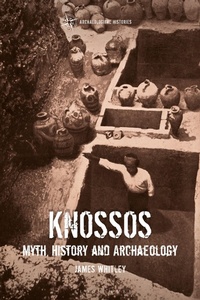
Knossos
Myth, History and Archaeology
Published on 30. November 2023
Book
Paperback/Softback
256 pages
978-1-4725-3284-8 (ISBN)
Description
Knossos is one of the most important sites in the ancient Mediterranean. It remained amongst the largest settlements on the island of Crete from the Neolithic until the late Roman times, but aside from its size it held a place of particular significance in the mythological imagination of Greece and Rome as the seat of King Minos, the location of the Labyrinth and the home of the Minotaur.
Sir Arthur Evans' discovery of 'the Palace of Minos' has indelibly associated Knossos in the modern mind with the 'lost' civilisation of Bronze Age Crete. The allure of this 'lost civilisation', together with the considerable achievements of 'Minoan' artists and craftspeople, remain a major attraction both to scholars and to others outside the academic world as a bastion of a romantic approach to the past.
In this volume, James Whitley provides an up-to-date guide to the site and its function from the Neolithic until the present day. This study includes a re-appraisal of Bronze Age palatial society, as well as an exploration of the history of Knossos in the archaeological imagination. In doing so he takes a critical look at the guiding assumptions of Evans and others, reconstructing how and why the received view of this ancient settlement has evolved from the Iron Age up to the modern era.
Sir Arthur Evans' discovery of 'the Palace of Minos' has indelibly associated Knossos in the modern mind with the 'lost' civilisation of Bronze Age Crete. The allure of this 'lost civilisation', together with the considerable achievements of 'Minoan' artists and craftspeople, remain a major attraction both to scholars and to others outside the academic world as a bastion of a romantic approach to the past.
In this volume, James Whitley provides an up-to-date guide to the site and its function from the Neolithic until the present day. This study includes a re-appraisal of Bronze Age palatial society, as well as an exploration of the history of Knossos in the archaeological imagination. In doing so he takes a critical look at the guiding assumptions of Evans and others, reconstructing how and why the received view of this ancient settlement has evolved from the Iron Age up to the modern era.
Reviews / Votes
[Whitley] introduces contextual material rarely found in studies of Bronze Age Crete ... Recommended [for] general readers and advanced undergraduates. * CHOICE * This is a very readable and stimulating book on one of the most visited archaeological sites in Greece, which does not focus exclusively on its Minoan (Bronze Age) palace, but explores its fascinating history in its entirety, from its humble beginnings in the Neolithic period to the present day. -- Nicoletta Momigliano, Professor of Aegean Studies, University of Bristol, UK Knossos: Myth, History and Archaeology remains an extremely accessible textbook, noteworthy for the completeness of its scholarship, making a much-needed contribution to the study of Knossos on a deeply human scale. Aimed at a wider audience unfamiliar with the topic, this book will serve as good educational reading. It provides an engaging glimpse into how to understand one of the most famous of all archaeological excavations, offering entertaining and informative content even for those who have never visited the site. * Bryn Mawr Classical Review *More details
Series
Language
English
Place of publication
London
United Kingdom
Publishing group
Bloomsbury Publishing PLC
Target group
College/higher education
Illustrations
62 bw illus
Dimensions
Height: 231 mm
Width: 152 mm
Thickness: 15 mm
Weight
410 gr
ISBN-13
978-1-4725-3284-8 (9781472532848)
DOI
CBID182899
Copyright in bibliographic data and cover images is held by Nielsen Book Services Limited or by the publishers or by their respective licensors: all rights reserved.
Schweitzer Classification
Other editions
Person
James Whitley is Professor in Mediterranean Archaeology at Cardiff University, UK. Between 2002 and 2007 he was Director of the British School at Athens, Greece.
Content
List of Tables and Figures
Preface and Acknowledgements
A Note on Chronology and Terminology
On the spelling of and transliteration of ancient Greek names
List of Abbreviations with Explanatory Note
Chapter 1. Legends and Labyrinths
Chapter 2. Inventing the Minoans: Arthur Evans and After
Chapter 3. From Village to Palace: Neolithic and Early Bronze Age Knossos
Chapter 4. Palatial Knossos: The Palace of Minos?
Chapter 5. After the Palace: From the Iron Age to the Romans
Chapter 6. Knossos Yesterday and Today
Bibliography
General Index
Topographical Index
Preface and Acknowledgements
A Note on Chronology and Terminology
On the spelling of and transliteration of ancient Greek names
List of Abbreviations with Explanatory Note
Chapter 1. Legends and Labyrinths
Chapter 2. Inventing the Minoans: Arthur Evans and After
Chapter 3. From Village to Palace: Neolithic and Early Bronze Age Knossos
Chapter 4. Palatial Knossos: The Palace of Minos?
Chapter 5. After the Palace: From the Iron Age to the Romans
Chapter 6. Knossos Yesterday and Today
Bibliography
General Index
Topographical Index