

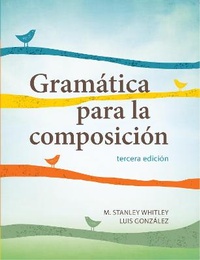
Gramatica para la composicion
tercera edicion
Published on 1. January 2016
Book
Paperback/Softback
560 pages
978-1-62616-255-6 (ISBN)
Description
Integrating grammar and composition, this new edition of the best-selling textbook guides the advanced student through progressively more complex types of writing by organizing the grammar lessons on a functionalist basis around the needs of composition. This innovative approach to teaching Spanish grammar and composition promotes systematic language development and enables students to strengthen their expressive and editing skills in the language in order to write more effectively and confidently. Refined by years of classroom testing and analysis of the problems students encounter, this new edition features the following: a new, colorful design helps students navigate the book more easily and engages visual learning strategies. It offers readings for the major composition exercises have been updated to stress authentic, connected discourse. It offers a fully redesigned companion website (www.books.quia.com) that works with both PCs and Macs and is sold separately. The site offers two-thirds more activities than the previous edition and features an instructor's interface for tracking student progress.
It provides a streamlined treatment of points of grammar, including an explanation for more than twelve functions of se with a rule of subject reflexivization. It offers the instructor's manual for Gramatica para la composicion, tercera edicion is available for free on the press's website. It is a wonderful resource for instructors, the manual includes details on updates to the new edition, suggested lesson sequences for different course lengths, and a sectional index of the text.
It provides a streamlined treatment of points of grammar, including an explanation for more than twelve functions of se with a rule of subject reflexivization. It offers the instructor's manual for Gramatica para la composicion, tercera edicion is available for free on the press's website. It is a wonderful resource for instructors, the manual includes details on updates to the new edition, suggested lesson sequences for different course lengths, and a sectional index of the text.
Reviews / Votes
A comprehensive text for upper-intermediate Spanish composition courses that is complemented by online, student oriented materials . . . A resource that can be used beyond the scope of the class for which it is assigned and can remain an active part of students' libraries long after the class is finished. * Hispania *More details
Edition
tercera edicion
Language
Spanish
Place of publication
Washington, DC
United States
Target group
College/higher education
US School Grade: From College Freshman to College Graduate Student
Product notice
Paperback (trade)
Illustrations
50 Illustrations, black and white; 125 Illustrations, color
Dimensions
Height: 279 mm
Width: 216 mm
Weight
1542 gr
ISBN-13
978-1-62616-255-6 (9781626162556)
Copyright in bibliographic data and cover images is held by Nielsen Book Services Limited or by the publishers or by their respective licensors: all rights reserved.
Schweitzer Classification
Other editions
New editions
Other
08/2021
Georgetown University Press
€198.26
Article is exhausted; no reprint
Previous edition
Book
08/2007
Georgetown University Press
€72.00
Article exhausted; check for reprint
Persons
M. Stanley Whitley is professor emeritus of Spanish and linguistics at Wake Forest University. He is the author of Spanish/English Contrasts: A Course in Spanish Linguistics, coauthor of Teaching Spanish Grammar with Pictures: How to Use William Bull's Visual Grammar of Spanish, and coauthor of Pronouncing English: A Stress-Based Approach with CD-ROM. Luis Gonzalez is associate professor of Spanish at Wake Forest University. Claudia Ospina is lecturer in Spanish at Wake Forest University.
Content
Introduccion: To the Student Leccion preliminar (L. 0): Ortografia y puntuacion Capitulo I: La descripcionLeccion 1: El presente de indicativo y el infinitivoLeccion 2: La flexion de sustantivos, articulos y adjetivosLeccion 3: Los verbos copulativos Leccion 4: La conjuncion, la negacion, la ubicacion y las preguntasLeccion 5: El uso del diccionarioLeccion 6: Composicion: la descripcion Capitulo II: El reportaje Leccion 7: El sujeto, el objeto directo y los reflexivos Leccion 8: Los pronombres personales Leccion 9: El objeto indirecto Leccion 10: El presente de subjuntivo y el imperativo Leccion 11: El discurso indirecto, las clausulas sustantivas y el modo Leccion 12: Composicion: El reportaje y las instrucciones Capitulo III: La narracion Leccion 13: El preterito y el imperfecto: su formacion Leccion 14: Preterito vs. imperfecto: su funcion Leccion 15: El pasado de subjuntivo Leccion 16: Los adverbiales de manera y tiempo Leccion 17: La gramatica de la narracion Leccion 18: Composicion: La narracion personal Capitulo IV: La narracion compleja Leccion 19: El participio y los tiempos perfectosLeccion 20: El futuro y el condicional Leccion 21: Las clausulas adverbiales y condicionales Leccion 22: El gerundio y los progresivos Leccion 23: El tiempo y los tiempos Leccion 24: Composicion: La narracion compleja Capitulo V: La exposicion Leccion 25: La frase sustantiva y la referencia Leccion 26: Las clausulas relativas Leccion 27: Los numeros Leccion 28: La sustantivacion y el neutro Leccion 29: La comparacion Leccion 30: Composicion: La exposicion Capitulo VI: La argumentacion Leccion 31: Las preposiciones Leccion 32: Cambios de estructura: el enfasis Leccion 33: Cambios de estructura: el "desenfasis" (impersonalidad) Leccion 34: ConectoresLeccion 35: La clausula sustantiva y su reduccion al infinitivo Leccion 36: Composicion: La argumentacion Capitulo VII: Lecciones facultativas Leccion 37: Las abreviaturas Leccion 38: La derivacion Leccion 39: Repaso de vosotros ApendicesApendice A: Distinciones problematicas Apendice B: Distinciones: ejercicios Apendice C: Resumen de la conjugacion del verboApendice D: Glosario bilingue e indice de materias Bibliografia Creditos