

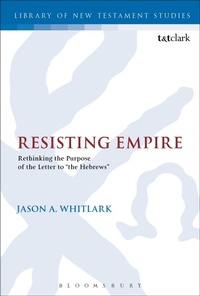
Resisting Empire
Rethinking the Purpose of the Letter to "the Hebrews"
Published on 31. July 2014
Book
Hardback
248 pages
978-0-567-45601-4 (ISBN)
Description
This book offers a fresh reading about the purpose for which Hebrews was written. In this book Whitlark argues that Hebrews engages both the negative pressures (persecution) and positive attractions (honor/prosperity) of its audience's Roman imperial context. Consequently, the audience of Hebrews appears to be in danger of defecting to the pagan imperial context. Due to the imperial nature of these pressures, Hebrews obliquely critiques the imperial script according to the rhetorical expectations in the first-century Mediterranean world-namely, through the use of figured speech. This critique is the primary focus of Whitlark's project. Whitlark examines Hebrews's figured response to the imperial hopes boasted by Rome along with Rome's claim to eternal rule, to the power of life and death, and to be led by the true, victorious ruler. Whitlark also makes a case for discerning Hebrews's response to the challenges of Flavian triumph. Whitlark concludes his study by suggesting that Hebrews functions much like Revelation, that is, to resist the draw of the Christians' Roman imperial context. This is done, in part, by providing a covert opposition to Roman imperial discourse. He also offers evaluation of relapse theories for Hebrews, of Hebrews's place among early Christian martyrdom, and of the nature of the resistance that Hebrews promotes.
Reviews / Votes
Jason Whitlark's volume, a recent addition to the Library of New Testament Studies series, move[s] this debate onto new ground, particularly in seeking to uncover the anti-imperial rhetoric that the letter purportedly displays. Whitlark's familiarity with, and usage of, contemporary classical sources is impressive. Indeed, one of the strengths of the volume is the usage of such material, and the book is as much a 'classics' text as it is an 'NT studies' one. -- David Allen * The Expository Times * In this new study on the background of Hebrews, Jason Whitlark, Associate Professor of New Testament at Baylor University, sets out to unravel the complexities of the letter, especially with regard to its purpose and ideological setting. Informed by the recent trend of empire studies conducted by James C. Scott, Richard A. Horsley, and others, Whitlark argues that the Letter to the Hebrews has been written to challenge the pressures and temptations of first-century Roman power. This study is a school example of scholarly work at its best: its aim is well-defined, its presuppositions are clear, and its method is lucid and sound (and its conclusions, I might add, are convincing). -- Arie W. Zwiep * RBL *More details
Series
Language
English
Place of publication
Edinburgh
United Kingdom
Publishing group
Bloomsbury Publishing PLC
Target group
Professional and scholarly
College/higher education
Dimensions
Height: 240 mm
Width: 161 mm
Thickness: 18 mm
Weight
540 gr
ISBN-13
978-0-567-45601-4 (9780567456014)
DOI
CBID179959
Copyright in bibliographic data and cover images is held by Nielsen Book Services Limited or by the publishers or by their respective licensors: all rights reserved.
Schweitzer Classification
Other editions
Additional editions
E-Book
07/2014
1st Edition
T.& T.Clark Ltd
€43.49
Available for download
Person
Jason A. Whitlark is an Associate Professor of New Testament at Baylor University, USA.
Content
1. Introduction: Hebrews and Its Imperial Context
2. Rhetoric of Resistance: Figured Speech and the Critique of Imperial Power
3. Resisting Assimilation: The Warning against Idolatry
4. Resisting Assimilation: A Better Hope
5. Resisting Imperial Claims: The Eternal City and Its Ruler
6. Resisting Imperial Claims: Jesus' Defeat of the Devil
7. Resisting Imperial Claims: Jesus' Herculean Labor of Liberation
8. Resisting Imperial Claims: Answering the Theodical Challenge of Flavian Triumph
9. Conclusion
2. Rhetoric of Resistance: Figured Speech and the Critique of Imperial Power
3. Resisting Assimilation: The Warning against Idolatry
4. Resisting Assimilation: A Better Hope
5. Resisting Imperial Claims: The Eternal City and Its Ruler
6. Resisting Imperial Claims: Jesus' Defeat of the Devil
7. Resisting Imperial Claims: Jesus' Herculean Labor of Liberation
8. Resisting Imperial Claims: Answering the Theodical Challenge of Flavian Triumph
9. Conclusion