

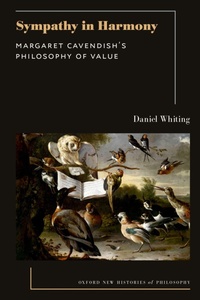
Sympathy in Harmony
Margaret Cavendish's Philosophy of Value
Will be published approx. on 12. November 2026
Book
Hardback
296 pages
978-0-19-784325-3 (ISBN)
Description
This is an open access title. It is available to read and download as a free PDF version on Oxford Academic and is made available under a Creative Commons Attribution-Non Commercial-No Derivatives 4.0 International licence.
Margaret Cavendish (1623-1673) was a philosopher, scientist, essayist, critic, biographer, and author of plays, poems, and prose. While she has received increasing attention in recent years, Sympathy in Harmony is the first book to examine Cavendish's philosophy of value. Is there such a thing as value? If so, is value a fundamental feature of reality or does it admit of explanation? Does the value something possesses depend in some way on the value we take it to possess? Is our taking something to possess value a matter of belief, say, or of feeling? Either way, is it an exercise of reason?
Daniel Whiting demonstrates Cavendish's philosophy of value to be systematic, continuous with her metaphysics, philosophy of mind, and epistemology, and wide-ranging. Her reflections encompass the beauty of the natural world, the expressive qualities of music, the pedagogical role of literature, the free play of the imagination, the nature of virtue, the depth of moral disagreement, and the limits of moral theory. By exploring Cavendish's perspectives on these varied topics, Whiting unearths a unified conception of value. He shows that that conception is distinctive relative to that of her peers-including Rene Descartes, Kenelm Digby, Thomas Hobbes, and Henry More-and indebted to ancient thought. At the same time, Whiting demonstrates the significance of Cavendish's writings for contemporary aesthetics and ethics.
Margaret Cavendish (1623-1673) was a philosopher, scientist, essayist, critic, biographer, and author of plays, poems, and prose. While she has received increasing attention in recent years, Sympathy in Harmony is the first book to examine Cavendish's philosophy of value. Is there such a thing as value? If so, is value a fundamental feature of reality or does it admit of explanation? Does the value something possesses depend in some way on the value we take it to possess? Is our taking something to possess value a matter of belief, say, or of feeling? Either way, is it an exercise of reason?
Daniel Whiting demonstrates Cavendish's philosophy of value to be systematic, continuous with her metaphysics, philosophy of mind, and epistemology, and wide-ranging. Her reflections encompass the beauty of the natural world, the expressive qualities of music, the pedagogical role of literature, the free play of the imagination, the nature of virtue, the depth of moral disagreement, and the limits of moral theory. By exploring Cavendish's perspectives on these varied topics, Whiting unearths a unified conception of value. He shows that that conception is distinctive relative to that of her peers-including Rene Descartes, Kenelm Digby, Thomas Hobbes, and Henry More-and indebted to ancient thought. At the same time, Whiting demonstrates the significance of Cavendish's writings for contemporary aesthetics and ethics.
More details
Series
Language
English
Place of publication
New York
United States
Target group
College/higher education
Product notice
sewn/stitched
Cloth over boards
Dimensions
Height: 235 mm
Width: 156 mm
ISBN-13
978-0-19-784325-3 (9780197843253)
Copyright in bibliographic data and cover images is held by Nielsen Book Services Limited or by the publishers or by their respective licensors: all rights reserved.
Schweitzer Classification
Person
Daniel Whiting is a Professor of Philosophy at the University of Southampton. His wide-ranging research interests include aesthetics, epistemology, ethics, and the history of philosophy. His many publications include the monograph The Range of Reasons (OUP 2022). Whiting is a trustee of the British Society of Aesthetics and a member of the scientific committee for the British Society for the Theory of Knowledge. From 2018-2023, he was the Director of the Mind Association. Whiting has led three projects supported by the Arts and Humanities Research Council.
Content
- Chapter 1: Introduction
- Chapter 2: Matter and Mind
- Chapter 3: Rationality and Truth
- Chapter 4: Passion and Pleasure
- Chapter 5: Beauty in Nature
- Chapter 6: Musical Expression and Harmony
- Chapter 7: Virtue and Moral Goodness
- Chapter 8: Poetry
- Chapter 9: Imagination and Play
- Chapter 10: Conclusion