

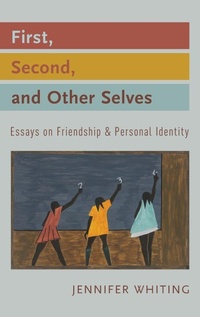
First, Second, and Other Selves
Essays on Friendship and Personal Identity
Published on 24. May 2016
Book
Hardback
280 pages
978-0-19-996791-9 (ISBN)
Description
In her essay collection First, Second, and Other Selves: Essays on Friendship and Personal Identity, well-known scholar of ancient philosophy Jennifer Whiting gathers her previously published essays taking Aristotle's theories on friendship as a springboard to engage with contemporary philosophical work on personal identity and moral psychology.
Whiting examines three themes throughout the collection, the first being psychic contingency, or the belief that the psychological structures characteristic of human beings may in fact vary, not just from one cultural (or socio-historical) context to another, but also from one individual to another. The second theme is the belief that friendship informs an understanding of the nature of the self, an idea that springs from Whiting's uncommon reading of Aristotle's writings on friendship.
Specifically, Whiting explains a scenario in which a "virtuous agent" adopts a kind of impersonal attitude both towards herself and towards her "character" friends, loving both because they are virtuous; this scenario ties in with an examination of the Aristotelian concept of the ideal friend as an "other
self," or a friendship that evolves from character rather than ego, as well as Whiting's meditation on whether or not a virtuous individual should have a "special" sort of concern for her own future self, distinct in kind from the concern that she has for others. The third theme is that of rational egoism, a concept that Whiting critiques, especially in the context of Aristotle's eudaimonism.
The central tenet of the collection is the message that taking "ethocentric" (or character-based) attitudes both towards ourselves and towards our friends sheds light on the nature of personal identity and helps to combat ethnocentric and other objectionable forms of bias, a message that is becoming increasingly urgent in light of the recent deaths of Trayvon Martin and Michael Brown.
Whiting examines three themes throughout the collection, the first being psychic contingency, or the belief that the psychological structures characteristic of human beings may in fact vary, not just from one cultural (or socio-historical) context to another, but also from one individual to another. The second theme is the belief that friendship informs an understanding of the nature of the self, an idea that springs from Whiting's uncommon reading of Aristotle's writings on friendship.
Specifically, Whiting explains a scenario in which a "virtuous agent" adopts a kind of impersonal attitude both towards herself and towards her "character" friends, loving both because they are virtuous; this scenario ties in with an examination of the Aristotelian concept of the ideal friend as an "other
self," or a friendship that evolves from character rather than ego, as well as Whiting's meditation on whether or not a virtuous individual should have a "special" sort of concern for her own future self, distinct in kind from the concern that she has for others. The third theme is that of rational egoism, a concept that Whiting critiques, especially in the context of Aristotle's eudaimonism.
The central tenet of the collection is the message that taking "ethocentric" (or character-based) attitudes both towards ourselves and towards our friends sheds light on the nature of personal identity and helps to combat ethnocentric and other objectionable forms of bias, a message that is becoming increasingly urgent in light of the recent deaths of Trayvon Martin and Michael Brown.
Reviews / Votes
These essays are long and densely argued, defying easy summary. But they are extremely rewarding and repay careful study...Whiting is engaged in dialogue with Plato, Aristotle, Locke, Sydney Shoemaker, Derek Parfit, Annette Baier, and Terence Irwin, among others, and one comes away with a strong sense of her as a philosophical interlocutor. Her essays on personal identity and friendship are among the most important work on these topics in the last three decades. Herdefense of a broadly psychological reductionist conception of personal identity is a worthy successor to the contributions of Shoemaker and Parfit, and her ethocentric conception of friendship and self-love is an important and original contribution to the literature on love and friendship. Anyone
interested in these philosophical topics will profit from reading these essays together. * David O. Brink, Notre Dame Philosophical Reviews *
More details
Other editions
Additional editions
E-Book
05/2016
1st Edition
OUP eBook
€49.99
Available for download
E-Book
04/2016
1st Edition
OUP eBook
€63.99
Available for download
Person
Jennifer Whiting is Professor of Philosophy at the University of Pittsburgh.
Content
0. Introduction; 1. Friends and Future Selves; 2. Impersonal Friends; 3. Trusting 'First' and 'Second' Selves; 4. Back to 'The Self and Future'; 5. Personal Identity: non-branching form of 'what matters'; 6. One is not Born but Becomes a Person; 7. Love: self-propagation, self-preservation or ekstasis?; 8. Psychic Contingency in the Republic; Reprint Information; Index