

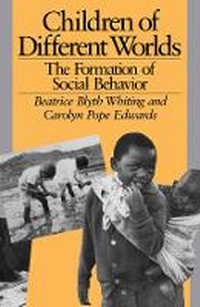
Children of Different Worlds
The Formation of Social Behavior
Published on 1. January 1992
Book
Paperback/Softback
337 pages
978-0-674-11617-7 (ISBN)
Description
The culmination of twenty years of research, this book is a cross-cultural exploration of the ways in which age, gender, and culture affect the development of social behavior in children. The authors and their associates observed children between the ages of two and ten going about their daily lives in communities in Africa, India, the Philippines, Okinawa, Mexico, and the United States. This rich fund of data has enabled them to identify the types of social behavior that are universal and those which differ from one cultural environment to another.
Whiting and Edwards shed new light on the nature-nurture question: in analyzing the behavior of young children, they focus on the relative contributions of universal physiological maturation and universal social imperatives. They point out cross-cultural similarities, but also note the differences in experience between children who grow up in simple and in complex societies. They show that knowledge of the company children keep, and of the proportion of time they spend with various categories of people, makes it possible to predict important aspects of their interpersonal behavior.
An extension and elaboration of the classic Children of Six Cultures (Harvard, 1975), Children of Different Worlds will appeal to the same audience-developmental psychologists, social psychologists, anthropologists, and educators-and is sure to be equally influential.
Whiting and Edwards shed new light on the nature-nurture question: in analyzing the behavior of young children, they focus on the relative contributions of universal physiological maturation and universal social imperatives. They point out cross-cultural similarities, but also note the differences in experience between children who grow up in simple and in complex societies. They show that knowledge of the company children keep, and of the proportion of time they spend with various categories of people, makes it possible to predict important aspects of their interpersonal behavior.
An extension and elaboration of the classic Children of Six Cultures (Harvard, 1975), Children of Different Worlds will appeal to the same audience-developmental psychologists, social psychologists, anthropologists, and educators-and is sure to be equally influential.
More details
Language
English
Place of publication
Cambridge, Mass
United States
Target group
College/higher education
Professional and scholarly
Illustrations
18 halftones, 50 tables
Dimensions
Height: 235 mm
Width: 156 mm
Weight
553 gr
ISBN-13
978-0-674-11617-7 (9780674116177)
Copyright in bibliographic data and cover images is held by Nielsen Book Services Limited or by the publishers or by their respective licensors: all rights reserved.
Schweitzer Classification