

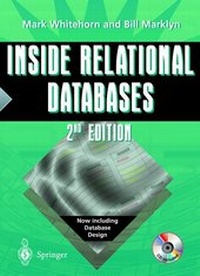
Inside Relational Databases
with examples in Access
Published on 5. November 1997
Book
Mixed media product
XII, 252 pages
978-3-540-76092-4 (ISBN)
Description
The authors cover essential relational database theory and explain how to build databases securely - without getting bogged down in too much detail and endless formulae. They start by explaining interface components, letting readers build working databases. Along the way the authors provide techniques to avoid potential disasters, equipping students with the necessary skills to build practical databases in the real world'as well as ensuring they have a sufficient theoretical grounding in the subject.
More details
Edition
1st Edition.
Language
English
Place of publication
London
United Kingdom
Publishing group
Springer Berlin
Target group
College/higher education
Professional and scholarly
Illustrations
glossary
Dimensions
Height: 250 mm
Weight
480 gr
ISBN-13
978-3-540-76092-4 (9783540760924)
Schweitzer Classification
Other editions
New editions
Mark Whitehorn | Bill Marklyn
Inside Relational Databases
Book
06/2001
2nd Edition
Springer
€42.75
Shipment within 15-20 days
Content
Introduction.- A simple, single-table database.- Introduction to section 1.- Tables.- Forms.- Queries.- Reports.- Summary of section 1.- A multi-table, single-user database.- Introduction to section 2.- Bad news! single tables often cause serious problems.- Good news! - multiple tables cure serious problems!- What do you need to make multiple tables work together?- Getting the right data into the correct tables.- Relationships in the real world.- How are relationships modelled?- Revisiting the big four.- Integrity.- Building a database application - GUIs, macros and control languages.- Summary of section 2.- Section 3 - Multi-table multi-user databases.- What exactly is a relational database?- Codd's rules.- Getting the right data into the right tables - normalisation.- Keeping track of everything (the data dictionary).- More on queries (data manipulation).- SQL.- Domains.- Speeding up your database.- What does null mean?- Primary keys - scope and problems finding truly global ones.- Glossary (a 'bluffer's guide' to database terminology).