

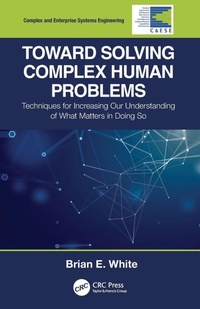
Toward Solving Complex Human Problems
Techniques for Increasing Our Understanding of What Matters in Doing So
1st Edition
Published on 19. December 2022
Book
Paperback/Softback
140 pages
978-0-367-68915-5 (ISBN)
Description
This book serves three basic purposes: (1) a tutorial-type reference for complex systems engineering (CSE) concepts and associated terminology, (2) a recommendation of a proposed methodology showing how the evolving practice of CSE can lead to a more unified theory, and (3) a complex systems (CSs) initiative for organizations to invest some of their resources toward helping to make the world a better place.
A wide variety of technical practitioners-e.g., developers of new or improved systems (particularly systems engineers), program and project managers, associated staff/workers, funders and overseers, government executives, military officers, systems acquisition personnel, contract specialists, owners of large and small businesses, professional society members, and CS researchers-may be interested in further exploring these topics.
Readers will learn more about CS characteristics and behaviors and CSE principles and will therefore be able to focus on techniques that will better serve them in their everyday work environments in dealing with complexity. The fundamental observation is that many systems inherently involve a deeper complexity because stakeholders are engaged in the enterprise. This means that such CSs are more difficult to invent, create, or improve upon because no one can be in total control since people cannot be completely controlled. Therefore, one needs to concentrate on trying to influence progress, then wait a suitable amount of time to see what happens, iterating as necessary. With just three chapters in this book, it seems to make sense to provide a tutorial introduction that readers can peruse only as necessary, considering their background and understanding, then a chapter laying out the suggested artifacts and methodology, followed by a chapter emphasizing worthwhile areas of application.
A wide variety of technical practitioners-e.g., developers of new or improved systems (particularly systems engineers), program and project managers, associated staff/workers, funders and overseers, government executives, military officers, systems acquisition personnel, contract specialists, owners of large and small businesses, professional society members, and CS researchers-may be interested in further exploring these topics.
Readers will learn more about CS characteristics and behaviors and CSE principles and will therefore be able to focus on techniques that will better serve them in their everyday work environments in dealing with complexity. The fundamental observation is that many systems inherently involve a deeper complexity because stakeholders are engaged in the enterprise. This means that such CSs are more difficult to invent, create, or improve upon because no one can be in total control since people cannot be completely controlled. Therefore, one needs to concentrate on trying to influence progress, then wait a suitable amount of time to see what happens, iterating as necessary. With just three chapters in this book, it seems to make sense to provide a tutorial introduction that readers can peruse only as necessary, considering their background and understanding, then a chapter laying out the suggested artifacts and methodology, followed by a chapter emphasizing worthwhile areas of application.
More details
Series
Language
English
Place of publication
London
United Kingdom
Publishing group
Taylor & Francis Ltd
Target group
College/higher education
Professional and scholarly
Postgraduate and Professional
Illustrations
6 s/w Tabellen, 10 s/w Abbildungen
6 Tables, black and white; 10 Illustrations, black and white
Dimensions
Height: 216 mm
Width: 140 mm
Thickness: 9 mm
Weight
208 gr
ISBN-13
978-0-367-68915-5 (9780367689155)
Copyright in bibliographic data and cover images is held by Nielsen Book Services Limited or by the publishers or by their respective licensors: all rights reserved.
Schweitzer Classification
Other editions
Additional editions
Brian E. White
Toward Solving Complex Human Problems
Techniques for Increasing Our Understanding of What Matters in Doing So
E-Book
12/2020
1st Edition
CRC Press
€24.99
Available for download
Brian E. White
Toward Solving Complex Human Problems
Techniques for Increasing Our Understanding of What Matters in Doing So
Book
12/2020
1st Edition
CRC Press
€81.00
Shipment within 15-20 days
Brian E. White
Toward Solving Complex Human Problems
Techniques for Increasing Our Understanding of What Matters in Doing So
E-Book
12/2020
1st Edition
CRC Press
€24.99
Available for download
Person
Brian E. White earned an MS and a PhD in computer science at the University of Wisconsin, and SM and SB degrees in electrical engineering at the Massachusetts Institute of Technology (MIT). He served in the U.S. Air Force and for 8 years was at the MIT Lincoln Laboratory. For ?ve years Dr. White was a principal engineering manager at Signatron, Inc. In his 28 years at The MITRE Corporation, he held a variety of senior professional staff and project/resource management positions. He was Director of MITRE's Systems Engineering Process Of?ce from 2003 to 2009. Dr. White retired from MITRE in July 2010 and has since offered a consulting service, CAU- SES ("Complexity Are Us"-Systems Engineering Strategies). He has taught technical courses as an Adjunct Professor at several U.S. universities, and he is currently tutoring in basic mathematics, calculus, electrical engineering, and complex systems. He has edited and authored several books and book chapters, mostly in his Complex and Enterprise Systems Engineering Series with Taylor & Francis and CRC Press. He has presented a dozen tutorials in complex systems and published over a hundred conference papers and journal articles in complex systems, systems engineering, digital communications, etc., over his 55+-year career.
Content
1. Introduction - A Tutorial of Sorts 2. Evolution of Practice - Theory of Complex Adaptive Systems Engineering 3. Leading Change Management to Address Complex World Issues