

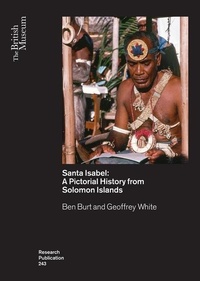
Santa Isabel
A Pictorial History from Solomon Islands
Published on 15. August 2025
Book
Paperback/Softback
300 pages
978-0-86159-243-2 (ISBN)
Description
This portrait of Santa Isabel in over 600 pictures shows an island transformed by its colonial history yet maintaining a confident and distinctive identity within Solomon Islands and the Pacific Island region.
Santa Isabel is one of the largest islands that make up the island nation of Solomon Islands in the southwest Pacific. Politically it is now one of nine provinces, each with its own variation of a shared history. In a country divided among many Christian denominations, Isabel is distinctive for its early acceptance of the Anglican Church, which united most of the island and its six language groups by the 1920s and then shaped its history up to the present.
This book traces Santa Isabel history through a selection of the many hundreds of pictures of the island made first by Europeans and increasingly by its own people. These begin with the drawings and paintings of voyagers from the late 18th century, gradually succeeded by photos from the 1860s onwards showing the arrival of missionaries, traders and warships. From the 1900s there are photos made by the Europeans who established plantations on Isabel and colonial officers asserting British colonial authority. However, the pictorial record is dominated by photos from the Anglican Melanesian Mission. The Second World War, portrayed mainly by military photos, was followed closely by economic and political developments leading up to Solomon Islands independence in 1978 - developments portrayed in both church and government photos. Photos of more recent social, ceremonial and political activities show the unique combination of church, chiefs and local government in Isabel life. A renewed interest in local culture in the 21st century is revealed through photos of festivals and cultural research by both visiting and local researchers as Isabel people explore the possibilities of tourism, resource extraction and environmental conservation.
Santa Isabel is one of the largest islands that make up the island nation of Solomon Islands in the southwest Pacific. Politically it is now one of nine provinces, each with its own variation of a shared history. In a country divided among many Christian denominations, Isabel is distinctive for its early acceptance of the Anglican Church, which united most of the island and its six language groups by the 1920s and then shaped its history up to the present.
This book traces Santa Isabel history through a selection of the many hundreds of pictures of the island made first by Europeans and increasingly by its own people. These begin with the drawings and paintings of voyagers from the late 18th century, gradually succeeded by photos from the 1860s onwards showing the arrival of missionaries, traders and warships. From the 1900s there are photos made by the Europeans who established plantations on Isabel and colonial officers asserting British colonial authority. However, the pictorial record is dominated by photos from the Anglican Melanesian Mission. The Second World War, portrayed mainly by military photos, was followed closely by economic and political developments leading up to Solomon Islands independence in 1978 - developments portrayed in both church and government photos. Photos of more recent social, ceremonial and political activities show the unique combination of church, chiefs and local government in Isabel life. A renewed interest in local culture in the 21st century is revealed through photos of festivals and cultural research by both visiting and local researchers as Isabel people explore the possibilities of tourism, resource extraction and environmental conservation.
More details
Language
English
Place of publication
London
United Kingdom
Target group
Professional and scholarly
Illustrations
600
Dimensions
Height: 295 mm
Width: 208 mm
Thickness: 12 mm
Weight
778 gr
ISBN-13
978-0-86159-243-2 (9780861592432)
Copyright in bibliographic data and cover images is held by Nielsen Book Services Limited or by the publishers or by their respective licensors: all rights reserved.
Schweitzer Classification
Person
Geoffrey White is Emeritus Professor at the University of Hawai'i Manoa Department of Anthropology. He has worked in Santa Isabel off and on since 1975. His publications based on that fieldwork include Identity Through History: Living Stories in a Solomon Islands Society (1991) and Cheke Holo (Maringe/Hograno) Dictionary (co-authored, 1988). His research on wider Solomon Islands and Pacific topics is published in a number of co-edited volumes, notably Pacific Alternatives: Cultural Politics in Contemporary Oceania (2015), Culture, Kastom, Tradition: Cultural Policy in Melanesia (1994) and The Big Death: Solomon Islanders Remember World War II (1988).
Content
Preface (Ben Burt)
Introduction (Geoffrey White)
Chapter 1: The arrival of the 'ship men' (16th century to 1880s)
Chapter 2: Colonisation and the 'new life' (1890s to 1910s)
Chapter 3: Church, government and the new economy (1920s to 1930s)
Chapter 4: World war comes to Isabel (1941 to 1946)
Chapter 5: Towards independence (1947 to 1970)
Chapter 6: Autonomy and renewal (1970s to 1990s)
Chapter 7: Kastom and development (2000s to 2020s)
Pictorial sources
Introduction (Geoffrey White)
Chapter 1: The arrival of the 'ship men' (16th century to 1880s)
Chapter 2: Colonisation and the 'new life' (1890s to 1910s)
Chapter 3: Church, government and the new economy (1920s to 1930s)
Chapter 4: World war comes to Isabel (1941 to 1946)
Chapter 5: Towards independence (1947 to 1970)
Chapter 6: Autonomy and renewal (1970s to 1990s)
Chapter 7: Kastom and development (2000s to 2020s)
Pictorial sources