

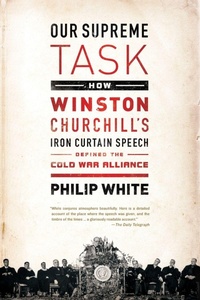
Our Supreme Task
How Winston Churchill's Iron Curtain Speech Defined the Cold War Alliance
Published on 5. March 2013
Book
Paperback/Softback
304 pages
978-1-61039-243-3 (ISBN)
Description
In 1946, in the midst of global turmoil and after being voted out of office, Winston Churchill made a trip to the unlikely venue of Fulton, Missouri, to deliver an address now known as the Iron Curtain Speech, which defined the dangers of totalitarian Communism. This is the story of that pivotal speech, the college president who made it happen, and the irrepressible man who delivered it.
Reviews / Votes
Andrew Roberts, author of The Storm of War "Winston Churchill thought his Iron Curtain speech the most important of a long and stormy career that was studded with vital speeches; it was certainly one of his bravest. Philip White has recreated the eight months between the Potsdam Conference at the end of World War II and the world-changing events in Fulton, Missouri, with impressive scholarship, a sure narrative skill and a fine eye for telling detail." John Lukacs, author of A New Republic: A History Of The United States In The Twentieth Century "I read Our Supreme Task with considerable care and I recommend it emphatically. There is now an enormous literature about the Cold War but very little about how it actually came about and almost nothing about this address. This book fills the gap." Nile Gardiner, Ph.D., Director, Margaret Thatcher Center for Freedom "Philip White has lovingly produced a detailed yet eminently readable account of Churchill's speech in Fulton, Missouri, in 1946. White shows not only how the great British statesman crystallized in word and image the perilous divide between democratic west and communist east, but also how one speech defined an era, and how it continues to inspire today." Kirkus Reviews "The genesis, occasion and aftermath of what Winston Churchill unhesitatingly called 'the most important speech of my career'... White fully reproduces the address and reminds us that Churchill's call for increased Anglo-American solidarity in the face of Soviet aggression was not particularly well received... Today, we remember it as 'one of the defining statements of the twentieth century.' White's at his best painting the small scenes in the background of the event: Churchill's construction of the speech as he sunbathed and painted, the whiskey and poker-fueled train ride with Truman to Missouri and especially the frantic preparations for the big day by Westminster and Fulton officials, including the charismatic college president who conceived of the long-shot invitation to a world figure who unexpectedly said yes. A small slice of history charmingly retold." Newark Star-Ledger "[An] absorbing reconstruction of events leading up to Fulton's fifteen minutes of fame... White shines a warm and winning spotlight on rural postwar America as he describes the hamlet's feverish preparation to host the leader." Commentary "The background and analysis White offers are valuable."More details
Language
English
Place of publication
United States
Product notice
Paperback (UK-trade)
Illustrations
b/w photos throughout
Dimensions
Height: 234 mm
Width: 156 mm
Thickness: 18 mm
Weight
524 gr
ISBN-13
978-1-61039-243-3 (9781610392433)
Copyright in bibliographic data and cover images is held by Nielsen Book Services Limited or by the publishers or by their respective licensors: all rights reserved.
Schweitzer Classification
Person
Philip White is a writer and a lecturer at MidAmerica Nazarene University, and a regular contributor to The Historical Society publications. Philip's business writing has been recognized with awards from the Public Relations Society of America and the International Association of Business Communicators. He lives in Olathe, KS, with his wife and two sons.