

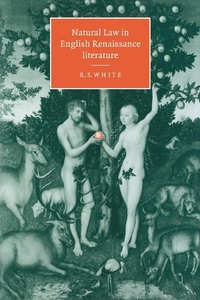
Natural Law in English Renaissance Literature
Published on 25. January 2007
Book
Paperback/Softback
308 pages
978-0-521-03289-6 (ISBN)
Description
Natural law, whether grounded in human reason or divine edict, encourages men to follow virtue and shun vice. The concept dominated Renaissance thought, where its literary equivalent, poetic justice, underpinned much of the period's creative writing. R. S. White's study examines a wide range of Renaissance texts, by More, Spenser, Sidney, Shakespeare and Milton, in the light of these developing ideas of Natural Law. It shows how writers as radically different as Aquinas and Hobbes formulated versions of Natural Law which served to maintain socially established hierarchies. For Aquinas, Natural Law always resided in the individual's conscience, whereas Hobbes thought individuals had limited access to virtue and therefore needed to be coerced into doing good by the state. White shows how the very flexibility and antiquity of Natural Law enabled its appropriation and application by thinkers of all political persuasions in a debate that raged throughout the Renaissance and which continues in our own time.
Reviews / Votes
"This fine, groundbreaking study analyzes the literature of the period from More to Milton for its engagement of the tradition of natural law, once crucial but now hardly ever remembered until very recently. This is a rich and important book." Anthony Dimatteo, Spenser NewsletterMore details
Language
English
Place of publication
Cambridge
United Kingdom
Target group
Professional and scholarly
Product notice
Paperback (trade)
Illustrations
Worked examples or Exercises
Dimensions
Height: 229 mm
Width: 152 mm
Thickness: 18 mm
Weight
503 gr
ISBN-13
978-0-521-03289-6 (9780521032896)
Copyright in bibliographic data and cover images is held by Nielsen Book Services Limited or by the publishers or by their respective licensors: all rights reserved.
Schweitzer Classification
Person
Content
Preface; Acknowledgements: 1. Natural Law in history and Renaissance literature; 2. The heritage of classical Natural Law; 3. The reception of Natural Law in Renaissance England; 4. Law and literature in sixteenth-century England; 5. More's Utopia; 6. 'Love is the fulfilling of the law': Arcadia and Love's Labour's Lost; 7. 'Hot temper leaps o'er a cold decree': The Merchant of Venice and Measure for Measure; 8. Shakespeare's The History of King Lear; 9. Milton and Natural Law; Epilogue: Hobbes and the demise of classical Natural Law; Appendix: Aquinas on the right to own private property; Notes; Select bibliography; Index.