

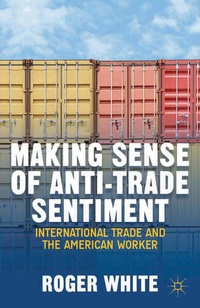
Making Sense of Anti-trade Sentiment
International Trade and the American Worker
Published on 25. September 2014
Book
Paperback/Softback
XV, 258 pages
978-1-349-47652-7 (ISBN)
Description
Examining the extent to which trade adversely affects domestic workers, Making Sense of Anti-Trade Sentiment documents statistical relationships between exports and imports and domestic employment/wages.
More details
Edition
1st ed. 2014
Language
English
Place of publication
New York
United States
Target group
Professional and scholarly
Illustrations
6 s/w Abbildungen
XV, 258 p. 6 illus.
Dimensions
Height: 216 mm
Width: 140 mm
Thickness: 16 mm
Weight
351 gr
ISBN-13
978-1-349-47652-7 (9781349476527)
DOI
10.1057/9781137373250
Schweitzer Classification
Other editions
Additional editions
Book
09/2014
Palgrave MacMillan
€106.99
Shipment within 10-20 days

E-Book
09/2014
1st Edition
Palgrave MacMillan
€96.29
Available for download
Person
Roger White is Associate Professor of Economics at Whittier College, USA. His research largely focuses on international trade, labor, and migration. Roger has published more than two dozen peer-reviewed articles and book chapters, and he is the author of three books.
Content
PART I: WHY IT IS IMPORTANT TO UNDERSTAND ANTI-TRADE SENTIMENT 1. Nearly Two Centuries Have Passed Since David Ricardo. 2. Public Opinion of International Trade: America and the World 3. A Shift in Comparative Advantage? PART II: IN SEARCH OF STOLPER-SAMUELSON(-LIKE) EFFECTS 4. The Influences of Trade on Industry-level Wages and Employment 5. Value Share Import Competition and U.S. Manufacturing Employment 6. The Employment Effects of Free Trade Agreements and Industry Trade-orientation 7. Import Competition and the Probability of Job Displacement 8. State and Regional Variation in the Probability of Trade-related Job Displacement PART III: THE SMOOTH ADJUSTMENT HYPOTHESIS AND POLICIES THAT ASSIST TRADE-DISPLACED WORKERS 9. Does Intra-industry Trade Explain a Lack of Trade-related Labor Market Dynamics 10. Displacement-related Earnings Losses: Evaluating Trade Adjustment Assistance and Wage Insurance PART IV: MAKING SENSE OF ANTI-TRADE SENTIMENT 11. What May Explain Anti-trade Sentiment Among the American Public 12. Identifying the Determinants of Pro- and Anti-trade Sentiment 13. Conclusions