

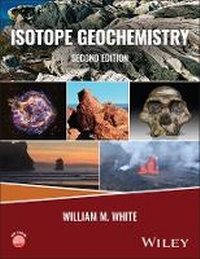
Isotope Geochemistry
2nd Edition
Published on 16. March 2023
Book
Paperback/Softback
704 pages
978-1-119-72993-8 (ISBN)
Description
Provides a thorough and up-to-date overview of radiogenic and stable isotope geochemistry
Now in its second edition, Isotope Geochemistry presents a comprehensive introduction to radiogenic and stable isotope geochemistry. The book opens with an overview of the physics and origins of atoms and nuclei, followed by a review of radioactive decay schemes and geochronological techniques such as fission-track and carbon-14 dating. Subsequent chapters cover nucleosynthetic anomalies in meteorites, early solar system chronology, the theory and application of stable isotope geochemistry, isotopic variation in the noble gases, and more.
This edition includes new sections on thermochronology, U-He dating, recently published La-Ce isotope data, stable isotopes in ore deposits, nuclear volume and nuclear spin effects, and the application of isotope geochemistry in areas such as agriculture, forensics, and environmental studies. Revised and expanded discussions address topics including isotope cosmochemistry, non-traditional isotopes, nucleosynthesis, advanced U-Pb dating and isotopic analysis technologies, the subcontinental lithosphere, and mass-independent isotope fractionation.
Describes the use of radiogenic isotopes in understanding the evolution of the Earth's mantle, crust, and oceans
Explores the use of stable isotopes in areas such as mantle evolution, archeology, paleontology, ore formation, and paleoclimatology
Reviews new developments in the understanding of nucleosynthesis, including insights gained from the study of the 2017 neutron star merger detected by gravitational waves
Discusses progress in the field of unconventional isotopes, advances in isotope cosmochemistry, and recent data on regional variations in isotopic compositions
Illustrated in full color throughout, Isotope Geochemistry, Second Edition is an excellent textbook for undergraduate and postgraduate students in all earth science disciplines.
Now in its second edition, Isotope Geochemistry presents a comprehensive introduction to radiogenic and stable isotope geochemistry. The book opens with an overview of the physics and origins of atoms and nuclei, followed by a review of radioactive decay schemes and geochronological techniques such as fission-track and carbon-14 dating. Subsequent chapters cover nucleosynthetic anomalies in meteorites, early solar system chronology, the theory and application of stable isotope geochemistry, isotopic variation in the noble gases, and more.
This edition includes new sections on thermochronology, U-He dating, recently published La-Ce isotope data, stable isotopes in ore deposits, nuclear volume and nuclear spin effects, and the application of isotope geochemistry in areas such as agriculture, forensics, and environmental studies. Revised and expanded discussions address topics including isotope cosmochemistry, non-traditional isotopes, nucleosynthesis, advanced U-Pb dating and isotopic analysis technologies, the subcontinental lithosphere, and mass-independent isotope fractionation.
Describes the use of radiogenic isotopes in understanding the evolution of the Earth's mantle, crust, and oceans
Explores the use of stable isotopes in areas such as mantle evolution, archeology, paleontology, ore formation, and paleoclimatology
Reviews new developments in the understanding of nucleosynthesis, including insights gained from the study of the 2017 neutron star merger detected by gravitational waves
Discusses progress in the field of unconventional isotopes, advances in isotope cosmochemistry, and recent data on regional variations in isotopic compositions
Illustrated in full color throughout, Isotope Geochemistry, Second Edition is an excellent textbook for undergraduate and postgraduate students in all earth science disciplines.
More details
Language
English
Place of publication
Hoboken
United States
Publishing group
John Wiley and Sons Ltd
Target group
Professional and scholarly
Dimensions
Height: 279 mm
Width: 216 mm
Thickness: 35 mm
Weight
2013 gr
ISBN-13
978-1-119-72993-8 (9781119729938)
Copyright in bibliographic data is held by Nielsen Book Services Limited or its licensors: all rights reserved.
Schweitzer Classification
Other editions
Additional editions
William M. White
Isotope Geochemistry
E-Book
02/2023
2nd Edition
Wiley-ISTE
€89.99
Available for download
William M. White
Isotope Geochemistry
E-Book
02/2023
2nd Edition
Wiley-ISTE
€89.99
Available for download
Previous edition
William M. White
Isotope Geochemistry
Book
01/2015
Wiley
Unfortunately, price unknown
Article exhausted; check for reprint
Person
William M. White is Professor Emeritus of Earth and Atmospheric Sciences at Cornell University. He is a fellow of the Geochemical Society, the European Association of Geochemistry, and the American Geophysical Union. He served as the founding editor of Geochemistry, Geophysics, Geosystems, and is the author of Geochemistry, also published by Wiley-Blackwell.
Content
1: Atoms and Nuclei: Their Physics and Origins 1.1 Introduction 1.2 Physics of the nucleus 1.3 Radioactive Decay 1.4 Nucleosynthesis
2: Decay Systems and Geochronology I 2.1 Basics of Radioactive Isotope Geochemistry 2.2 Fundamentals of Geochronology 2.3 The KA ArA Ca system 2.4 The RbA Sr System 2.5 Rare Earth Decay Systems 2.6 The ReA OsA Pt System
3: Decay Systems and Geochronology II: U and Th 3.1 Introduction 3.2 Pb-Pb Ages and Isochrons 3.3 Zircon Dating 3.4 U-Decay Series Dating
4: Geochronology III: Other Dating Methods 4.1 Introduction 4.2 Cosmogenic Nuclides 4.3 Thermochronology
5: Fractionation of isotopes 5.1 Introduction 5.2 Notation, definitions, and standards 5.3 Theory of Equilibrium isotopic fractionations 5.4 Kinetic fractionation 5.5 Mass dependent versus mass dependent fractionation
6: Isotope Cosmochemistry 6.1 Introduction 6.2 Star Birth 6.3 Meteorites 6.4 Cosmochronology 6.5 Stardust 6.6 Isotopic variations in bulk meteorites 6.7 Cosmic ray exposure ages of meteorites
7: Isotope Geochemistry of the Mantle 7.1 Introduction 7.2 Composition of the EarthAs Mantle 7.3 Radiogenic isotopes in oceanic basalts 7.4 Inferences on mantle structure and evolution 7.5 The Subcontinental Lithosphere 7.6 U-Series Isotopes and Melt Generation
8: Isotope geochemistry of the continental crust 8.1 Introduction 8.2 Mechanisms of crustal growth 8.3 The earliest continental crust 8.4 The continental crust through time 8.5 Isotopic composition of the continental crust 8.6 Subduction Zones
9: Stable Isotopes in the solid Earth 9.1 Introduction 9.2 Equilibrium Fractionations Among Minerals 9.3 Geothermometry 9.4 Stable Isotope Composition of the Mantle 9.5 Oxygen Isotopes in Hydrothermal Systems 9.6 Sulfur Isotopes in magmatic and hydrothermal systems 9.7 Copper isotopes in ore deposits
10: Light Stable Isotopes in the exogene 10.1 Introduction 10.2 The hydrologic system 10.3 isotope ratios in the biosphere 10.4 isotope ratios in the atmosphere
11: Non-traditional stable and radiogenic isotopes in the exogene 11.1 Introduction 11.2 Radiogenic isotopes in the modern ocean 11.3 Stable isotope ratios of conservative elements 11.4 Stable isotope ratios of nutrient elements 11.5 Stable isotope ratios of transition metals
12: Paleoclimate, paleoceanography, and atmospheric history 12.1 Introduction 12.2 The Pleistocene Climate Record in Deep Sea Sediments 12.3 Isotopes in paleoceanography 12.4 Climate in the Cenozoic 12.5 Carbon isotopes, atmospheric carbon dioxide, and climate 12.6 Tracing the evolution of atmospheric oxygen
13: Life, Paleoecology, and Human History 13.1 Introduction 13.2 Isotopes in evolution 13.3 Isotopes and diet: you are what you eat 13.4 Paleoecology of grasslands 13.5 Paleoecology of the Pleistocene Tundra Steppe 13.6.1 Domestication of maize 13.7 The metallurgical revolution
14: Noble Gas Isotope Geochemistry 14.1 Introduction 14.1.1 Noble Gas Chemistry 14.2 Noble Gases in the Solar System 14.3 Helium 14.4 Neon 14.5 Argon 14.6 Krypton 14.7 Xenon 14.8 Implications of Noble Gas Isotope Ratios for the Origin and Evolution of the Earth 14.9 Noble gas constraints on formation and evolution of the Earth
2: Decay Systems and Geochronology I 2.1 Basics of Radioactive Isotope Geochemistry 2.2 Fundamentals of Geochronology 2.3 The KA ArA Ca system 2.4 The RbA Sr System 2.5 Rare Earth Decay Systems 2.6 The ReA OsA Pt System
3: Decay Systems and Geochronology II: U and Th 3.1 Introduction 3.2 Pb-Pb Ages and Isochrons 3.3 Zircon Dating 3.4 U-Decay Series Dating
4: Geochronology III: Other Dating Methods 4.1 Introduction 4.2 Cosmogenic Nuclides 4.3 Thermochronology
5: Fractionation of isotopes 5.1 Introduction 5.2 Notation, definitions, and standards 5.3 Theory of Equilibrium isotopic fractionations 5.4 Kinetic fractionation 5.5 Mass dependent versus mass dependent fractionation
6: Isotope Cosmochemistry 6.1 Introduction 6.2 Star Birth 6.3 Meteorites 6.4 Cosmochronology 6.5 Stardust 6.6 Isotopic variations in bulk meteorites 6.7 Cosmic ray exposure ages of meteorites
7: Isotope Geochemistry of the Mantle 7.1 Introduction 7.2 Composition of the EarthAs Mantle 7.3 Radiogenic isotopes in oceanic basalts 7.4 Inferences on mantle structure and evolution 7.5 The Subcontinental Lithosphere 7.6 U-Series Isotopes and Melt Generation
8: Isotope geochemistry of the continental crust 8.1 Introduction 8.2 Mechanisms of crustal growth 8.3 The earliest continental crust 8.4 The continental crust through time 8.5 Isotopic composition of the continental crust 8.6 Subduction Zones
9: Stable Isotopes in the solid Earth 9.1 Introduction 9.2 Equilibrium Fractionations Among Minerals 9.3 Geothermometry 9.4 Stable Isotope Composition of the Mantle 9.5 Oxygen Isotopes in Hydrothermal Systems 9.6 Sulfur Isotopes in magmatic and hydrothermal systems 9.7 Copper isotopes in ore deposits
10: Light Stable Isotopes in the exogene 10.1 Introduction 10.2 The hydrologic system 10.3 isotope ratios in the biosphere 10.4 isotope ratios in the atmosphere
11: Non-traditional stable and radiogenic isotopes in the exogene 11.1 Introduction 11.2 Radiogenic isotopes in the modern ocean 11.3 Stable isotope ratios of conservative elements 11.4 Stable isotope ratios of nutrient elements 11.5 Stable isotope ratios of transition metals
12: Paleoclimate, paleoceanography, and atmospheric history 12.1 Introduction 12.2 The Pleistocene Climate Record in Deep Sea Sediments 12.3 Isotopes in paleoceanography 12.4 Climate in the Cenozoic 12.5 Carbon isotopes, atmospheric carbon dioxide, and climate 12.6 Tracing the evolution of atmospheric oxygen
13: Life, Paleoecology, and Human History 13.1 Introduction 13.2 Isotopes in evolution 13.3 Isotopes and diet: you are what you eat 13.4 Paleoecology of grasslands 13.5 Paleoecology of the Pleistocene Tundra Steppe 13.6.1 Domestication of maize 13.7 The metallurgical revolution
14: Noble Gas Isotope Geochemistry 14.1 Introduction 14.1.1 Noble Gas Chemistry 14.2 Noble Gases in the Solar System 14.3 Helium 14.4 Neon 14.5 Argon 14.6 Krypton 14.7 Xenon 14.8 Implications of Noble Gas Isotope Ratios for the Origin and Evolution of the Earth 14.9 Noble gas constraints on formation and evolution of the Earth