

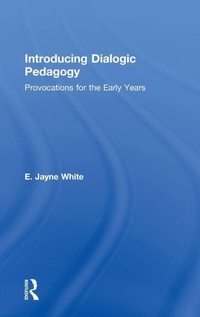
Introducing Dialogic Pedagogy
Provocations for the Early Years
1st Edition
Published on 1. July 2015
Book
Hardback
182 pages
978-0-415-81984-8 (ISBN)
Description
Introducing Dialogic Pedagogy presents some of the ideas of Russian philosopher Mikhail Bakhtin concerning dialogism in a way that will engage and inspire those studying early childhood education. By translating the growing body of dialogic scholarship into a practical application of teaching and learning with very young children, this book provides readers with alternative ways of examining, engaging and reflecting on practice in the early years to provoke new ways of understanding and enacting pedagogy.
This text combines important theoretical ideas with a practical application to support practitioners who are keen to promote creativity and agency through ethical self-other relations. It provides unique insights into the amazing world of the youngest child, and offers enriched understandings of the profound impact of adults in their journey of becoming (or bildung).
Key points covered include:
Investigating dialogic philosophy and its application to early childhood education, with an emphasis on notions of justice, democracy, ethics and answerability
Considering the relationship between dialogism and pedagogical approaches
Theorising a range of approaches to relevant early childhood practice, as pedagogy
This accessible and readable guide offers sound theoretical principles with practical suggestions for early years' settings. The book is supplemented by an extensive online video resource website that will bring these revolutionary ideas to life.
This text combines important theoretical ideas with a practical application to support practitioners who are keen to promote creativity and agency through ethical self-other relations. It provides unique insights into the amazing world of the youngest child, and offers enriched understandings of the profound impact of adults in their journey of becoming (or bildung).
Key points covered include:
Investigating dialogic philosophy and its application to early childhood education, with an emphasis on notions of justice, democracy, ethics and answerability
Considering the relationship between dialogism and pedagogical approaches
Theorising a range of approaches to relevant early childhood practice, as pedagogy
This accessible and readable guide offers sound theoretical principles with practical suggestions for early years' settings. The book is supplemented by an extensive online video resource website that will bring these revolutionary ideas to life.
Reviews / Votes
"The ideas of Russian philosopher Mikhail Bakhtin concerning dialogism are a deeply fascinating read and are conveyed in a way that will engage and inspire anyone studying early childhood education. It highlights the profound impact we have as adults as we contribute to children's lives in whatever role we play and the crucial importance of love, laughter and dialogue!" - Martine Horvath, eye magazineMore details
Language
English
Place of publication
London
United Kingdom
Publishing group
Taylor & Francis Ltd
Target group
College/higher education
Professional and scholarly
Illustrations
1 s/w Tabelle, 30 s/w Abbildungen, 25 s/w Photographien bzw. Rasterbilder, 5 s/w Zeichnungen
1 Tables, black and white; 5 Line drawings, black and white; 25 Halftones, black and white; 30 Illustrations, black and white
Dimensions
Height: 240 mm
Width: 161 mm
Thickness: 15 mm
Weight
461 gr
ISBN-13
978-0-415-81984-8 (9780415819848)
Copyright in bibliographic data and cover images is held by Nielsen Book Services Limited or by the publishers or by their respective licensors: all rights reserved.
Schweitzer Classification
Other editions
Additional editions
Book
06/2015
1st Edition
Routledge
€60.20
Shipment within 15-20 days
E-Book
06/2015
Routledge
€52.49
Available for download
E-Book
06/2015
Routledge
€52.49
Available for download
Person
E. Jayne White is an Associate Professor at the University of Waikato, New Zealand.
Content
Introduction 1. Towards dialogism 2. Introducing dialogic pedagogy 3. Dialogic pedagogy in the early years 4. Teaching with love 5. Teaching and play 6. Teaching and laughter 7. Teaching and accountability 8. Dialogic provocations