

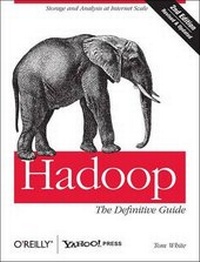
Hadoop: The Definitive Guide
2nd Edition
Published on 26. October 2010
Book
626 pages
978-1-4493-8973-4 (ISBN)
Description
Discover how Apache Hadoop can unleash the power of your data. This comprehensive resource shows you how to build and maintain reliable, scalable, distributed systems with the Hadoop framework -- an open source implementation of MapReduce, the algorithm on which Google built its empire. Programmers will find details for analyzing datasets of any size, and administrators will learn how to set up and run Hadoop clusters.
This revised edition covers recent changes to Hadoop, including new features such as Hive, Sqoop, and Avro. It also provides illuminating case studies that illustrate how Hadoop is used to solve specific problems. Looking to get the most out of your data? This is your book.
* Use the Hadoop Distributed File System (HDFS) for storing large datasets, then run distributed computations over those datasets with MapReduce
* Become familiar with Hadoop's data and I/O building blocks for compression, data integrity, serialization, and persistence
* Discover common pitfalls and advanced features for writing real-world MapReduce programs
* Design, build, and administer a dedicated Hadoop cluster, or run Hadoop in the cloud
* Use Pig, a high-level query language for large-scale data processing
* Analyze datasets with Hive, Hadoop's data warehousing system
* Take advantage of HBase, Hadoop's database for structured and semi-structured data
* Learn ZooKeeper, a toolkit of coordination primitives for building distributed systems
"Now you have the opportunity to learn about Hadoop from a master -- not only of the technology, but also of common sense and plain talk."
--Doug Cutting, Cloudera
This revised edition covers recent changes to Hadoop, including new features such as Hive, Sqoop, and Avro. It also provides illuminating case studies that illustrate how Hadoop is used to solve specific problems. Looking to get the most out of your data? This is your book.
* Use the Hadoop Distributed File System (HDFS) for storing large datasets, then run distributed computations over those datasets with MapReduce
* Become familiar with Hadoop's data and I/O building blocks for compression, data integrity, serialization, and persistence
* Discover common pitfalls and advanced features for writing real-world MapReduce programs
* Design, build, and administer a dedicated Hadoop cluster, or run Hadoop in the cloud
* Use Pig, a high-level query language for large-scale data processing
* Analyze datasets with Hive, Hadoop's data warehousing system
* Take advantage of HBase, Hadoop's database for structured and semi-structured data
* Learn ZooKeeper, a toolkit of coordination primitives for building distributed systems
"Now you have the opportunity to learn about Hadoop from a master -- not only of the technology, but also of common sense and plain talk."
--Doug Cutting, Cloudera
More details
Language
English
Place of publication
Sebastopol
United States
Edition type
Revised edition
Product notice
Paperback (trade)
Illustrations
1, black & white illustrations
Dimensions
Height: 233 mm
Width: 178 mm
Thickness: 32 mm
Weight
987 gr
ISBN-13
978-1-4493-8973-4 (9781449389734)
Schweitzer Classification
Other editions
New editions
Book
05/2015
4th Edition
O'Reilly
€60.50
Shipment within 10-20 days
Tom White
Hadoop: The Definitive Guide
Book
06/2012
3rd Edition
O'Reilly
€41.00
Article exhausted; check for reprint
Person
Tom White has been an Apache Hadoop committer since February 2007, and is a member of the Apache Software Foundation. He works for Cloudera, a company set up to offer Hadoop support and training. Previously he was as an independent Hadoop consultant, working with companies to set up, use, and extend Hadoop. He has written numerous articles for O'Reilly, java.net and IBM's developerWorks, and has spoken at several conferences, including at ApacheCon 2008 on Hadoop. Tom has a Bachelor's degree in Mathematics from the University of Cambridge and a Master's in Philosophy of Science from the University of Leeds, UK.