


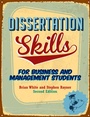
Dissertation Skills
For Management and Business Students
Published on 1. September 2003
Book
Paperback/Softback
168 pages
978-0-8264-6788-1 (ISBN)
Description
The dissertation is often a crucial part of a business and management degree and can heavily influence the final mark. This book provides practical help to approach the dissertation in a positive and successful way. The tried and tested techniques will help to: choose and develop a subject to investigate, select an appropriate methodology, effectively carry out qualitative and quantitative research, make the best use of relevant literature, evaluate and analyse the data collected, write and present findings and get the most out of the dissertation advisor. This is an essential guide for all students carrying out a dissertation.
Reviews / Votes
1. Introduction to Cognitive Psychology. 2. Cognition and the Brain: Basic Principles. 3. Perception. 4. Attention. 5. Short-Term and Working Memory. 6. Long-Term Memory: Basic Principles. 7. Everyday Memory and Memory Errors. 8. Knowledge. 9. Visual Imagery. 10. Language. 11. Problem Solving. 12. Reasoning and Decision Making.More details
Language
English
Place of publication
New York
United States
Target group
College/higher education
Illustrations
bibliography
Dimensions
Height: 211 mm
Width: 135 mm
Thickness: 13 mm
Weight
228 gr
ISBN-13
978-0-8264-6788-1 (9780826467881)
Copyright in bibliographic data is held by Nielsen Book Services Limited or its licensors: all rights reserved.
Schweitzer Classification
Other editions
New editions
Book
02/2014
2nd Edition
Cengage Learning EMEA
€57.50
Shipment within 15-20 days
Person
Brian White was formerly Principal Lecturer at the Lincoln School of Management at the University of Lincoln. He has many years of experience tutoring students from a wide range of countries on dissertation presentation.
Content
1. Introduction to Cognitive Psychology. 2. Cognition and the Brain: Basic Principles. 3. Perception. 4. Attention. 5. Short-Term and Working Memory. 6. Long-Term Memory: Basic Principles. 7. Everyday Memory and Memory Errors. 8. Knowledge. 9. Visual Imagery. 10. Language. 11. Problem Solving. 12. Reasoning and Decision Making.