

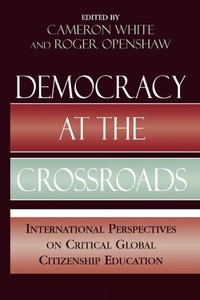
Democracy at the Crossroads
International Perspectives on Critical Global Citizenship Education
Published on 7. November 2007
Book
Paperback/Softback
378 pages
978-0-7391-2321-8 (ISBN)
Description
In Democracy at the Crossroads, the editors argue that there have been too few scholarly attempts to provide a comprehensive critique of the assumptions behind citizenship education. In particular, they ask the distinguished contributors to this volume to address difficult but essential questions that are often avoided or intentionally overlooked: What do all-embracing terms like 'global citizenship' really mean? What does democracy mean internationally? A timely work, Democracy at the Crossroads provides a necessary examination and re-interpretation of international perspectives on democracy and global citizenship as they apply to social education.
Reviews / Votes
Democracy at the Crossroads plumbs the core issues of citizenship education, namely, what constitutes the "good citizen" in today's globalized society and how individuals come to understand and act on their world. White, Openshaw, and Keller have brought together an impressive group of scholars from around the world in their efforts to unpack the history, assumptions, and practices of citizenship education while critically examining influence of globalization and neoliberalism on the curriculum and aims of social studies education in the 21st century. I highly recommend this book for anyone interested moving beyond the platitudes and passivity that have hitherto marked the dominant strains of education for democracy. -- E. Wayne Ross, University of British Columbia Democracy at the Crossroads will serve as a global benchmark for citizenship education in the early 21st century. -- Merry M. Merryfield, Ohio State University From a variety of theoretical and national perspectives, this collection provides an interrogation of unexamined meanings, assumptions, and socio-political dynamics implicated in the programs and rhetorics promoting education for "global citizenship." The need for such work in our world today could hardly be more critical! -- Tony Whitson, University of DelawareMore details
Series
Language
English
Place of publication
United States
Publishing group
Bloomsbury Publishing Plc
Target group
Professional and scholarly
Dimensions
Height: 229 mm
Width: 152 mm
Thickness: 22 mm
Weight
616 gr
ISBN-13
978-0-7391-2321-8 (9780739123218)
Copyright in bibliographic data and cover images is held by Nielsen Book Services Limited or by the publishers or by their respective licensors: all rights reserved.
Schweitzer Classification
Persons
Cameron White is Associate Professor of Curriculum and Instruction / Social Education at the University of Houston. Roger Openshaw is Professor in Social and Policy Studies in Education at Massey University in New Zealand. Pamela Keller is a doctoral student in Curriculum and Instruction / Social Education at the University of Houston.
Content
1 Preface
2 Part I: Tensions
3 Democracy at the Crossroads?
4 Neoliberalism, Democracy, and Education for Citizenship in New Zealand
5 Freedom or French Fries: Packaged Democracy for World Consumption
6 Towards a Model of Citizenship Education: Coping with Differences in Definition
7 Critical Democratic Education for Social Efficacy
8 Entwined Ideals: Connecting Democracy to Peace
9 Part II: Unpacking Approaches
10 Developing a Global Dimension in Dutch Education
11 The Social Construction of a Curriculum for Citizenship Education in the United Kingdom
12 Reexamining Competing Views of Citizenship Education and Their Influence On Social Studies
13 Developing Global Citizens: The Rhetoric and the Reality in the New Zealand Curriculum
14 Citizenship Education and the Crick Report in England and Wales
15 Part III: National Exemplars
16 Suffering from Enthusiasts? Some Relevant National Case Studies for Global Citizenship Advocates
17 Perceptions of Citizenship in Australia
18 Whose Civics, Whose Citizen: Reconceptualizing U.S. Democracy In the Post Industrial Era
19 Locating Democracy: Meanings and Intersections in the Czech Republic
20 Part IV: School-Based Studies
21 Dealing with Discourses: U.S. Teaching about the Pacific War and Shifting Locations of "American" Identities
22 Jefferson County Open School: Voices of Global Citizenship
2 Part I: Tensions
3 Democracy at the Crossroads?
4 Neoliberalism, Democracy, and Education for Citizenship in New Zealand
5 Freedom or French Fries: Packaged Democracy for World Consumption
6 Towards a Model of Citizenship Education: Coping with Differences in Definition
7 Critical Democratic Education for Social Efficacy
8 Entwined Ideals: Connecting Democracy to Peace
9 Part II: Unpacking Approaches
10 Developing a Global Dimension in Dutch Education
11 The Social Construction of a Curriculum for Citizenship Education in the United Kingdom
12 Reexamining Competing Views of Citizenship Education and Their Influence On Social Studies
13 Developing Global Citizens: The Rhetoric and the Reality in the New Zealand Curriculum
14 Citizenship Education and the Crick Report in England and Wales
15 Part III: National Exemplars
16 Suffering from Enthusiasts? Some Relevant National Case Studies for Global Citizenship Advocates
17 Perceptions of Citizenship in Australia
18 Whose Civics, Whose Citizen: Reconceptualizing U.S. Democracy In the Post Industrial Era
19 Locating Democracy: Meanings and Intersections in the Czech Republic
20 Part IV: School-Based Studies
21 Dealing with Discourses: U.S. Teaching about the Pacific War and Shifting Locations of "American" Identities
22 Jefferson County Open School: Voices of Global Citizenship