

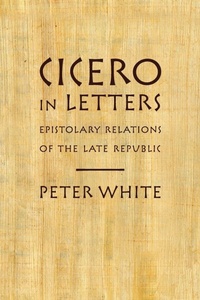
Cicero in Letters
Epistolary Relations of the Late Republic
1st Edition
Published on 7. June 2012
Book
Paperback/Softback
250 pages
978-0-19-991434-0 (ISBN)
Description
Cicero in Letters is a guide to the first extensive correspondence that survives from the Greco-Roman world. The more than eight hundred letters of Cicero that are its core provided literary models for subsequent letter writers from Pliny to Petrarch to Samuel Johnson and beyond. The collection also includes some one hundred letters by Cicero's contemporaries. The letters they exchanged provide unique insight into the experience of the Roman political class at the turning point between Republican and imperial rule.
The first part of this study analyzes effects of the milieu in which the letters were written. The lack of an organized postal system limited the correspondence that Cicero and his contemporaries could conduct and influenced what they were willing to write about. Their chief motive for exchanging letters was to protect political relationships until they could resume their customary, face-to-face association in Rome. Romans did not normally sign letters, much less write them in their own hand. Their correspondence was handled by agents who drafted, expedited, and interpreted it. Yet every letter advertised the level of intimacy that bound the writer and the addressee. Finally, the published letters were not drawn at random from the archives that Cicero left. An editor selected and arranged them in order to impress on readers a particular view of Cicero as a public personality. The second half of the book explores the significance of leading themes in the letters. It shows how, in a time of deepening crisis, Cicero and his correspondents drew on their knowledge of literature, the habit of consultation, and the rhetoric of government in an effort to improve cooperation and to maintain the political culture which they shared. The result is a revealing look at Cicero's epistolary practices and also the world of elite social intercourse in the late Republic.
The first part of this study analyzes effects of the milieu in which the letters were written. The lack of an organized postal system limited the correspondence that Cicero and his contemporaries could conduct and influenced what they were willing to write about. Their chief motive for exchanging letters was to protect political relationships until they could resume their customary, face-to-face association in Rome. Romans did not normally sign letters, much less write them in their own hand. Their correspondence was handled by agents who drafted, expedited, and interpreted it. Yet every letter advertised the level of intimacy that bound the writer and the addressee. Finally, the published letters were not drawn at random from the archives that Cicero left. An editor selected and arranged them in order to impress on readers a particular view of Cicero as a public personality. The second half of the book explores the significance of leading themes in the letters. It shows how, in a time of deepening crisis, Cicero and his correspondents drew on their knowledge of literature, the habit of consultation, and the rhetoric of government in an effort to improve cooperation and to maintain the political culture which they shared. The result is a revealing look at Cicero's epistolary practices and also the world of elite social intercourse in the late Republic.
Reviews / Votes
White is a splendid guide to the strategies of Cicero's letters and to the social values and motives underpinning those strategies. * William Fitzgerald, Times Literary Supplement * One of the outstanding virtues of this fine book is that within it we seem to hear the living voices of the last generation of the Republic. Through his elegant and colloquial translations and accompanying elucidation [White} gives us a vivid sense of how elite discourse was carried on at this critical moment * Ann Vasaly, Classical Review * a valuable treatment of Cicero ... Whites book is conversational and dialogic, engaging the reader at every stage with its processes of development. * Eleanor Brooke, Phoenix *More details
Language
English
Place of publication
New York
United States
Target group
College/higher education
Professional and scholarly
Students and scholars of Cicero and Classical Studies.
Dimensions
Height: 234 mm
Width: 156 mm
Thickness: 14 mm
Weight
395 gr
ISBN-13
978-0-19-991434-0 (9780199914340)
Copyright in bibliographic data and cover images is held by Nielsen Book Services Limited or by the publishers or by their respective licensors: all rights reserved.
Schweitzer Classification
Other editions
Additional editions
Book
08/2010
1st Edition
Oxford University Press Inc
€110.18
Shipment within 15-20 days
E-Book
07/2010
1st Edition
OUP eBook
€22.99
Available for download
E-Book
07/2010
1st Edition
OUP eBook
€28.49
Available for download
Person
Peter White is Herman C. Bernick Family Professor in Classics and the College at the University of Chicago. His previous books include Promised Verse, winner of the Charles J. Goodwin Award of Merit from the American Philological Association.
Content
Preface ; I. Reading the Letters from the Outside In ; 1. Constraints and Biases in Roman Letter-Writing ; 2. The Editing of the Collection ; 3. Frames of the Letter ; II. Epistolary Preoccupations ; 4. The Letters and Literature ; 5. Giving and Getting Advice by Letter ; 6. Letter-Writing and Leadership ; Afterword: The Collection in Hindsight ; Appendix 1: Quantifying the Letter Corpus ; Appendix 2: Contemporary Works Mentioned in the Letters ; Bibliography of Titles Cited