

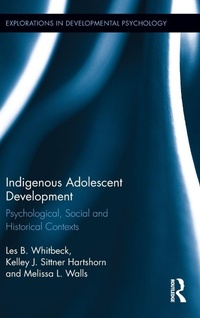
Indigenous Adolescent Development
Psychological, Social and Historical Contexts
1st Edition
Published on 13. January 2014
Book
Hardback
300 pages
978-0-415-71606-2 (ISBN)
Description
This volume explores the first four waves of a longitudinal diagnostic study of Indigenous adolescents and their families. The first study of its kind, it calls attention to culturally specific risk factors that affect Indigenous (American Indian and Canadian First Nations) adolescent development and describe the historical and social contexts in which Indigenous adolescents come of age. It provides unique information on ethical research and development within Indigenous communities, psychiatric diagnosis at early and mid-adolescence, and suggestions for putting the findings into action through empirically-based interventions.
More details
Series
Language
English
Place of publication
Hove
United Kingdom
Publishing group
Taylor & Francis Ltd
Target group
College/higher education
Illustrations
24 s/w Zeichnungen, 81 s/w Tabellen
81 Tables, black and white; 24 Line drawings, black and white
Dimensions
Height: 235 mm
Width: 157 mm
Thickness: 21 mm
Weight
591 gr
ISBN-13
978-0-415-71606-2 (9780415716062)
Copyright in bibliographic data and cover images is held by Nielsen Book Services Limited or by the publishers or by their respective licensors: all rights reserved.
Schweitzer Classification
Other editions
Additional editions
Les B. Whitbeck | Melissa Walls | Kelley Hartshorn
Indigenous Adolescent Development
Psychological, Social and Historical Contexts
Book
10/2015
1st Edition
Psychology Press Ltd
€65.70
Shipment within 10-20 days
Les B. Whitbeck | Melissa Walls | Kelley Hartshorn
Indigenous Adolescent Development
Psychological, Social and Historical Contexts
E-Book
01/2014
1st Edition
Psychology Press Ltd
€59.49
Available for download
Les B. Whitbeck | Melissa Walls | Kelley Hartshorn
Indigenous Adolescent Development
Psychological, Social and Historical Contexts
E-Book
01/2014
1st Edition
Psychology Press Ltd
€59.49
Available for download
Persons
Les B. Whitbeck is the John G. Bruhn Professor of Sociology at the University of Nebraska-Lincoln. He has been working in research partnerships with Indigenous people since the mid-1990s and is the author of more than one hundred refereed articles. Whitbeck specializes in community based participatory research (CBPR) and has been PI for nine NIH grants, one SAMSHA grant, and one NARCH grant for work with Indigenous people.
Kelley J. Sittner Hartshorn is an Assistant Professor in the Department of Sociology at Oklahoma State University. She received her PhD in 2011 from the University of Nebraska-Lincoln. Her research is in the areas of crime and delinquency, mental health, substance use, and inequality, with a particular focus on North American Indigenous communities. She has worked with the Healing Pathways Project for over four years.
Melissa L. Walls is an Assistant Professor in the Department of Biobehavioral Health and Population Sciences at the University of Minnesota Medical School-Duluth. She is also a Co-Director of the Research for Indigenous Community Health (RICH) Center at UMN. Her involvement in community-based participatory research (CBPR) projects to date includes mental health epidemiology; culturally relevant, family-based substance use prevention and mental health promotion programming and evaluation; and, examining the impact of mental health and stress on type 2 diabetes.?
Kelley J. Sittner Hartshorn is an Assistant Professor in the Department of Sociology at Oklahoma State University. She received her PhD in 2011 from the University of Nebraska-Lincoln. Her research is in the areas of crime and delinquency, mental health, substance use, and inequality, with a particular focus on North American Indigenous communities. She has worked with the Healing Pathways Project for over four years.
Melissa L. Walls is an Assistant Professor in the Department of Biobehavioral Health and Population Sciences at the University of Minnesota Medical School-Duluth. She is also a Co-Director of the Research for Indigenous Community Health (RICH) Center at UMN. Her involvement in community-based participatory research (CBPR) projects to date includes mental health epidemiology; culturally relevant, family-based substance use prevention and mental health promotion programming and evaluation; and, examining the impact of mental health and stress on type 2 diabetes.?
Content
Part 1: The Healing Pathways Longitudinal Study 1. The Reach of History 2. Ethical Research with Indigenous Communities 3. The Longitudinal Study Part 2: Cultural Contexts of Development 4. Traditions across Generations 5. Perceptions of Historical Cultural Losses Part 3: Family and Community Contexts 6. Family Configurations and Family Influence 7. Inside and Outside the Reservation and Reserves: Community Characteristics and Encountering Discrimination 8. School Adjustment and Adolescent Resilience 9. The Influence of Friends 10. A Model of Indigenous Adolescent Development Part 4: Mental and Physical Health 11. From Early to Mid-Adolescence: Health and Well-Being 12. Behavioral Problems 13. Sadness, Depression, and Suicidal Ideation from early to Mid-Adolescence 14. Substance Use and Abuse Part 5: Building on Cultural Strengths 15. Services Preferences and Utilization 16. Turning Research to Action