

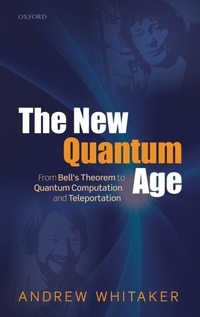
The New Quantum Age
From Bell's Theorem to Quantum Computation and Teleportation
Published on 6. October 2011
Book
Hardback
408 pages
978-0-19-958913-5 (ISBN)
Description
While quantum theory has been used to study the physical universe with great profit, both intellectual and financial, ever since its discovery eighty-five years ago, over the last fifty years we have found out more and more about the theory itself, and what it tells us about the universe. It seems we may have to accept non-locality - cause and effect may be light-years apart; loss of realism - nature may be fundamentally probabilistic; and non-determinism - it seems that God does play dice!
This book, totally up-to-date and written by an expert in the field, explains the emergence of our new perspective on quantum theory, but also describes how the ideas involved in this re-evaluation led seamlessly to a totally new discipline - quantum information theory. This discipline includes quantum computation, which is able to perform tasks quite out of the range of other computers; the totally secure algorithms of quantum cryptography; and quantum teleportation - as part of science fact rather than science fiction.
The book is the first to combine these elements, and will be of interest to anybody interested in fundamental aspects of science and their application to the real world.
This book, totally up-to-date and written by an expert in the field, explains the emergence of our new perspective on quantum theory, but also describes how the ideas involved in this re-evaluation led seamlessly to a totally new discipline - quantum information theory. This discipline includes quantum computation, which is able to perform tasks quite out of the range of other computers; the totally secure algorithms of quantum cryptography; and quantum teleportation - as part of science fact rather than science fiction.
The book is the first to combine these elements, and will be of interest to anybody interested in fundamental aspects of science and their application to the real world.
Reviews / Votes
During this century there has been an explosion in interest in fundamental issues in quantum mechanics, especially about the mysterious properties of entanglement. Interestingly, many of these studies into the fundamentals of quantum mechanics are driven and motivated by technological quests. This book is ideally placed to tap into this genuine enthusiasm about the fundamental and applied nature of the mysteries at the heart of quantum mechanics. * Ifan G Hughes, Durham University *More details
Language
English
Place of publication
Oxford
United Kingdom
Target group
College/higher education
General readers with an interest in modern aspects of physics, philosophy and computation. This includes lecturers, teachers and undergraduate students of science, mathematics and computation.
Illustrations
60 b/w halftones, 19 b/w line drawings
Dimensions
Height: 240 mm
Width: 161 mm
Thickness: 26 mm
Weight
775 gr
ISBN-13
978-0-19-958913-5 (9780199589135)
Copyright in bibliographic data and cover images is held by Nielsen Book Services Limited or by the publishers or by their respective licensors: all rights reserved.
Schweitzer Classification
Other editions
Additional editions
Book
12/2015
Oxford University Press
€40.22
Shipment within 15-20 days
E-Book
10/2011
1st Edition
OUP eBook
€25.99
Available for download
Person
Andrew Whitaker lectured at the University of Ulster from 1978-1988 before joining Queen's University Belfast where he is now Professor of Physics. For 25 years his main field of research has been on the Foundations of Quantum Theory, which has developed into the present 'hot topic' of Quantum Information Theory. Whitaker has published around 50 papers on this subject and has numerous publications on the History of Physics and Physics Education.
Content
A: QUANTUM THEORY: AN INTRODUCTORY SKETCH ; B: INVESTIGATING QUANTUM THEORY ; C: QUANTUM INFORMATION THEORY