

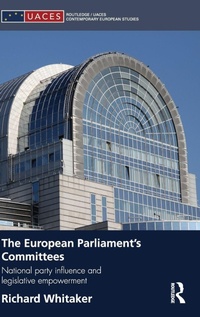
The European Parliament's Committees
National Party Influence and Legislative Empowerment
1st Edition
Published on 6. April 2011
Book
Hardback
170 pages
978-0-415-48525-8 (ISBN)
Description
This book analyzes the development of the European Parliament's (EP) committees and their relationship with national political parties in the light of the EP's increased legislative role over the last three decades.
The book argues that national parties have a greater incentive to care about what goes on in the EP given the growth in its legislative power. Because most of the EP's detailed legislative work takes place in its committees, national parties should be concerned about their involvement with the EP's committee system. Based on extensive original research, this book shows how the EP's committees have changed over time in response to legislative empowerment and analyzes how national parties and individual MEPs use the committee system to further their policy goals. The book makes a theoretical contribution by providing an explanation for the variation in powers of committees between separated and fused systems of government and by adapting theories of legislative organization developed in the context of the US Congress, to the EP.
The European Parliament's Committees will be of interest to students and scholars studying the European Parliament, EU institutions, policy-making, and the development of legislatures and political parties.
The book argues that national parties have a greater incentive to care about what goes on in the EP given the growth in its legislative power. Because most of the EP's detailed legislative work takes place in its committees, national parties should be concerned about their involvement with the EP's committee system. Based on extensive original research, this book shows how the EP's committees have changed over time in response to legislative empowerment and analyzes how national parties and individual MEPs use the committee system to further their policy goals. The book makes a theoretical contribution by providing an explanation for the variation in powers of committees between separated and fused systems of government and by adapting theories of legislative organization developed in the context of the US Congress, to the EP.
The European Parliament's Committees will be of interest to students and scholars studying the European Parliament, EU institutions, policy-making, and the development of legislatures and political parties.
Reviews / Votes
'Richard Whitaker's elegant and deceptively simple study is an important and convincing addition to the increasingly empirical literature about the European Parliament (EP).' - Martin Westlake, The Journal of Legislative Studies, Vol. 17, 4, November 2011'The committees of the European Parliament are highly influential in shaping EU legislation. Yet scholarly knowledge of how they function has remained limited until now. Theoretically informed and methodologically sophisticated, Whitaker's excellent study explains the development of the EP committee system, paying special attention to how national parties and MEPs use committees for advancing their policy goals. Absolutely essential reading for students of EU policy-making and parliaments.' - Professor Tapio Raunio, University of Tampere, Finland
'In this first ever book-length treatment of the subject, Richard Whitaker provides the definitive account of how and why the European Parliament's committees matter both to the role of the members of the European Parliament and, more importantly, to their national party leaders. To understand the committees is to understand the parliament.' - Professor David Farrell, University College Dublin
'This is the most important book thus far on what happens inside the European Parliament's committees, which is where much of the legislative business of Brussels now takes place. Using innovative theoretical ideas and empirical techniques as well as new data, Whitaker finds that national parties are the key players inside the committees. This finding reinforces a particular conception of how EU politics works.' - Professor Simon Hix, London School of Economics and Political Science
More details
Series
Language
English
Place of publication
London
United Kingdom
Publishing group
Taylor & Francis Ltd
Target group
College/higher education
Product notice
Paper over boards
Illustrations
5 s/w Abbildungen, 30 s/w Tabellen
30 Tables, black and white; 5 Illustrations, black and white
Dimensions
Height: 240 mm
Width: 161 mm
Thickness: 14 mm
Weight
435 gr
ISBN-13
978-0-415-48525-8 (9780415485258)
Copyright in bibliographic data and cover images is held by Nielsen Book Services Limited or by the publishers or by their respective licensors: all rights reserved.
Schweitzer Classification
Other editions
Additional editions
Richard Whitaker
The European Parliament's Committees
National Party Influence and Legislative Empowerment
Book
09/2014
1st Edition
Routledge
€78.00
Shipment within 10-20 days
Richard Whitaker
The European Parliament's Committees
National Party Influence and Legislative Empowerment
E-Book
04/2011
1st Edition
Routledge
€72.49
Available for download
Richard Whitaker
The European Parliament's Committees
National Party Influence and Legislative Empowerment
E-Book
04/2011
1st Edition
Routledge
€72.49
Available for download
Person
Richard Whitaker is Lecturer at the Department of Politics and International Relations, University of Leicester, UK.
Content
1. Introduction: Studying a Changing Parliament 2. Committees and National Parties in the European Parliament: Responding to Legislative Empowerment 3. The Development of the European Parliament's Committee System: Structure and Turnover 4. Member States and National Parties' Committee Membership 5. Committee Assignments at the Individual Level in the European Parliament 6. Committee Leadership Positions in the EP: A Game of Musical Chairs? 7. Representativeness in Committee Contingents 8. Conclusions: National party Influence in a Committee-Based Parliament