

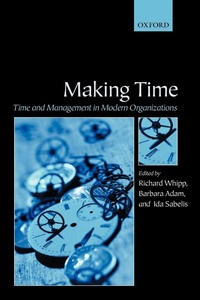
Making Time
Time and Management in Modern Organizations
Published on 4. July 2002
Book
Paperback/Softback
244 pages
978-0-19-925370-8 (ISBN)
Description
Time is an essential feature of social and organizational life and part of the deep structure of business activity. Plans, performance, productivity, and pay are all linked to and often measured by time.
Yet time is often taken for granted in daily life and the business world. The aim of this book is to bring time into sharper focus and in particular to look at the way time is constructed, made, managed, and used in organizations. The book both provides an overview of some of the key concepts in time -- time's arrow, time's cycle, clock time, etc. -- and it explores how particular features of the modern world -- global time, futures, etc. -- extend and change the temporal dimension of organizational activity.
Making Time emphasizes the richness of the temporal relations within organizations and the wealth of competing attempts to order and control time in the act of managing. It describes and explains this temporal complexity as it occurs in management, giving full recognition to the way that people create their own sense of time alongside the official temporal apparatus of the clock and diary. The contributors use a variety of management perspectives -- strategy, organization theory, decision making, industrial relations, and marketing -- and deliberately place the experience of more traditional industrial settings alongside those at the forefront of the
'new economy'.
Making Time seeks to spark a debate across the field of management that does justice to the richness of the temporal features of contemporary organizations. The book will be vital reading for those who want to understand the complexities of time in organizations and the modern world, and the challenges it presents for the theoretical and practical spheres of management.
Yet time is often taken for granted in daily life and the business world. The aim of this book is to bring time into sharper focus and in particular to look at the way time is constructed, made, managed, and used in organizations. The book both provides an overview of some of the key concepts in time -- time's arrow, time's cycle, clock time, etc. -- and it explores how particular features of the modern world -- global time, futures, etc. -- extend and change the temporal dimension of organizational activity.
Making Time emphasizes the richness of the temporal relations within organizations and the wealth of competing attempts to order and control time in the act of managing. It describes and explains this temporal complexity as it occurs in management, giving full recognition to the way that people create their own sense of time alongside the official temporal apparatus of the clock and diary. The contributors use a variety of management perspectives -- strategy, organization theory, decision making, industrial relations, and marketing -- and deliberately place the experience of more traditional industrial settings alongside those at the forefront of the
'new economy'.
Making Time seeks to spark a debate across the field of management that does justice to the richness of the temporal features of contemporary organizations. The book will be vital reading for those who want to understand the complexities of time in organizations and the modern world, and the challenges it presents for the theoretical and practical spheres of management.
Reviews / Votes
This book is a welcome sign of continued growth and vitality in the study of time ... reading this book will be an eye-opening experience for those in management who cling to traditional assumptions concerning temporality. * KronoScope: Journal for the Study of Time * ... original and provocative. * Work, employment and society *More details
Language
English
Place of publication
Oxford
United Kingdom
Target group
Professional and scholarly
Illustrations
7 figures; 2 tables; 5 boxes
Dimensions
Height: 234 mm
Width: 156 mm
Thickness: 13 mm
Weight
377 gr
ISBN-13
978-0-19-925370-8 (9780199253708)
Copyright in bibliographic data and cover images is held by Nielsen Book Services Limited or by the publishers or by their respective licensors: all rights reserved.
Schweitzer Classification
Other editions
Additional editions
E-Book
12/2002
Oxford University Press
€51.49
Available for download
Book
07/2002
Oxford University Press
€306.30
Shipment within 15-20 days
Persons
Richard Whipp is a Professor at Cardiff Business School and is the Chair of the British Academy of Management. He has taught and researched at Warwick Business School and Aston Business School as well as holding visiting positions at the University of Uppsala and the LSE. He has published widely in the areas of innovation and strategic change.
Barbara Adam is Professor of Sociology at Cardiff University. She is the founding editor of the journal Time & Society and has published extensively on the social relations of time.
Ida Sabelis is Senior Lecturer of Organisation Anthropology with the research group Culture, Organisation & Management at the Vrije Universiteit in Amsterdam. Before her current position, she was co-founder and consultant of Kantharos, Institute for the Management of Diversity in Amsterdam. She is review editor for non-English publications of the journal Time & Society.
Barbara Adam is Professor of Sociology at Cardiff University. She is the founding editor of the journal Time & Society and has published extensively on the social relations of time.
Ida Sabelis is Senior Lecturer of Organisation Anthropology with the research group Culture, Organisation & Management at the Vrije Universiteit in Amsterdam. Before her current position, she was co-founder and consultant of Kantharos, Institute for the Management of Diversity in Amsterdam. She is review editor for non-English publications of the journal Time & Society.
Content
1. Choreographing Time and Management: Traditions, Developments, and Opportunities ; PART I: MASKING TIME, MAKING TIME: RETHINKING BASIC ASSUMPTIONS ; 2. Towards a Theory of Timing: Kairology in Business Networks ; 3. Taking Time Seriously: Organizational Change, Flexibility, and the Present Time in a New Perspective ; 4. Now's the Time! Consumption and Time (Space) Disruptions in Postmodern Virtual Worlds ; 5. Good Times and Bad Times: The Moral Discourse of Time and Management ; PART II: TEMPORAL STRATEGIES IN A RAPIDLY CHANGING WORLD ; 6. Hidden Causes for Unknown Losses: Time Compression in Management ; 7. Cooperation Engineered: Efficiency in a Complex Division of Labour of the 'Just-in-Time' System ; 8. Hanging on the Telephone: Temporal Flexibility and the Accessible Worker ; 9. A New Time Discipline: Managing Virtual Work Environments ; 10. The Simultaneous Use of Time by Management and Consumers in Launching and Buying a New Product: An Empirical Analysis of the Computer Industry ; PART III: THE TEMPORAL IMPLICATIONS OF ALTERNATIVE APPROACHES TO MANAGEMENT ; 11. Contested Presents: Critical Perspectives on 'Real Time' Management ; 12. The Rhythm of the Organization: Simultaneity, Identity, and Discipline in an Australian Coastal Hotel ; 13. Interpretative Times: The Timescapes of Managerial Decision Making