

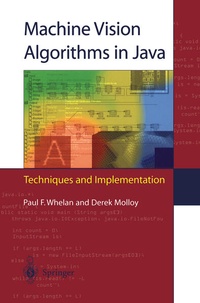
Machine Vision Algorithms in Java
Techniques and Implementation
Published on 10. September 2012
Book
Paperback/Softback
XVII, 284 pages
978-1-4471-1066-8 (ISBN)
Description
Machine Vision Algorithms in Java
provides a comprehensive introduction to the algorithms and techniques associated with machine vision systems. The Java programming language is also introduced, with particular reference to its imaging capabilities. The book contains explanations of key machine vision techniques and algorithms, along with the associated Java source code.
Special features include:
- A complete self-contained treatment of the topics and techniques essential to the understanding and implementation of machine vision.
- An introduction to object-oriented programming and to the Java programming language, with particular reference to its imaging capabilities.
- Java source code for a wide range of practical image processing and analysis functions.
- Readers will be given the opportunity to download a fully functional Java-based visual programming environment for machine vision, available via the WWW. This contains over 200 image processing, manipulation and analysis functions and will enable users to implement many of the ideas covered in this book.
- Details relating to the design of a Java-based visual programming environment for machine vision.
- An introduction to the Java 2D imaging and Java Advanced Imaging (JAI) APIs
- A wide range of illustrative examples.
- Practical treatment of the subject matter.
This book is aimed at senior undergraduate and postgraduate students in engineering and computer science as well as practitioners in machine vision who may wish to update or expand their knowledge of the subject. The techniques and algorithms of machine vision are expounded in a way that will be understood not only by specialists but also by those who are less familiar with the topic.
Special features include:
- A complete self-contained treatment of the topics and techniques essential to the understanding and implementation of machine vision.
- An introduction to object-oriented programming and to the Java programming language, with particular reference to its imaging capabilities.
- Java source code for a wide range of practical image processing and analysis functions.
- Readers will be given the opportunity to download a fully functional Java-based visual programming environment for machine vision, available via the WWW. This contains over 200 image processing, manipulation and analysis functions and will enable users to implement many of the ideas covered in this book.
- Details relating to the design of a Java-based visual programming environment for machine vision.
- An introduction to the Java 2D imaging and Java Advanced Imaging (JAI) APIs
- A wide range of illustrative examples.
- Practical treatment of the subject matter.
This book is aimed at senior undergraduate and postgraduate students in engineering and computer science as well as practitioners in machine vision who may wish to update or expand their knowledge of the subject. The techniques and algorithms of machine vision are expounded in a way that will be understood not only by specialists but also by those who are less familiar with the topic.
More details
Edition
Softcover reprint of the original 1st ed. 2001
Language
English
Place of publication
London
United Kingdom
Target group
Professional and scholarly
Professional/practitioner
Illustrations
XVII, 284 p.
Dimensions
Height: 235 mm
Width: 155 mm
Thickness: 17 mm
Weight
470 gr
ISBN-13
978-1-4471-1066-8 (9781447110668)
DOI
10.1007/978-1-4471-0251-9
Schweitzer Classification
Other editions
Additional editions
E-Book
12/2012
Springer
€149.79
Available for download
Book
10/2000
Springer
€160.49
Shipment within 15-20 days
Content
1. An Introduction to Machine Vision.- 1.1 Human, Computer and Machine Vision.- 1.2 Vision System Hardware.- 1.3 Vision System Software.- 1.4 Machine Vision System Design.- 1.5 NeatVision: Where Java meets Machine Vision.- 2. Java Fundamentals.- 2.1 The History of Java.- 2.2 Object-oriented Programming.- 2.3 Java Language Basics.- 2.4 Applications and Applets.- 2.5 Java and Image Processing.- 2.6 Additional Classes.- 2.7 Double Buffering.- 2.8 Recent Additions to Java for Imaging.- 2.9 Additional Information on Java.- 2.10 Conclusion.- 3. Machine Vision Techniques.- 3.1 Elementary Image Processing Functions.- 3.2 Local Operators.- 3.3 Binary Images.- 3.4 Global Image Transforms.- 3.5 Conclusion.- 4. Mathematical Morphology.- 4.1 Binary Mathematical Morphology.- 4.2 Grey Scale Mathematical Morphology.- 4.3 Morphological Reconstruction.- 4.4 Morphological Segmentation.- 4.5 Case Study: Geometric Packing.- 4.6 Morphological System Implementation.- 4.7 Conclusion.- 5. Texture Analysis.- 5.1 Texture and Images.- 5.2 Edge Density.- 5.3 Monte-Carlo Method.- 5.4 Auto-Correlation Function (ACF).- 5.5 Fourier Spectral Analysis.- 5.6 Histogram Features.- 5.7 Grey Level Run Length Method (GLRLM).- 5.8 Grey Level Difference Method (GLDM).- 5.9 Co-occurrence Analysis.- 5.10 Morphological Texture Analysis.- 5.11 Fractal Analysis.- 5.12 Textural Energy.- 5.13 Texture Spectrum Method.- 5.14 Local Binary Patterns (LBP).- 5.15 Random Field Models.- 5.16 Spatial/Frequency Methods.- 5.17 Autoregressive Model.- 5.18 Structural Approaches to Texture Analysis.- 5.19 Conclusion.- 6. Colour Image Analysis.- 6.1 Colour Cameras.- 6.2 Red-Green-Blue (RGB) Colour Representation.- 6.3 Hue-Saturation-Intensity (HSI) Colour Representation.- 6.4 Opponent Process Representation.- 6.5 YIQ Colour Representation.- 6.6 YUV Colour Representation.- 6.7 CIE Chromaticity Diagram.- 6.8 CIEXYZ Colour Representation.- 6.9 CIELUV Colour Representation.- 6.10 CIELAB Colour Representation.- 6.11 Spatial CIELAB Colour Representation.- 6.12 Programmable Colour Filter (PCF).- 6.13 Conclusion.- 7. NeatVision: Visual Programming for Machine Vision.- 7.1 Visual Programming in Neat Vision.- 7.2 Java Programming in NeatVision.- 7.3 The Neat Vision Application.- 7.4 Sample Applications.- 7.5 Conclusion.- A. NeatVision Graphic File Formats.- B. NeatVision Imaging API Specification.- C. NeatVision Components.- References.