

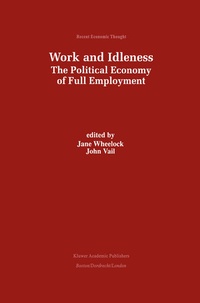
Work and Idleness
The Political Economy of Full Employment
Published on 30. November 1998
Book
Hardback
XV, 329 pages
978-0-7923-8390-1 (ISBN)
Description
Work and Idleness
develops the view that redistributing employment is a `feasible capitalist' solution, not just to the unemployment which particular groups suffer, but also to the work that others have to contend with, including many women. Putting the redistribution of employment on the policy agenda opens up debate on how to ensure a more equitable and fulfilling relationship between the ways we gain our livelihoods and the lives we lead.
Growing insecurity in labour markets and changing patterns in the commodification of labour have led to a redistribution of paid and unpaid labour time as the structure of power relations, the gender order, discrimination, and state regulation have been modified. The first main trend affecting insecurity is mass unemployment and the growth of workless households. A second notable trend is a gender-based redistribution of hours worked. The third major trend is a shift from full-time waged work to full-time self-employment.
Part I of this book presents the main economic theories driving the continuing divide between the intensification of work and the extension of idleness. Part II documents the ways in which the shift to mass idleness in advanced industrial countries has hit some groups particularly hard: the youngest and oldest age groups and other groups, including disabled workers, have traditionally been subject to discrimination in the labor markets. Part III provides a set of policy prescriptions.
Growing insecurity in labour markets and changing patterns in the commodification of labour have led to a redistribution of paid and unpaid labour time as the structure of power relations, the gender order, discrimination, and state regulation have been modified. The first main trend affecting insecurity is mass unemployment and the growth of workless households. A second notable trend is a gender-based redistribution of hours worked. The third major trend is a shift from full-time waged work to full-time self-employment.
Part I of this book presents the main economic theories driving the continuing divide between the intensification of work and the extension of idleness. Part II documents the ways in which the shift to mass idleness in advanced industrial countries has hit some groups particularly hard: the youngest and oldest age groups and other groups, including disabled workers, have traditionally been subject to discrimination in the labor markets. Part III provides a set of policy prescriptions.
More details
Series
Edition
1998 ed.
Language
English
Place of publication
Dordrecht
Netherlands
Target group
College/higher education
Professional and scholarly
Research
Illustrations
XV, 329 p.
Dimensions
Height: 241 mm
Width: 160 mm
Thickness: 24 mm
Weight
688 gr
ISBN-13
978-0-7923-8390-1 (9780792383901)
DOI
10.1007/978-94-011-4397-4
Schweitzer Classification
Other editions
Additional editions
E-Book
12/2012
Springer
€149.79
Available for download
Book
11/2012
Springer
€160.49
Shipment within 15-20 days
Content
1 A feasible capitalist response to a changing political economy.- I Theories of Full Employment.- 2 A Keynesian view of the redistribution of work.- 3 Neo-classical perspectives on unemployment and labour supply: the macro environment and micro responses.- 4 Whose full employment? A feminist perspective on work redistribution.- 5 A green approach to work and idleness.- II Who Needs Work?.- 6 Crap jobs, 'govy' schemes and trainspotting: reassessing the youth, employment and idleness debate.- 7 Managing the end of occupational life.- 8 Working opportunities for disabled people.- 9 Reducing the burden of work on women?.- III Blueprints For Action.- 10 The US model: the wages of inequality.- 11 'The cult of training'; unemployment and capitalist employment policy.- 12 Redistributing work: the role of the welfare state.- 13 Working time in Europe: current trends.- 14 Social labour and democratic capital: the margins or the main-stream?.- 15 The feasible Utopia of a redistribution of work: radical alternatives for full employment.