

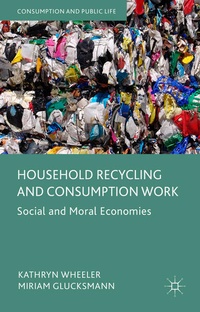
Household Recycling and Consumption Work
Social and Moral Economies
Published on 29. September 2015
Book
Hardback
XIII, 235 pages
978-1-137-44043-3 (ISBN)
Description
Consumers are not usually incorporated into the sociological concept of 'division of labour', but using the case of household recycling, this book shows why this foundational concept needs to be revised.
More details
Series
Edition
1st ed. 2015
Language
English
Place of publication
London
United Kingdom
Target group
Professional and scholarly
Product notice
sewn/stitched
Cloth over boards
With dust jacket
Illustrations
XIII, 235 p.
Dimensions
Height: 216 mm
Width: 140 mm
Thickness: 16 mm
Weight
435 gr
ISBN-13
978-1-137-44043-3 (9781137440433)
DOI
10.1057/9781137440440
Schweitzer Classification
Other editions
Additional editions
Kathryn Wheeler | Miriam Glucksmann
Household Recycling and Consumption Work
Social and Moral Economies
Book
07/2017
Palgrave Macmillan
€53.49
Shipment within 15-20 days
Kathryn Wheeler | Miriam Glucksmann
Household Recycling and Consumption Work
Social and Moral Economies
E-Book
04/2016
Palgrave Macmillan
€53.49
Available for download
Persons
Kathryn Wheeler is Lecturer in Sociology at the University of Essex, UK. Her research focuses on ethical consumption and moral economies. She is the author of Fair Trade and the Citizen-Consumer: Shopping for Justice? (2012), which analyses the organisations, institutions and grassroots networks that promote and support fair-trade in the UK, USA and Sweden.
Miriam Glucksmann is Emeritus Professor of Sociology at the University of Essex, UK and Visiting Professor of Sociology at the London School of Economics, UK. She has longstanding interests in work, employment and gender, especially restructuring, and connections between, different forms of labour. Her books include Structuralist Analysis in Contemporary Social Thought (1974, 2014), Women on the Line (1982, 2009), Women Assemble (1990), Cottons and Casuals (2000), and the jointly edited A New Sociology of Work? (2005). She completed a programme of research on 'Transformations of Work' as an ESRC Professorial Fellow in 2007, and was funded by the European Research Council (2010-2014) to research 'Consumption Work and Societal Divisions of Labour'.
Miriam Glucksmann is Emeritus Professor of Sociology at the University of Essex, UK and Visiting Professor of Sociology at the London School of Economics, UK. She has longstanding interests in work, employment and gender, especially restructuring, and connections between, different forms of labour. Her books include Structuralist Analysis in Contemporary Social Thought (1974, 2014), Women on the Line (1982, 2009), Women Assemble (1990), Cottons and Casuals (2000), and the jointly edited A New Sociology of Work? (2005). She completed a programme of research on 'Transformations of Work' as an ESRC Professorial Fellow in 2007, and was funded by the European Research Council (2010-2014) to research 'Consumption Work and Societal Divisions of Labour'.
Content
1. Picking a way through rubbish 2. Consumers as workers in economies of waste 3. Environmentally regimented rubbish: recycling systems in Sweden 4. Market and state heterogeneity: recycling systems in England 5. The three stages of recycling consumption work 6. Comparing recycling consumption work 7. Moral economies of recycling 8. Living off tips: waste and recycling in Brazil and India 9. Varieties of recycling work