

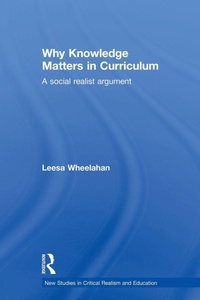
Why Knowledge Matters in Curriculum
A Social Realist Argument
1st Edition
Published on 10. January 2012
Book
Paperback/Softback
208 pages
978-0-415-52200-7 (ISBN)
Description
What should we teach in our schools and vocational education and higher education institutions? Is theoretical knowledge still important?
This book argues that providing students with access to knowledge should be the raison d'etre of education. Its premise is that access to knowledge is an issue of social justice because society uses it to conduct its debates and controversies.
Theoretical knowledge is increasingly marginalised in curriculum in all sectors of education, particularly in competency-based training which is the dominant curriculum model in vocational education in many countries. This book uses competency-based training to explore the negative consequences that arise when knowledge is displaced in curriculum in favour of a focus on workplace relevance.
The book takes a unique approach by using the sociology of Basil Bernstein and the philosophy of critical realism as complementary modes of theorising to extend and develop social realist arguments about the role of knowledge in curriculum. Both approaches are increasingly influential in education and the social sciences and the book will be helpful for those seeking an accessible introduction to these complex subjects.
Why Knowledge Matters in Curriculum is a key reading for those interested in the sociology of education, curriculum studies, work-based learning, vocational education, higher education, adult and community education, tertiary education policy and lifelong learning more broadly.
This book argues that providing students with access to knowledge should be the raison d'etre of education. Its premise is that access to knowledge is an issue of social justice because society uses it to conduct its debates and controversies.
Theoretical knowledge is increasingly marginalised in curriculum in all sectors of education, particularly in competency-based training which is the dominant curriculum model in vocational education in many countries. This book uses competency-based training to explore the negative consequences that arise when knowledge is displaced in curriculum in favour of a focus on workplace relevance.
The book takes a unique approach by using the sociology of Basil Bernstein and the philosophy of critical realism as complementary modes of theorising to extend and develop social realist arguments about the role of knowledge in curriculum. Both approaches are increasingly influential in education and the social sciences and the book will be helpful for those seeking an accessible introduction to these complex subjects.
Why Knowledge Matters in Curriculum is a key reading for those interested in the sociology of education, curriculum studies, work-based learning, vocational education, higher education, adult and community education, tertiary education policy and lifelong learning more broadly.
Reviews / Votes
'This book deserves a wide readership. I believe it has some important messages and explanations for us all that go well beyond curriculum development considerations.''[T]he book has implications well beyond the area of secondary and tertiary education curriculum design...Dr Wheelahan has produced a significant contribution to the understanding of wider cultural and intellectual changes and issues in Australia and elsewhere over the last several decades.'-Neil Mudford, Deputy Head, School of Engineering and Information Technology, Australian Defence Force Academy in Australian Universities' Review, vol. 53, no. 1, 2011
'[T]his book is a timely publication in examining the politics of knowledge within the curriculum.'
'If you are interested in a high-level debate on a broad range of educational locations, and if you believe that higher education should be about equitable access to knowledge, the sharing of knowledge, reflecting and imagining the unthought, then this is a book for you.'-Dr Helen Jones, Manchester Metropolitan University in ELiSS, vol. 3, no. 1, July 2010
'[R]ich, scholarly, and rigorous.'
'[A] broad audience could well be attracted to Wheelahan's book, especially those concerned with the design of vocational curricula.'-Ronald Barnett, Institute of Education, University of London in London Review of Education, vol. 9, no. 1, March 2011
'[A]n important book for both researchers and graduate students'
'[A] serious addition to critical scholarship about a meaningful knowledge society.'-Dr Airini, University of Auckland in Journal of the Pacific Circle Consortium for Education
More details
Series
Language
English
Place of publication
London
United Kingdom
Publishing group
Taylor & Francis Ltd
Target group
College/higher education
Professional and scholarly
Postgraduate and Professional
Dimensions
Height: 234 mm
Width: 156 mm
Thickness: 11 mm
Weight
324 gr
ISBN-13
978-0-415-52200-7 (9780415522007)
Copyright in bibliographic data and cover images is held by Nielsen Book Services Limited or by the publishers or by their respective licensors: all rights reserved.
Schweitzer Classification
Other editions
Additional editions
E-Book
07/2012
1st Edition
Routledge
€64.49
Available for download
E-Book
07/2012
1st Edition
Routledge
€64.49
Available for download
Book
03/2010
1st Edition
Routledge
€231.50
Shipment within 15-20 days
Person
Leesa Wheelahan is an associate professor at the L.H. Martin Institute for Higher Education Leadership and Management at the University of Melbourne. Her research interests include vocational knowledge in curriculum, and tertiary education policy and social justice. She is a regular commentator for Campus Review, Australia's weekly tertiary education newspaper
Content
This book takes a unique approach by using the sociology of Basil Bernstein and the philosophy of critical realism as complementary modes of theorising to extend and develop social realist arguments about the role of knowledge in curriculum, and to elaborate social realism's critique of constructivism, technical-instrumentalism and neo-conservatism.