

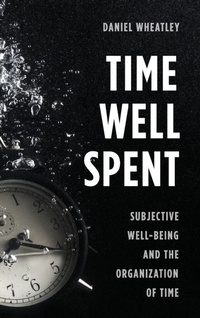
Time Well Spent
Subjective Well-Being and the Organization of Time
Published on 2. May 2017
Book
Hardback
272 pages
978-1-78348-425-6 (ISBN)
Description
Measuring quality of life has been identified as fundamental in assessing the relative progress of societies and as having relevance for both monitoring and policy-making purposes. Self-reported measures of well-being, referred to as subjective well-being, have become increasingly topical given the growing awareness of the limitations of existing measures of well-being including gross domestic product (GDP). In the UK, the ONS's 'Happiness Index' was launched in 2010 by Prime Minister David Cameron.
This book aims to improve our understanding of well-being through an analysis of time-use in a post-industrial society, the UK, drawing on empirical data from large-scale surveys such as Understanding Society and smaller-scale case study evidence. It uses a plurality of theoretical perspectives to explore the relationship between our use of time and our reported levels of satisfaction, and considers the policy lessons that we can take from our organization of time.
This book aims to improve our understanding of well-being through an analysis of time-use in a post-industrial society, the UK, drawing on empirical data from large-scale surveys such as Understanding Society and smaller-scale case study evidence. It uses a plurality of theoretical perspectives to explore the relationship between our use of time and our reported levels of satisfaction, and considers the policy lessons that we can take from our organization of time.
Reviews / Votes
Combining both new empirical evidence and a mix of different theories, this book offers a unique insight into the relationship between subjective well-being and time use. The book contributes positively to an important debate on how we might lead better and more fulfilled lives inside and outside work. Reading it is time well-spent. -- David Spencer, Professor of Economics and Political Economy, Centre for Employment Relations Innovation and Change, University of Leeds This is an intelligent book dedicated to one of the most important and scarcest resources in a modern human's life: time. It provides an excellent account of different authoritative theories on time-use, as well as offers new evidence on how different allocations of time can impact our overall sense of well-being. A good companion for well-being researchers everywhere. -- Nick Powdthavee, Professor, Warwick Business School, University of Warwick This book is an excellent addition to the growing social science literature on well-being. The perspective of time-use and its relation to subjective well-being provides a range of insights, and the findings presented and discussed are thought-provoking and noteworthy. I was particularly pleased to see the strong presence of themes relating to politics, policy and gender, and will be making extensive use of this book in the course I teach on politics and well-being. -- David Walker, Politics Undergraduate Degree Director, Newcastle University (This book) explores the relationship between how time is used and well-being, using empirical measures of self-assessed well-being, and evaluates the impact of the organization of time on subjective well-being. * Journal of Economic Literature *More details
Language
English
Place of publication
United Kingdom
Publishing group
Bloomsbury Publishing PLC
Target group
Professional and scholarly
US School Grade: From College Sophomore to College Graduate Student
Illustrations
16 Charts, 18 Tables
Dimensions
Height: 235 mm
Width: 157 mm
Thickness: 21 mm
Weight
600 gr
ISBN-13
978-1-78348-425-6 (9781783484256)
Copyright in bibliographic data and cover images is held by Nielsen Book Services Limited or by the publishers or by their respective licensors: all rights reserved.
Schweitzer Classification
Other editions
Additional editions
E-Book
05/2017
1st Edition
Rowman & Littlefield Publishers
€42.49
Available for download
Person
Daniel Wheatley is Senior Lecturer in Business and Labour Economics in the Department of Management at University of Birmingham Business School.
Content
1. Subjective well-being and time-use: An introduction / 2. A pluralist perspective on time-use / 3. Time-use: The historical and policy context / 4. Work-time, the quality of work and well-being / 5. The household division of labour and flexibility in paid work / 6. Care and volunteering: The (feel) good Samaritan (with Irene Hardill) / 7. Where to next? Travel-to-work and travel-for-work / 8. Leisure time: The pursuit of happiness (with Craig Bickerton) / 9. The organization of time and subjective well-being: Key findings and implications for public and organizational policy