

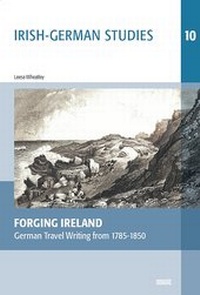
Forging Ireland
German Travel Writing from 1785-1850
Published on 27. September 2018
Book
Paperback/Softback
332 pages
978-3-86821-771-1 (ISBN)
Description
How did late eighteenth and early nineteenth-century German-speaking visitors to Ireland view the country and its people? What shaped their perceptions? How did they make sense of what they experienced? This book considers these questions by investigating the travel narratives of circa thirty German-speaking visitors to Ireland between 1785-1850. The study shows how aesthetic theories of the sublime and the picturesque, the trope of the savage, as well as racial, colonial and national discourses informed observers' views of Ireland and the Irish. Yet, although authors employed similar conceptual frameworks, tropes and stereotypes, the study outlines how these could be employed in very different ways: authors' attempts to make sense of Ireland reveal predispositions, (mis)appropriations and specific agendas which both informed and curtailed explainability. In outlining German observers' construction of the Irish
Volk
,
Volkscharakter
and
Volksgeist
, this study reveals how a number of discourses combined to forge an Irish collective, no matter how disparate that collective might be. With the emergence of the nation state as a means for political organisation around 1800, this book then investigates if a potential Irish nation is 'imagined' into being through outside observation.
More details
Person
Content
Contents
Acknowledgements ix
Abbreviations xi
1 Visiting Ireland: Introduction 1
2 Framing Ireland 15
2.1 Picturesque Ireland: Compositional Techniques and Subject Matter 19
2.2 Imperfection, Improvement, Perfection 37
2.3 The Irish Sublime and Ossian 47
3 Populating the Picture 59
3.1 Visualising the Irish People 61
3.2 Breaking the Idyll 81
3.3 Aesthetics and the City 88
4 Constructing the Individual 99
4.1 Savages both Noble and Ignoble 102
4.2 Savages, Social Inequality and Middle-Class Sensibilities 105
4.3 Colonial Configurations of the Savage 116
4.4 The Violent Savage 124
4.5 Changing Perceptions of the Savage 126
5 Constructing the Collective 134
5.1 An Irish Nationalcharakter , the Protestant Nation and the Union 140
5.2 The 'Discovery' of Irish Folk Culture 151
5.3 Folk Culture and an Irish Nationalcharakter 160
5.4 Folk Culture and the 'Wild Irish' 167
6 Racialising the Irish 173
6.1 Celtic and Germanic Ireland 176
6.2 Physiognomy and Phrenology 182
6.3 Celtic and Germanic Character 184
6.4 Race and Religion 190
6.5 A Celtic Irish Volksgeist 196
7 Changing Perspectives:
The Emergence of Vormärz Rhetoric 208
7.1 Reconfigured Comparisons 213
7.2 A Freedom-Loving Oppressed People 222
7.3 Signs of Cultural and Moral Improvement 226
7.4 The Famine Years 230
8 Explaining Ireland 239
8.1 Landlordism 239
8.2 Union, Emancipation, Repeal: Solutions Offered 243
9 Knowing Ireland? Conclusion 269
10 Biographies of Authors 274
List of Portraits 291
11 Bibliography 293
11.1 Primary Literature 293
11.2 Secondary Literature 300
Index 313
Acknowledgements ix
Abbreviations xi
1 Visiting Ireland: Introduction 1
2 Framing Ireland 15
2.1 Picturesque Ireland: Compositional Techniques and Subject Matter 19
2.2 Imperfection, Improvement, Perfection 37
2.3 The Irish Sublime and Ossian 47
3 Populating the Picture 59
3.1 Visualising the Irish People 61
3.2 Breaking the Idyll 81
3.3 Aesthetics and the City 88
4 Constructing the Individual 99
4.1 Savages both Noble and Ignoble 102
4.2 Savages, Social Inequality and Middle-Class Sensibilities 105
4.3 Colonial Configurations of the Savage 116
4.4 The Violent Savage 124
4.5 Changing Perceptions of the Savage 126
5 Constructing the Collective 134
5.1 An Irish Nationalcharakter , the Protestant Nation and the Union 140
5.2 The 'Discovery' of Irish Folk Culture 151
5.3 Folk Culture and an Irish Nationalcharakter 160
5.4 Folk Culture and the 'Wild Irish' 167
6 Racialising the Irish 173
6.1 Celtic and Germanic Ireland 176
6.2 Physiognomy and Phrenology 182
6.3 Celtic and Germanic Character 184
6.4 Race and Religion 190
6.5 A Celtic Irish Volksgeist 196
7 Changing Perspectives:
The Emergence of Vormärz Rhetoric 208
7.1 Reconfigured Comparisons 213
7.2 A Freedom-Loving Oppressed People 222
7.3 Signs of Cultural and Moral Improvement 226
7.4 The Famine Years 230
8 Explaining Ireland 239
8.1 Landlordism 239
8.2 Union, Emancipation, Repeal: Solutions Offered 243
9 Knowing Ireland? Conclusion 269
10 Biographies of Authors 274
List of Portraits 291
11 Bibliography 293
11.1 Primary Literature 293
11.2 Secondary Literature 300
Index 313