

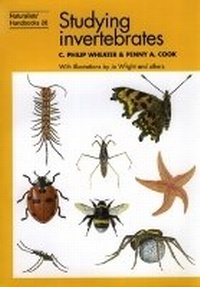
Studying Invertebrates
1st Edition
Published on 4. July 2010
Book
Paperback/Softback
122 pages
978-0-85546-313-7 (ISBN)
Description
Studying invertebrates is a comprehensive guide to designing and carrying out ecological investigations, especially those involving sampling invertebrates. A highly practical guide to fieldwork, statistical testing and interpretation. The book introduces ways of designing and analysing experiments so that complex situations can be described and summarised, comparisons made, and interactions between organisms and their environment examined objectively.
More details
Series
Language
English
Place of publication
Slough
United Kingdom
Target group
College/higher education
Professional and scholarly
Illustrations
4 farbige Bildtafeln, s/w Abbildungen
Illustrations, black and white; 4 Plates, color
Dimensions
Height: 210 mm
Width: 148 mm
Weight
220 gr
ISBN-13
978-0-85546-313-7 (9780855463137)
Copyright in bibliographic data and cover images is held by Nielsen Book Services Limited or by the publishers or by their respective licensors: all rights reserved.
Schweitzer Classification
Other editions
New editions
C. Philip Wheater | Penny A. Cook
Studying Invertebrates
Book
09/2015
Pelagic Publishing
€29.39
Shipment within 10-15 days
Content
Introduction;
Designing an investigation: Designing and setting up experiments and surveys; Types of data; Sampling strategies; Selecting independent data points; Asking questions.
Sampling invertebrates: Conducting fieldwork responsibly and safely; Surveying vegetation; Measuring environmental variables; Monitoring substrates such as sand and soil; Monitoring water; Measuring physical attributes of a habitat; Sampling invertebrates from water; Sampling invertebrates from substrates; Sampling invertebrates from rocky shores; Sampling surface active invertebrates; Sampling invertebrates living in and on plants; Sampling aerial insects; Marking invertebrates; Keeping live invertebrates; Killing and preserving invertebrates.
Identifying invertebrates: Marine invertebrates; Freshwater invertebrates; Terrestrial invertebrates.
Describing data: Examining frequencies; Finding the average value; Examining variation; Estimating the reliability of the sample mean; Estimating population sizes and densities; Identifying clumped, regular and random distributions; Examining similarities between communities.
Statistical testing: Choosing a statistical test; Testing for differences between samples; Testing for relationships between variables; Testing for associations between frequency distributions.
Presenting your results: Creating tables and graphs; Writing up work.
Some useful addresses; Appendix I Calculating statistics; Mathematical glossary; II Statistical tables; References and further reading.
Designing an investigation: Designing and setting up experiments and surveys; Types of data; Sampling strategies; Selecting independent data points; Asking questions.
Sampling invertebrates: Conducting fieldwork responsibly and safely; Surveying vegetation; Measuring environmental variables; Monitoring substrates such as sand and soil; Monitoring water; Measuring physical attributes of a habitat; Sampling invertebrates from water; Sampling invertebrates from substrates; Sampling invertebrates from rocky shores; Sampling surface active invertebrates; Sampling invertebrates living in and on plants; Sampling aerial insects; Marking invertebrates; Keeping live invertebrates; Killing and preserving invertebrates.
Identifying invertebrates: Marine invertebrates; Freshwater invertebrates; Terrestrial invertebrates.
Describing data: Examining frequencies; Finding the average value; Examining variation; Estimating the reliability of the sample mean; Estimating population sizes and densities; Identifying clumped, regular and random distributions; Examining similarities between communities.
Statistical testing: Choosing a statistical test; Testing for differences between samples; Testing for relationships between variables; Testing for associations between frequency distributions.
Presenting your results: Creating tables and graphs; Writing up work.
Some useful addresses; Appendix I Calculating statistics; Mathematical glossary; II Statistical tables; References and further reading.