

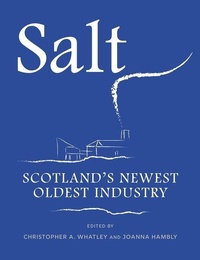
Salt
Scotland's Newest Oldest Industry
Published on 14. September 2023
Book
Paperback/Softback
240 pages
978-1-910900-97-0 (ISBN)
Description
Discover the story of Scotland, salt and the world.
Salt is a vital commodity. For many centuries it sustained life for Scots as seasoning for a diet dominated by grains (mainly oats), and for preservation of fish and cheese.
Sea-salt manufacturing is one of Scotland's oldest industries, dating to the eleventh century if not earlier. Smoke- and steam-emitting panhouses were once a common sight along the country's coastline and are reflected in many of Scotland's placenames. The industry was a high-status activity, with the monarch initially owning salt pans. Salt manufacture was later organised by Scotland's abbeys and then by landowners who had access to the sea and a nearby supply of coal. As salt was an important source of tax revenue for the government, it was often a cause of conflict (and military action) between Scotland and England. The future of the industry - and the price of salt for consumers - was a major issue during negotiations around the Union of 1707.
This book celebrates both the history and the rebirth of the salt industry in Scotland. Although salt manufacturing declined in the nineteenth century and was wound up in the 1950s, in the second decade of the twenty-first century the trade was revived. Scotland's salt is now a high-prestige, green product that is winning awards and attracting interest across the UK.
Salt is a vital commodity. For many centuries it sustained life for Scots as seasoning for a diet dominated by grains (mainly oats), and for preservation of fish and cheese.
Sea-salt manufacturing is one of Scotland's oldest industries, dating to the eleventh century if not earlier. Smoke- and steam-emitting panhouses were once a common sight along the country's coastline and are reflected in many of Scotland's placenames. The industry was a high-status activity, with the monarch initially owning salt pans. Salt manufacture was later organised by Scotland's abbeys and then by landowners who had access to the sea and a nearby supply of coal. As salt was an important source of tax revenue for the government, it was often a cause of conflict (and military action) between Scotland and England. The future of the industry - and the price of salt for consumers - was a major issue during negotiations around the Union of 1707.
This book celebrates both the history and the rebirth of the salt industry in Scotland. Although salt manufacturing declined in the nineteenth century and was wound up in the 1950s, in the second decade of the twenty-first century the trade was revived. Scotland's salt is now a high-prestige, green product that is winning awards and attracting interest across the UK.
Reviews / Votes
'one of those all-too-rare books that cover their subject so definitively that it's hard to imagine anyone ever wanting or needing to write another book on the subject' -- Ken Lussey * Undiscovered Scotland * 'the definitive history of salt-making in Scotland, richly illustrated with photographs, maps and archaeological plans... authoritative, highly engaging and beautifully produced, Salt reads like history as it should be written' * History Scotland *More details
Language
English
Place of publication
United Kingdom
Publishing group
Birlinn General
Target group
Professional and scholarly
Dimensions
Height: 189 mm
Width: 247 mm
Thickness: 18 mm
Weight
726 gr
ISBN-13
978-1-910900-97-0 (9781910900970)
Copyright in bibliographic data and cover images is held by Nielsen Book Services Limited or by the publishers or by their respective licensors: all rights reserved.
Schweitzer Classification
Other editions
Additional editions
E-Book
09/2023
John Donald
€17.99
Available for download
Persons
Christopher A. Whatley OBE FRSE is Professor of Scottish History at the University of Dundee. His publications include the award-winning The Scots and the Union, Immortal Memory: Burns and the Scottish People and Pabay: An Island Odyssey.
Joanna Hambly is an archaeologist and research fellow at the University of St Andrews. Through her work with the SCAPE Trust, she manages an award-winning national programme of community research into the archaeology of Scotland's coasts and has a long-standing interest in the archaeology of sea-salt manufacture in the UK.
Joanna Hambly is an archaeologist and research fellow at the University of St Andrews. Through her work with the SCAPE Trust, she manages an award-winning national programme of community research into the archaeology of Scotland's coasts and has a long-standing interest in the archaeology of sea-salt manufacture in the UK.