

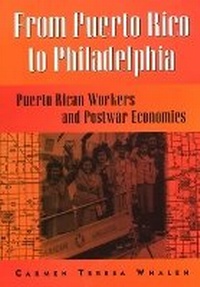
From Puerto Rico to Philadelphia
Puerto Rican Workers and Postwar Economies
Published on 15. February 2001
Book
Hardback
277 pages
978-1-56639-835-0 (ISBN)
Description
"We were poor but we had everything we needed," reminisces Dona Epifania. Nonetheless, when a man she knew told her about a job in Philadelphia, she grasped the opportunity to leave Coamas. "He went to Puerto Rico and told me there were beans to cook. I came here and cooked for fourteen workers." In San Lorenzo, Dona Carmen and her husband made the same decision: "We didn't want to, nobody wanted to leave...There wasn't any alternative." Don Florencio recalls that in Salinas work had gotten scarce, "especially for the youth, the young men...The farmworker that was used to cutting cane, already the sugar cane was disappearing," and government licensing regulations made fishing "more difficult for the poor." Puerto Rican migration to the mainland following World War II took place for a range of reasons - globalization of the economy, the colonial relationship between the United States and Puerto Rico, state policies, changes in regional and local economies, social networks, and, not least, the decisions made by individual immigrants. In this wide-ranging book, Carmen Whalen weaves them all into a tapestry of Puerto Rican immigration to Philadelphia.
Like African Americans and Mexicans, Puerto Ricans were recruited for low-wage jobs, only to confront racial discrimination as well as economic restructuring. As Whalen shows, they were part of that wave of newcomers who come from areas in the Caribbean, Latin America, and Asia characterized by a heavy U.S. military and economic presence, especially export processing zones, looking for a new life in depressed urban environments already populated by earlier labor migrants. But Puerto Rican immigration was also unique, especially in its regional and gender dimensions. Many migrants came as part of contract labor programs shaped by competing agendas. By the 1990s, economic conditions, government policies, and racial ideologies had transformed Puerto Rican labor migrants into what has been called "the other underclass." Professor Whalen analyzes this continuation of "culture of poverty" interpretations and contrasts it with the efforts of Philadelphia Puerto Ricans to recreate their communities and deal with the impact of economic restructuring and residential segregation in the City of Brotherly Love.
Author note: Carmen Teresa Whalen is Assistant Professor of Puerto Rican and Hispanic Caribbean Studies at Rutgers University.
Like African Americans and Mexicans, Puerto Ricans were recruited for low-wage jobs, only to confront racial discrimination as well as economic restructuring. As Whalen shows, they were part of that wave of newcomers who come from areas in the Caribbean, Latin America, and Asia characterized by a heavy U.S. military and economic presence, especially export processing zones, looking for a new life in depressed urban environments already populated by earlier labor migrants. But Puerto Rican immigration was also unique, especially in its regional and gender dimensions. Many migrants came as part of contract labor programs shaped by competing agendas. By the 1990s, economic conditions, government policies, and racial ideologies had transformed Puerto Rican labor migrants into what has been called "the other underclass." Professor Whalen analyzes this continuation of "culture of poverty" interpretations and contrasts it with the efforts of Philadelphia Puerto Ricans to recreate their communities and deal with the impact of economic restructuring and residential segregation in the City of Brotherly Love.
Author note: Carmen Teresa Whalen is Assistant Professor of Puerto Rican and Hispanic Caribbean Studies at Rutgers University.
More details
Language
English
Place of publication
Philadelphia PA
United States
Target group
Professional and scholarly
Dimensions
Height: 254 mm
Width: 178 mm
Thickness: 20 mm
Weight
767 gr
ISBN-13
978-1-56639-835-0 (9781566398350)
Copyright in bibliographic data and cover images is held by Nielsen Book Services Limited or by the publishers or by their respective licensors: all rights reserved.
Schweitzer Classification
Content
List of Maps, Figures, and Tables Acknowledgments 1. Looking for Work in the Global Economy: An Introduction 2. From the Country to the Cities: Internal Migration and Migration to the States 3. Contract Labor: The State-Sponsored Migration 4. Leaving Local Communities: San Lorenzo and Salinas 5. A Plethora of Limited Opportunities: Philadelphia's Economy 6. Formulating the "Culture of Poverty": Philadelphia's Response to Puerto Rican Migration 7. From Labor Migrants to the "Underclass": Interpreting Puerto Rican Poverty Epilogue Appendix I: Additional Data Appendix II: A Word on Sources Notes Selected Bibliography Index