

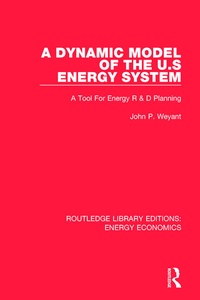
A Dynamic Model of the US Energy System
A Tool For Energy R & D Planning
1st Edition
Published on 29. October 2019
Book
Paperback/Softback
232 pages
978-1-138-50266-6 (ISBN)
Description
Originally published in 1984, this book develops a quantitative model designed for use in the evaluation of the relative merits of alternative energy R&D programmes. It is used to compare the merits of major energy-technology R&D programmes during the 1970s in the USA: Liquid-metal fast breeder reactors, synthetic fuels derived from coal and oil shale and improved efficiency in end-use technologies. The benefits/disadvantages are analyzed in terms of economics, security and the environment. Although published some years ago, the economic benefit assessed is in terms of the impact that commercialization of a particular energy-technology would have on the total 60 year cost of the US energy supply system. The security benefit is measured in terms of the reduction of crude oil imports and the environmental factors are measured here by the total tonnage of coal and oil shale that is extracted each year. All of these issues continue to be relevant today.
More details
Series
Language
English
Place of publication
London
United Kingdom
Publishing group
Taylor & Francis Ltd
Target group
College/higher education
Professional and scholarly
General, Postgraduate, Professional, and Undergraduate
Dimensions
Height: 234 mm
Width: 156 mm
Weight
430 gr
ISBN-13
978-1-138-50266-6 (9781138502666)
Copyright in bibliographic data and cover images is held by Nielsen Book Services Limited or by the publishers or by their respective licensors: all rights reserved.
Schweitzer Classification
Other editions
Additional editions
Book
09/2017
1st Edition
Routledge
€186.10
Shipment within 10-20 days
E-Book
09/2017
Routledge
€47.49
Available for download
E-Book
09/2017
Routledge
€47.49
Available for download
Person
John P. Weyant
Content
1. Introduction 2. Summary of the Example Application 3. Description of the Model Concept 4. Results from the Example Application of the Model 5. R&D Policy Interpretations of the Results 6. Other Potential Model Applications