

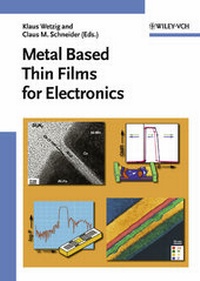
Metal Based Thin Films for Electronics
1st Edition
Published on 12. September 2003
Book
Hardback
388 pages
978-3-527-40365-3 (ISBN)
Description
This up-to-date handbook covers the main topics of preparation, characterization and properties of complex metal based layer systems, essential for scientists and materials specialists in industry, especially in microelectronics.
Reviews / Votes
"...I can certainly agree with the final sentence of the book cover: A perfect introduction to the field--for professionals and students." (Angewandte Chemie, 2004, No. 11) "Through its focus on practical aspects and its didactic approach, the book is designed especially for practitioners. It can be highly recommended to materials engineers, physicists or process engineers who work or plan to work in the still exciting field of micro electronics." (European Society of Thin Films)More details
Other editions
New editions
Klaus Wetzig | Claus M. Schneider
Metal Based Thin Films for Electronics
Book
05/2006
2nd Edition
Wiley-VCH
€229.00
Article is exhausted; no reprint
Additional editions
Klaus Wetzig | Claus M. Schneider
Metal Based Thin Films for Electronics
E-Book
03/2006
1st Edition
Wiley-VCH
€111.99
Available for download
Persons
Klaus Wetzig studied physics at the University of Technology in Dresden, receiving his licence in 1963, his doctorate in 1967 and his habilitation in 1973. In 1975 he moved to the Academy of Sciences, and since 1992 he is Full Professor of Materials Analysis at the University of Technology in Dresden and Director at the Leibniz Institute of Solid State and Materials Research Dresden.
His research interests include materials analysis and microstructures, especially electron microscopy of functional materials, characterization of thin films for electronics, and nanostructural features in general.
Claus Michael Schneider studied physics at the Institute of Technology Aachen receiving his diploma in 1985. He obtained his PhD in 1990 at the Free University of Berlin and his habilitation in 1996 at the Martin-Luther-University Halle. In 1998 he moved to the Leibniz Institute of Solid State and Materials Research Dresden, heading the department of thin film systems and nanostructures. In June 2003 he was appointed director at the Institut für Festkörperforschung (IFF-IEE) of the Forschungszentrum Jülich.
His research interests include solid state physics, thin film systems and surface magnetism as well as the physics of nanostructures.
Content
1 Introduction (Klaus Wetzig and Claus M. Schneider). 2 Thin Film Systems: Basic Aspects. 2.1 Interconnects for Microelectronics (Ralph Spolenak and Ehrenfried Zschech). 2.1.1 Introduction. 2.1.2 Metallization Layers. 2.1.3 Materials Science of Metallic Interconnects. 2.1.4 Function of Barrier and Nucleation Layers and Materials Selection. 2.2 Metallization Structures in Acoustoelectronics (Manfred Weihnacht). 2.2.1 Introduction. 2.2.2 Fundamentals of Surface Acoustic Waves. 2.2.3 Interdigital Transducers (IDTs). 2.2.4 Reflector Gratings. 2.2.5 Waveguides, Energy Trapping. 2.2.6 Multistrip Couplers. 2.3 Silicide Layers for Electronics (Joachim Schumann). 2.3.1 Introduction. 2.3.2 The Basic Chemical and Physical Properties. 2.3.3 Preparation of Silicides. 2.3.4 Silicides with Metallic Conductivity. 2.3.5 Semiconducting Silicides. 2.3.6 Heterogeneously Disordered Silicide Films. 2.4 Complex Layered Systems for Magnetoelectronics (Claus M. Schneider). 2.4.1 Introduction. 2.4.2 Magnetism: A Primer. 2.4.3 Magnetic Coupling Phenomena. 2.4.4 Electric Transport in Layered Magnetic Systems. 2.4.5 Functional Thin Film Systems. 2.5 Multilayer and Single--Surface Reflectors for X--Ray Optics (Hermann Mai and Stefan Braun). 2.5.1 Introduction. 2.5.2 Refraction and Reflection at Single Boundaries. 2.5.3 BRAGG Reflection at 1D Lattice Systems. 2.5.4 Multilayer Preparation. References. 3 Thin Film Preparation and Characterization Techniques. 3.1 Thin Film Preparation Methods (Christian Wenzel). 3.1.1 Introduction. 3.1.2 Physical Vapor Deposition. 3.1.3 Chemical Vapor Deposition. 3.1.4 Non--Vacuum Based Deposition. 3.1.5 Outlook. 3.2 Electron Microscopy and Diffraction (Klaus Wetzig and Jurgen Thomas). 3.2.1 Transmission Electron Microscopy (TEM) -- Imaging. 3.2.2 TEM -- Selected Area Electron Diffraction. 3.2.3 In situ--SEM Methods. 3.2.4 Electron Backscatter Diffraction. 3.3 X--Ray Scattering Techniques (Michael Hecker). 3.3.1 Wide Angle Diffraction. 3.3.2 Reflectometry. 3.3.3 Soft X--Rays and Magnetic Scattering. 3.4 Spectroscopic Techniques (Klaus Wetzig). 3.4.1 Element Distribution Analysis. 3.4.2 Element Depth Profile Analysis. 3.5 Stress Measurement Techniques (Winfried Bruckner). 3.5.1 Stress and Strain. 3.5.2 Substrate Curvature. 3.5.3 Measurement Techniques. References. 4 Challenges for Thin Film Systems Characterization and Optimization. 4.1 Electromigration in Metallization Layers (Ralph Spolenak, et al.). 4.1.1 Fundamentals. 4.1.2 Methods for Quantitative Damage Analysis. 4.1.3 Al Interconnects. 4.1.4 Cu Interconnects. 4.2 Barrier and Nucleation Layers for Interconnects (Ehrenfried Zschech). 4.2.1 Introduction. 4.2.2 PVD Barrier Layers for Copper Interconnects. 4.2.3 Barrier/Seed Microstructure and Step Coverage. 4.2.4 New Barrier/Seed Concepts using CVD and ALD. 4.2.5 Atomic Layer Deposition (ALD). 4.3 Acoustomigration in Surface Acoustic Waves Structures (Siegfried Menzel and Klaus Wetzig). 4.3.1 General Remarks. 4.3.2 Acoustomigration Mechanism. 4.3.3 Metallization Concepts for Power SAW Structures. 4.3.4 Experimental Set--up. 4.3.5 Acoustomigration Experiments. 4.4 Thermal Stability of Magnetoresistive Layer Stacks (Claus M. Schneider and Jurgen Thomas). 4.4.1 Metallic Multilayers as GMR Model Systems. 4.4.2 Co/Cu Multilayers. 4.4.3 Ni80Fe20/Cu Multilayers. 4.5 Functional Magnetic Layers for Sensors and MRAMs (Hartmut Vinzelberg and Dieter Elefant). 4.5.1 Magnetic Multilayers: Layer Thickness Dependence of the GMR Parameters. 4.5.2 Spin Valves. 4.5.3 Magnetic Tunnel Junctions. 4.6 Multilayers for X--Ray Optical Purposes (Hermann Mai and Stefan Braun). 4.6.1 Multilayers as Reflectors for X--Rays. 4.6.2 Real Structure of nm--Multilayers. 4.6.3 High--Resolution Multilayers. 4.6.4 Multilayers with Uniform and Graded Period Thickness. 4.7 Functional Electric Layers (Joachim Schumann and Jurgen Thomas). 4.7.1 Resistance Layers. 4.7.2 Thermoelectic Thin Films. References. 5 Devices. 5.1 Devices Related Aspects for Si Based Electronics (Ehrenfried Zschech). 5.1.1 Interconnect Technology and Materials Trends for Memory and Logic Products. 5.1.2 Copper Inlaid Process: Process Integration and Materials Related Topics. 5.1.3 Wiring Hierarchy for Copper/Low--K on--Chip Interconnects. 5.1.4 New Global Interconnect Concepts. 5.2 SAW High Frequency Filters, Resonators and Delay Lines (Manfred Weihnacht). 5.2.1 Introduction. 5.2.2 Transversal Filters. 5.2.3 Resonators. 5.2.4 Filters with Spread Spectrum. 5.2.5 Delay Lines. 5.3 Sensor Devices (Christoph Treutler). 5.3.1 Introduction. 5.3.2 Requirements for Thin Films to be Used as Transducers. 5.3.3 Thin Film Strain Gauges for Pressure Sensors and Force Meters. 5.3.4 Thin Film Thermometer in a Micromachined Air--Mass Flow Meter for Automotive Application. 5.3.5 Magnetic Thin Films for Measuring Position, Angle, Rotational Speed and Torque. 5.3.6 Conclusions and Outlook. 5.4 X--Ray Optical Systems (Hermann Mai and Stefan Braun). 5.4.1 Basic Properties of the Combination of X--Ray Optical Elements. 5.4.2 X--Ray Astronomy. 5.4.3 X--Ray Microscopy. 5.4.4 Extreme Ultraviolet Lithography (EUVL). 5.4.5 X--Ray Reflectometry and Diffractometry. 5.5 Thermoelectric Sensors and Transducers (Joachim Schumann). 5.5.1 Introduction. 5.5.2 Thermoelectric Energy Conversion -- Some Basic Considerations. 5.5.3 Thermoelectric Sensors. 5.5.4 Thermoelectric Transducers. 5.5.5 Outlook. References. 6 Outlook (Klaus Wetzig and Claus M. Schneider). Index.