

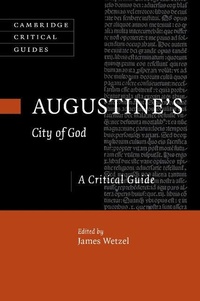
Augustine's City of God
A Critical Guide
Published on 6. November 2014
Book
Paperback/Softback
280 pages
978-1-107-46318-9 (ISBN)
Description
Augustine's City of God has profoundly influenced the course of Western political philosophy, but there are few guides to its labyrinthine argumentation that hold together the delicate interplay of religion and philosophy in Augustine's thought. The essays in this volume offer a rich examination of those themes, using the central, contested distinction between a heavenly city on earthly pilgrimage and an earthly city bound for perdition to elaborate aspects of Augustine's political and moral vision. Topics discussed include Augustine's notion of the secular, his critique of pagan virtue, his departure from classical eudaimonism, his mythology of sin, his dystopian politics, his surprising attention to female bodies, his moral psychology, his valorisation of love, his critique of empire and his conception of a Christian philosophy. Together the essays advance our understanding of Augustine's most influential work and provide a rich overview of Augustinian political theology and its philosophical implications.
Reviews / Votes
'To guide readers into the bishop's magnum opus, this collection of twelve essays, one of fifteen titles in the Cambridge Critical Guide series focusing on philosophical authors, draws upon specialists from the fields of theology, philosophy, and classics ... a helpful resource for suitably equipped readers critically examining De civitate Dei ... The contributions are diverse enough that few are likely to agree with every argument, but those arguments are generally well presented and the collection will stimulate discussion ... academics in any pertinent field leading honours/upper-division students through De civ. would be hard pressed not to find several essays here suitable for assigning as supplemental reading ...' David Neal Greenwood, Bryn Mawr Classical Review 'It has to be said, I think, that the consequence of the fine web of detail in the essays means that this is not a book which is likely to serve any but the most able and ambitious of undergraduate students, or more probably a postgraduate class. But for such a group, this book vindicates Wetzel's assertion that Augustine's 'antithesis - two cities, two loves, two ends - can still challenge the parodies that we would make of them'.' Studies in Christian EthicsMore details
Series
Language
English
Place of publication
Cambridge
United Kingdom
Target group
Professional and scholarly
Product notice
Paperback (trade)
Illustrations
Worked examples or Exercises; Printed music items
Dimensions
Height: 229 mm
Width: 152 mm
Thickness: 16 mm
Weight
410 gr
ISBN-13
978-1-107-46318-9 (9781107463189)
Copyright in bibliographic data and cover images is held by Nielsen Book Services Limited or by the publishers or by their respective licensors: all rights reserved.
Schweitzer Classification
Other editions
Additional editions
E-Book
10/2012
1st Edition
Cambridge University Press
€27.99
Available for download
Book
10/2012
Cambridge University Press
€79.20
Shipment within 15-20 days
Person
James Wetzel is Professor of Philosophy at Villanova University and the first permanent holder of the Augustinian Endowed Chair in the Thought of Saint Augustine. He is the author of Augustine and the Limits of Virtue (Cambridge University Press, 1992) and Augustine: A Guide for the Perplexed (2010).
Content
Introduction James Wetzel; 1. The history of the book: Augustine's City of God and post-Roman cultural memory Mark Vessey; 2. Secularity and the saeculum Paul J. Griffiths; 3. Augustine's dystopia Peter Iver Kaufman; 4. From rape to resurrection: sin, sexual difference, and politics Margaret R. Miles; 5. Ideology and solidarity in Augustine's City of God John Cavadini; 6. The theatre of the virtues: Augustine's critique of Pagan mimesis Jennifer Herdt; 7. The psychology of compassion: Stoicism in City of God 9.5 Sarah Byers; 8. Augustine's rejection of eudaimonism Nicholas Wolterstorff; 9. Augustine on the origin of evil: myth and metaphysics James Wetzel; 10. Hell and the dilemmas of intractable alienation John Bowlin; 11. On the nature and worth of Christian philosophy: evidence from the City of God John Rist; 12. Reinventing Augustine's ethics: the afterlife of City of God Bonnie Kent.