

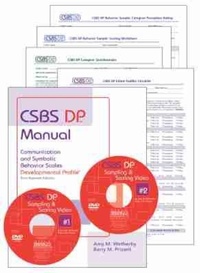
CSBS DP (TM) Test Kit
Communication and Symbolic Behavior Scales Developmental Profile (CSBS DP (TM))
Published on 30. July 2002
Book
Paperback/Softback
978-1-55766-551-5 (ISBN)
Description
The CSBS DP (TM) Test Kit contains the testing and scoring materials for the Communication and Symbolic Behavior Scales Developmental Profile (CSBS DP (TM)), an easy-to-use, norm-referenced screening and evaluation tool that measures the communicative competence (use of eye gaze, gestures, sounds, words, understanding, and play) of children with a functional communication age of 6 to 24 months and a chronological age of 6 months to 6 years.
Derived from the popular, norm-referenced CSBS (TM), CSBS DP (TM) is shorter and faster and lets early intervention professionals begin identification earlier. CSBS DP (TM) is an ideal starting point for planning IFSPs, determining the efficacy of interventions, documenting changes in a child's behavior over time, and identifying areas for further assessment.
The CSBS DP (TM) Test Kit includes:
Infant-Toddler Checklist: In 5-10 minutes, caregivers answer 24 multiple-choice questions grouped into seven language predictor clusters: Emotion and Eye Gaze, Communication, Gestures, Sounds, Words, Understanding, and Object Use. Then, a professional combines the clusters to yield scores in three composite categories: social, speech, and symbolic. The Checklist can also be used to monitor development every 3 months between the ages of 6 and 24 months.
Caregiver Questionnaire: If the Checklist indicates a need for further evaluation, caregivers complete this easy-to-read four-page questionnaire, which measures in more detail the same seven clusters. It takes approximately 15-25 minutes and is designed to be given or mailed to the caregiver before the child is brought in for the Behavior Sample.
Behavior Sample: This face-to-face sampling procedure takes 30 minutes to conduct and simultaneously score. Professionals lead a brief warm-up with the child and then sample behavior in various contexts: communicative temptations, book sharing, symbolic play probes, language comprehension probes, and constructive play probes. The Behavior Sample measures 20 scales that comprise the social, speech, and symbolic composites, and professionals record the presence or absence of 20 types of behavior on a scoring worksheet.
Caregiver Perception Rating: This one-page form asks caregivers to compare the child's behavior during the assessment to the child's typical behavior.
CSBS DP (TM) Manual: The Manual includes instructions for administering and scoring the profile, technical data on standardization and norming, and guidelines for interpreting a child's CSBS DP (TM) for screening and evaluation.
Instructional Videos: These two videos demonstrate how to collect a Behavior Sample and complete the scoring worksheets as well as explain key developmental terms.
Derived from the popular, norm-referenced CSBS (TM), CSBS DP (TM) is shorter and faster and lets early intervention professionals begin identification earlier. CSBS DP (TM) is an ideal starting point for planning IFSPs, determining the efficacy of interventions, documenting changes in a child's behavior over time, and identifying areas for further assessment.
The CSBS DP (TM) Test Kit includes:
Infant-Toddler Checklist: In 5-10 minutes, caregivers answer 24 multiple-choice questions grouped into seven language predictor clusters: Emotion and Eye Gaze, Communication, Gestures, Sounds, Words, Understanding, and Object Use. Then, a professional combines the clusters to yield scores in three composite categories: social, speech, and symbolic. The Checklist can also be used to monitor development every 3 months between the ages of 6 and 24 months.
Caregiver Questionnaire: If the Checklist indicates a need for further evaluation, caregivers complete this easy-to-read four-page questionnaire, which measures in more detail the same seven clusters. It takes approximately 15-25 minutes and is designed to be given or mailed to the caregiver before the child is brought in for the Behavior Sample.
Behavior Sample: This face-to-face sampling procedure takes 30 minutes to conduct and simultaneously score. Professionals lead a brief warm-up with the child and then sample behavior in various contexts: communicative temptations, book sharing, symbolic play probes, language comprehension probes, and constructive play probes. The Behavior Sample measures 20 scales that comprise the social, speech, and symbolic composites, and professionals record the presence or absence of 20 types of behavior on a scoring worksheet.
Caregiver Perception Rating: This one-page form asks caregivers to compare the child's behavior during the assessment to the child's typical behavior.
CSBS DP (TM) Manual: The Manual includes instructions for administering and scoring the profile, technical data on standardization and norming, and guidelines for interpreting a child's CSBS DP (TM) for screening and evaluation.
Instructional Videos: These two videos demonstrate how to collect a Behavior Sample and complete the scoring worksheets as well as explain key developmental terms.
More details
Edition
First Normed Edition
Language
English
Place of publication
Baltimore
United States
Target group
College/higher education
Professional and scholarly
Weight
2268 gr
ISBN-13
978-1-55766-551-5 (9781557665515)
Copyright in bibliographic data and cover images is held by Nielsen Book Services Limited or by the publishers or by their respective licensors: all rights reserved.
Schweitzer Classification
Persons
> Amy M. Wetherby, Ph.D., is Professor and former Chair of the Department of Communication Disorders at Florida State University. She received her doctorate from the University of California-San Francisco/Santa Barbara in 1982. She has had more than 20 years of clinical experience in the design and implementation of communication programs for children with autism and severe communication impairments and is an American Speech-Language-Hearing Association fellow. Dr. Wetherby's research has focused on communicative and social-cognitive aspects of language difficulties in children with autism and, more recently, on the early identification of children with communicative impairments. She has published extensively on these topics and presents regularly at national conventions. She is a co-author of the Communication and Symbolic Behavior Scales (with Barry M. Prizant [Applied Symbolix, 1993]). She is the Executive Director of the Florida State University Center for Autism and Related Disabilities and is Project Director of U.S. Department of Education Model Demonstration Grant No. H324M980173 on early identification of communication disorders in infants and toddlers and Personnel Preparation Training Grant No. H029A10066 specializing in autism.