

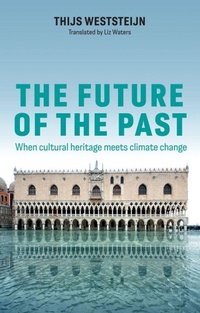
The Future of the Past
When Cultural Heritage Meets Climate Change
1st Edition
Published on 5. June 2026
Book
Hardback
240 pages
978-1-5095-6784-3 (ISBN)
Description
As the wooden piles under Amsterdam begin to rot, water levels rise in Venice. The 4,500-year-old ruins of Mohenjo-daro flood in Pakistan. Compaction of peat soil in northern England is causing Hadrian's Wall to collapse. The bricks of excavated Babylon are exploding as a result of increasing salt levels. Melting permafrost in Siberia is endangering the ancient burial mounds of the Scythian civilization. In the US, hurricanes have partially destroyed the heritage of New Orleans and Puerto Rico, while the 2019 wildfires forced the Getty Museum in Los Angeles to close.
The climate crisis is threatening historical heritage all over the world, with higher temperatures, more storms and fires and, of course, rising sea levels. Monuments, buildings, inner cities and cultural landscapes are at risk, and museums such as the Louvre have already started relocating parts of their collections to climate-proof storage facilities. Written by a highly regarded art historian, The Future of the Past addresses this urgent issue and asks us to include the fate of beauty in our conversations on climate change.
Extreme weather means we have to approach history in new ways. Historical heritage now confronts us not only with the past, but also the future.
The climate crisis is threatening historical heritage all over the world, with higher temperatures, more storms and fires and, of course, rising sea levels. Monuments, buildings, inner cities and cultural landscapes are at risk, and museums such as the Louvre have already started relocating parts of their collections to climate-proof storage facilities. Written by a highly regarded art historian, The Future of the Past addresses this urgent issue and asks us to include the fate of beauty in our conversations on climate change.
Extreme weather means we have to approach history in new ways. Historical heritage now confronts us not only with the past, but also the future.
Reviews / Votes
"Thijs Weststeijn's The Future of the Past isn't quite canned soup splattered on Van Gogh's Sunflowers, but its message is every bit as urgent: cultural heritage is under threat from climate change. With a sure grasp of climate science and the policy landscape, Weststeijn takes us on a thoughtful tour of the cultural sites - and the preservation theories - that climate change is putting to the test in the Netherlands and around the globe. He shows that we do, in fact, have tools to protect cultural heritage at our disposal: age-old non-Western practices, new digital technologies, and refined reconstruction techniques. If the facts of climate science alone fail to motivate adequate climate action, perhaps the prospect of losing our shared cultural heritage will."Simon Richter, Class of 1965 Endowed Term Professor of Germanic Studies, University of Pennsylvania
"Weststeijn's volume is an eye-opening account of how the climate is putting historical heritage at risk on a global scale. As institutions are tasked with adapting to a rapidly changing world, we will need to take necessary measures to protect our collections. For curators and all supporters of culture, this book lays the essential foundations on how to approach preserving the past."
Lizzie Marx, Curator of Dutch and Flemish Art, National Gallery of Ireland
"This book is so well written it is hard to put down. Thijs Weststeijn shows us that, the way things are going, climate change is not only going to wipe out species and make wide areas of the globe uninhabitable, it is also going to destroy many of the most beautiful products of the world's cultures. He offers no false hopes but constructive suggestions, and a mass of fascinating detail which allows us to gauge the scale of the problems we need to address."
Paul Taylor, Professor of the History of the Classical Tradition, University of London
"Heritage experts have spent years documenting the threats posed by mass tourism, war and commerce, but Weststeijn says they have been late to chart the damage wrought by a warming climate."
Pilita Clark, Financial Times
More details
Language
English
Place of publication
Oxford
United Kingdom
Dimensions
Height: 147 mm
Width: 224 mm
Thickness: 29 mm
Weight
470 gr
ISBN-13
978-1-5095-6784-3 (9781509567843)
Copyright in bibliographic data and cover images is held by Nielsen Book Services Limited or by the publishers or by their respective licensors: all rights reserved.
Schweitzer Classification
Other editions
Additional editions
E-Book
05/2026
1st Edition
Wiley-Scrivener
€21.99
Available for download
Persons
Thijs Weststeijn is Professor of Art History at the University of Utrecht.
Content
Prologue: A cry of nations o'er sunken halls
1. Historical heritage threatened by the climate crisis
Dutch canaries in a global coalmine
A bathtub surrounded by water
A heritage worldwide under threat
Higher water temperatures, more droughts and rain
Thawing permafrost
Storms and fires
The rising sea
Museums
Combinations of factors
2. Why heritage?
The heritage crusade continues
Inheriting and legating: the new challenge
Solastalgia
Heritage: between micro and micro
3. Art and nature: fertile cross-pollination
Mankind's best moment?
The Little Ice Age
Landscape into art
The artificial landscape
From wind and pear to coal and oil
Shell and the climate movement
Artists versus the fossil fuel industry
The robber barons and their art patronage
Artwashing worldwide
Another colonial dimension: Britain, India, Myanmar, Iran, Iraq
Museums as battlegrounds for climate action
4. The historical sensation in the Anthropocene
Human and natural history: a matter of scale
The historical sensation in the light of the future
The end of progressivism
Progress in the West = decline in the Global South
Cyclical history
The Great Acceleration
Human and non-human time regimes
The multiple temporalities of heritage
5. Transformation
Authenticity and materials
A cyclical view: breaking down and building up
Look on my works, ye Mighty, and despair!
Abandoning heritage
6. Digitization
The real and the virtual
The ubiquity and ephemerality of the digital world
Digitization as a tool
7. Reconstruction
A receding coastline: the Cape Hatteras lighthouse and Clavell Tower
The temple of Zhang Fei
UNESCO's views on reconstruction
Place, identity and the 'global commons'
Epilogue: looking the beast in the eye
Heritage contributes to better understanding
Cathedral thinking
List of illustrations
Notes
Index
1. Historical heritage threatened by the climate crisis
Dutch canaries in a global coalmine
A bathtub surrounded by water
A heritage worldwide under threat
Higher water temperatures, more droughts and rain
Thawing permafrost
Storms and fires
The rising sea
Museums
Combinations of factors
2. Why heritage?
The heritage crusade continues
Inheriting and legating: the new challenge
Solastalgia
Heritage: between micro and micro
3. Art and nature: fertile cross-pollination
Mankind's best moment?
The Little Ice Age
Landscape into art
The artificial landscape
From wind and pear to coal and oil
Shell and the climate movement
Artists versus the fossil fuel industry
The robber barons and their art patronage
Artwashing worldwide
Another colonial dimension: Britain, India, Myanmar, Iran, Iraq
Museums as battlegrounds for climate action
4. The historical sensation in the Anthropocene
Human and natural history: a matter of scale
The historical sensation in the light of the future
The end of progressivism
Progress in the West = decline in the Global South
Cyclical history
The Great Acceleration
Human and non-human time regimes
The multiple temporalities of heritage
5. Transformation
Authenticity and materials
A cyclical view: breaking down and building up
Look on my works, ye Mighty, and despair!
Abandoning heritage
6. Digitization
The real and the virtual
The ubiquity and ephemerality of the digital world
Digitization as a tool
7. Reconstruction
A receding coastline: the Cape Hatteras lighthouse and Clavell Tower
The temple of Zhang Fei
UNESCO's views on reconstruction
Place, identity and the 'global commons'
Epilogue: looking the beast in the eye
Heritage contributes to better understanding
Cathedral thinking
List of illustrations
Notes
Index