

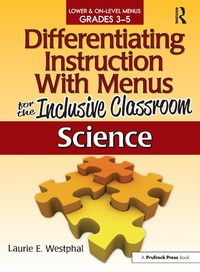
Differentiating Instruction With Menus for the Inclusive Classroom
Science (Grades 3-5)
1st Edition
Published on 1. March 2012
Book
Paperback/Softback
154 pages
978-1-59363-887-0 (ISBN)
Description
Differentiating Instruction With Menus for the Inclusive Classroom: Science for grades 3-5 offers teachers everything they need to create a student-centered learning environment based on choice. This book provides six different types of menus that students can use to select exciting products that they will develop so teachers can assess what has been learned-instead of using a traditional worksheet format. Topics addressed include physical science, biological science, Earth science, and tools scientists use.
Differentiating Instruction With Menus for the Inclusive Classroom: Science provides numerous types of leveled menus that lower and on-level elementary-aged students can use to demonstrate learning through a method of their choice. Menus with similar formats but geared towards varying ability levels allow teachers to differentiate easily. Using the creative and challenging choices found in Tic-Tac-Toe menus, List menus, 2-5-8 menus, Three Shape menus, Baseball menus, and Game Show menus, students will look forward to sharing their newfound knowledge throughout the year. Also included are specific guidelines for products, rubrics for assessing student products, and teacher introduction pages for each menu. This is a must-have for any teacher wanting to differentiate for a wide range of learners!
Grades 3-5
Differentiating Instruction With Menus for the Inclusive Classroom: Science provides numerous types of leveled menus that lower and on-level elementary-aged students can use to demonstrate learning through a method of their choice. Menus with similar formats but geared towards varying ability levels allow teachers to differentiate easily. Using the creative and challenging choices found in Tic-Tac-Toe menus, List menus, 2-5-8 menus, Three Shape menus, Baseball menus, and Game Show menus, students will look forward to sharing their newfound knowledge throughout the year. Also included are specific guidelines for products, rubrics for assessing student products, and teacher introduction pages for each menu. This is a must-have for any teacher wanting to differentiate for a wide range of learners!
Grades 3-5
Reviews / Votes
Integration of lessons in an inclusive classroom presents a severe challenge to the teacher. Kids are on-level, below-level, and often learning English as well. Westphal comes to the rescue by providing menus of appropriate activities for the commonly taught science topics . . . The bulk of the book is comprised of menus that are ready to be photocopied and used with classes. It is recommended as at least a partial answer to the perennial lament: "What do I do Monday?"Ann Rubino,Lewis University School of Education, 4/24/12
More details
Language
English
Place of publication
Oxford
United States
Publishing group
Taylor & Francis Inc
Target group
Professional and scholarly
Professional Practice & Development
Dimensions
Height: 209 mm
Width: 280 mm
Thickness: 61 mm
Weight
404 gr
ISBN-13
978-1-59363-887-0 (9781593638870)
Copyright in bibliographic data and cover images is held by Nielsen Book Services Limited or by the publishers or by their respective licensors: all rights reserved.
Schweitzer Classification
Other editions
Additional editions
Laurie E. Westphal
Differentiating Instruction With Menus for the Inclusive Classroom
Science (Grades 3-5)
E-Book
09/2021
1st Edition
Routledge
€27.49
Available for download
Laurie E. Westphal
Differentiating Instruction With Menus for the Inclusive Classroom
Science (Grades 3-5)
E-Book
09/2021
1st Edition
Routledge
€27.49
Available for download
Person
After teaching science for more than 15 years, both overseas and in the U.S., Laurie E. Westphal now works as an independent gifted education and science consultant. She enjoys developing and presenting staff development on differentiation for various districts and conferences, working with teachers to assist them in planning and developing lessons to meet the needs of their advanced students.
Content
Author's Note Chapter 1: Choice Chapter 2: How to Use Menus in the Inclusive Classroom Chapter 3: Guidelines for Products Chapter 4: Rubrics The Menus How to Use the Menu Pages Chapter 5: Physical Science The Three States of Matter Physical Properties of Matter Sound and Vibrations Light and Its Properties Alternate Energy Sources Tools Scientists Use Chapter 6: Biological Science Plants Food Chains Adaptations Human Body Systems Life Cycles of Plants and Animals Chapter 7: Earth Science The Water Cycle Our Soil Earth Processes Our Earth's Resources Our Weather Space The Sun The Lunar Cycle References About the Author Next Generation Science Standards Alignment