

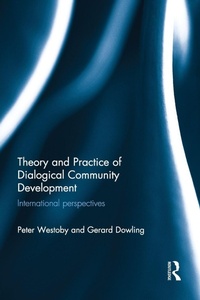
Theory and Practice of Dialogical Community Development
International Perspectives
1st Edition
Published on 12. September 2014
Book
Paperback/Softback
192 pages
978-1-138-83821-5 (ISBN)
Description
This book proposes that community development has been increasingly influenced and co-opted by a modernist, soulless, rational philosophy - reducing it to a shallow technique for 'solving community problems'. In contrast, this dialogical approach re-maps the ground of community development practice within a frame of ideas such as dialogue, hospitality and depth. For the first time community development practitioners are provided with an accessible understanding of dialogue and its relevance to their practice, exploring the contributions of internationally significant thinkers such as P. Freire, M. Buber, D. Bohm and H.G Gadamer, J. Derrida, G. Esteva and R. Sennett. What makes the book distinctive is that: first, it identifies a dialogical tradition of community development and considers how such a tradition shapes practice within contemporary contexts and concerns - economic, social, political, cultural and ecological. Second, the book contrasts such an approach with technical and instrumental approaches to development that fail to take complex systems seriously. Third, the approach links theory to practice through a combination of storytelling and theory-reflection - ensuring that readers are drawn into a practice-theory that they feel increasingly confident has been 'tried and tested' in the world over the past 25 years.
More details
Language
English
Place of publication
London
United Kingdom
Publishing group
Taylor & Francis Ltd
Target group
College/higher education
Dimensions
Height: 234 mm
Width: 156 mm
Thickness: 11 mm
Weight
304 gr
ISBN-13
978-1-138-83821-5 (9781138838215)
Copyright in bibliographic data and cover images is held by Nielsen Book Services Limited or by the publishers or by their respective licensors: all rights reserved.
Schweitzer Classification
Other editions
Additional editions
Peter Westoby | Gerard Dowling
Theory and Practice of Dialogical Community Development
International Perspectives
E-Book
07/2013
1st Edition
Routledge
€55.49
Available for download
Peter Westoby | Gerard Dowling
Theory and Practice of Dialogical Community Development
International Perspectives
E-Book
07/2013
Routledge
€55.49
Available for download
Peter Westoby | Gerard Dowling
Theory and Practice of Dialogical Community Development
International Perspectives
Book
04/2013
1st Edition
Routledge
€231.40
Shipment within 15-20 days
Persons
Peter Westoby is a Senior Lecturer in Community Development (CD) within the CD Unit of the School of Social Science, Queensland University, Australia, and a Research Fellow with the Centre for Development Support, University of Free State, South Africa. He is also a Director/Consultant with the non-profit co-operative Community Praxis Co-op, which provides youth, community and organisational development services. His experience includes over 20 years of practice work in South Africa, PNG, the Philippines, Vanuatu and Australia.
Gerard Dowling has 20 years of experience in various community development roles in Brisbane, Australia, including housing work with the Tenants' Union and collaborative community planning consultancies with Community Praxis Co-op. He currently manages a strategy unit organises youth projects for Brisbane City Council, working to make the city's programmes, services and facilities more inclusive. He explores creative ways to engage young people in youth space, urban design, multicultural community, sustainability, social enterprise, and e-citizenship in an innovative local government context.
Gerard Dowling has 20 years of experience in various community development roles in Brisbane, Australia, including housing work with the Tenants' Union and collaborative community planning consultancies with Community Praxis Co-op. He currently manages a strategy unit organises youth projects for Brisbane City Council, working to make the city's programmes, services and facilities more inclusive. He explores creative ways to engage young people in youth space, urban design, multicultural community, sustainability, social enterprise, and e-citizenship in an innovative local government context.
Content
Preface. Foreword. Introduction 1. Theoretical Prelude - an introduction to dialogue for community development 2. Re-imagining Community Practice 3. Transformational Community Processes 4. Analytical Interlude - What Weakens Dialogue Within Community Development 5. Caring for Different Spheres of Community Life 6. Dialogue and Training for Transformation Conclusion