

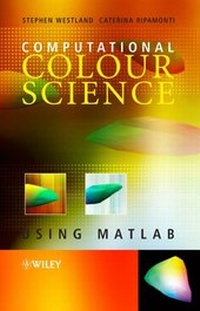
Computational Colour Science using MATLAB
Using MATLAB
1st Edition
Published on 16. March 2004
Book
Hardback
220 pages
978-0-470-84562-2 (ISBN)
Description
Presenting a practical, problem-based approach to colour physics, this title describes the key issues encountered in modern colour engineering, including efficient representation of colour information, fourier analysis of reflectance spectra and advanced colorimetric computation. Emphasis is placed on the practical applications rather than the techniques themselves, with material structured around key topics, such as colour calibration of visual displays, computer recipe prediction and models for colour-appearance prediction.
Each topic is carefully introduced at three levels to enhance student understanding. Firstly, theoretical ideas and background information are discussed, explanations of mathematical solutions then follow and finally practical solutions are presented using MATLAB.
* Includes a compendium of equations and numerical data required by the modern colour and imaging scientist.
* Numerous examples of solutions and algorithms for a wide-range of computational problems in colour science.
* Provides example scripts using the MATLAB programming language.
This text is a must-have for students taking courses in colour science, colour chemistry and colour physics as well as technicians and researchers working in the area.
Each topic is carefully introduced at three levels to enhance student understanding. Firstly, theoretical ideas and background information are discussed, explanations of mathematical solutions then follow and finally practical solutions are presented using MATLAB.
* Includes a compendium of equations and numerical data required by the modern colour and imaging scientist.
* Numerous examples of solutions and algorithms for a wide-range of computational problems in colour science.
* Provides example scripts using the MATLAB programming language.
This text is a must-have for students taking courses in colour science, colour chemistry and colour physics as well as technicians and researchers working in the area.
Reviews / Votes
"...a practical, problem-based approach...each main topic in the book is presented in a structured way..." (World Surface Coatings Abstracts, April 2004) "...highly recommended as a concise introduction to the practicalities of colour science..." (Color Technology, No.120 2004)More details
Edition
1., Auflage
Language
English
Place of publication
Chichester
United Kingdom
Publishing group
John Wiley and Sons Ltd
Target group
Professional and scholarly
Illustrations
Illustrations
Dimensions
Height: 25.2 cm
Width: 17.5 cm
Thickness: 19 mm
Weight
615 gr
ISBN-13
978-0-470-84562-2 (9780470845622)
Schweitzer Classification
Other editions
New editions
Stephen Westland | Caterina Ripamonti | Vien Cheung
Computational Colour Science Using MATLAB
A Practical Approach
Book
07/2012
2nd Edition
Wiley
€125.50
Shipment within 10-20 days
Content
Acknowledgements.
1. Introduction.
1.1 Who this book is for.
1.2 Why base this book on MATLAB?
1.3 A brief review of the CIE system of colorimetry.
2. Linear Algebra for Beginners.
2.1 Some basic definitions.
2.2 Solving systems of simultaneous equations.
2.3 Transposes and inverses.
2.4 Linear and non-linear transforms.
3. A Short Introduction to MATLAB.
3.1 Matrix operations.
3.2 Computing the transpose and inverse of matrices.
3.3 M-files.
3.4 Using functions in MATLAB.
4. Computing CIE Tristimulus Values.
4.1 Introduction.
4.2 Standard colour-matching functions.
4.3 Interpolation methods.
4.4 Extrapolation methods.
4.5 Tables of weights.
4.6 Correction for spectral bandpass.
4.7 Chromaticity diagrams.
4.8 Implementation and examples.
4.8.1 Spectral bandpass correction.
4.8.2 Reflectance interpolation.
4.8.3 Computing tristimulus values.
4.8.4 Plotting the spectral locus.
5. Computing Colour Difference.
5.1 Introduction.
5.2 CIELAB and CIELUV colour space.
5.3 CIELAB colour difference.
5.4 Optimized colour-difference formulae.
5.4.1 CMC(l:c).
5.4.2 CIE94.
5.4.3 CIEDE2000.
5.5 Implementations and examples.
5.5.1 Computing CIELAB and CIELUV coordinates.
5.5.2 Computing colour difference.
6. Chromatic-adaptation Transforms and Colour Appearance.
6.1 Introduction.
6.2 CATs.
6.2.1 CIECAT94.
6.2.2 CMCCAT97.
6.2.3 CMCCAT2000.
6.3 CAMs.
6.3.1 CIECAM97s.
6.3.2 CMCCAM2000.
6.4 Implementations and examples.
6.4.1 CATs.
6.4.2 Computing colour appearance.
7. Characterization of Computer Displays.
7.1 Introduction.
7.2 Gamma.
7.3 The GOG model.
7.4 Device-independent transformation.
7.5 Typical characterization procedure.
7.6 Implementations and examples.
8. Characterization of Cameras.
8.1 Introduction.
8.2 Correction for non-linearity.
8.3 Device-independent representation.
8.4 Implementations and examples.
9. Characterization of Printers.
9.1 Introduction.
9.2 Physical models.
9.3 Neural networks.
9.4 Characterization of half-tone printers.
9.4.1 Correction for non-linearity.
9.4.2 Device-independent representation.
9.4.3 The Kubelka-Munk model.
9.5 Implementations and examples.
9.5.1 Half-tone printer.
9.5.2 Continuous-tone printer.
10. Multispectral Imaging.
10.1 Introduction.
10.2 Computational colour constancy and linear models.
10.3 Surface and illuminant estimation algorithms.
10.4 Techniques for multispectral imaging.
10.4.1 The Hardeberg method.
10.4.2 The Imai and Berns method.
10.4.3 Methods based on maximum smoothness.
10.5 Implementations and examples.
10.5.1 Deriving a set of basis functions.
10.5.2 Representation of reflectance spectra in a linear model.
10.5.3 Estimation of reflectance spectra from tristimulus values.
10.5.4 Estimation of reflectance spectra from camera responses.
10.5.5 Fourier operations on reflectance spectra.
11. Colour Toolbox.
11.1 cband.m (Box 1).
11.2 pinterp.m (Box 2).
11.3 r2xyz.m (Box 3).
11.4 plocus.m (Box 4).
11.5 xyz2lab.m (Box 5).
11.6 lab2xyz.m (Box 6).
11.7 xyz2luv.m (Box 7).
11.8 car2pol.m (Box 8).
11.9 pol2car (Box 9).
11.10 cielabde.m (Box 10).
11.11 dhpolarity (Box 11).
11.12 cmcde.m (Box 12).
11.13 cie94de.m (Box 13).
11.14 cie00de.m (Box 14).
11.15 cmccat97.m (Box 15).
11.16 cmccat00.m (Box 16).
11.17 ciecam97s.m (Box 17).
11.18 gogtest.m (Box 18).
11.19 compgog.m (Box 19).
11.20 rgb2xyz.m (Box 20).
11.21 xyz2rgb.m (Box 21).
11.22 compigog (Box 22).
11.23 getlincam.m (Box 23).
11.24 lincam (Box 24).
11.25 gettrc (Box 25).
11.26 r2xyz (Box 26).
References.
Index.
1. Introduction.
1.1 Who this book is for.
1.2 Why base this book on MATLAB?
1.3 A brief review of the CIE system of colorimetry.
2. Linear Algebra for Beginners.
2.1 Some basic definitions.
2.2 Solving systems of simultaneous equations.
2.3 Transposes and inverses.
2.4 Linear and non-linear transforms.
3. A Short Introduction to MATLAB.
3.1 Matrix operations.
3.2 Computing the transpose and inverse of matrices.
3.3 M-files.
3.4 Using functions in MATLAB.
4. Computing CIE Tristimulus Values.
4.1 Introduction.
4.2 Standard colour-matching functions.
4.3 Interpolation methods.
4.4 Extrapolation methods.
4.5 Tables of weights.
4.6 Correction for spectral bandpass.
4.7 Chromaticity diagrams.
4.8 Implementation and examples.
4.8.1 Spectral bandpass correction.
4.8.2 Reflectance interpolation.
4.8.3 Computing tristimulus values.
4.8.4 Plotting the spectral locus.
5. Computing Colour Difference.
5.1 Introduction.
5.2 CIELAB and CIELUV colour space.
5.3 CIELAB colour difference.
5.4 Optimized colour-difference formulae.
5.4.1 CMC(l:c).
5.4.2 CIE94.
5.4.3 CIEDE2000.
5.5 Implementations and examples.
5.5.1 Computing CIELAB and CIELUV coordinates.
5.5.2 Computing colour difference.
6. Chromatic-adaptation Transforms and Colour Appearance.
6.1 Introduction.
6.2 CATs.
6.2.1 CIECAT94.
6.2.2 CMCCAT97.
6.2.3 CMCCAT2000.
6.3 CAMs.
6.3.1 CIECAM97s.
6.3.2 CMCCAM2000.
6.4 Implementations and examples.
6.4.1 CATs.
6.4.2 Computing colour appearance.
7. Characterization of Computer Displays.
7.1 Introduction.
7.2 Gamma.
7.3 The GOG model.
7.4 Device-independent transformation.
7.5 Typical characterization procedure.
7.6 Implementations and examples.
8. Characterization of Cameras.
8.1 Introduction.
8.2 Correction for non-linearity.
8.3 Device-independent representation.
8.4 Implementations and examples.
9. Characterization of Printers.
9.1 Introduction.
9.2 Physical models.
9.3 Neural networks.
9.4 Characterization of half-tone printers.
9.4.1 Correction for non-linearity.
9.4.2 Device-independent representation.
9.4.3 The Kubelka-Munk model.
9.5 Implementations and examples.
9.5.1 Half-tone printer.
9.5.2 Continuous-tone printer.
10. Multispectral Imaging.
10.1 Introduction.
10.2 Computational colour constancy and linear models.
10.3 Surface and illuminant estimation algorithms.
10.4 Techniques for multispectral imaging.
10.4.1 The Hardeberg method.
10.4.2 The Imai and Berns method.
10.4.3 Methods based on maximum smoothness.
10.5 Implementations and examples.
10.5.1 Deriving a set of basis functions.
10.5.2 Representation of reflectance spectra in a linear model.
10.5.3 Estimation of reflectance spectra from tristimulus values.
10.5.4 Estimation of reflectance spectra from camera responses.
10.5.5 Fourier operations on reflectance spectra.
11. Colour Toolbox.
11.1 cband.m (Box 1).
11.2 pinterp.m (Box 2).
11.3 r2xyz.m (Box 3).
11.4 plocus.m (Box 4).
11.5 xyz2lab.m (Box 5).
11.6 lab2xyz.m (Box 6).
11.7 xyz2luv.m (Box 7).
11.8 car2pol.m (Box 8).
11.9 pol2car (Box 9).
11.10 cielabde.m (Box 10).
11.11 dhpolarity (Box 11).
11.12 cmcde.m (Box 12).
11.13 cie94de.m (Box 13).
11.14 cie00de.m (Box 14).
11.15 cmccat97.m (Box 15).
11.16 cmccat00.m (Box 16).
11.17 ciecam97s.m (Box 17).
11.18 gogtest.m (Box 18).
11.19 compgog.m (Box 19).
11.20 rgb2xyz.m (Box 20).
11.21 xyz2rgb.m (Box 21).
11.22 compigog (Box 22).
11.23 getlincam.m (Box 23).
11.24 lincam (Box 24).
11.25 gettrc (Box 25).
11.26 r2xyz (Box 26).
References.
Index.