

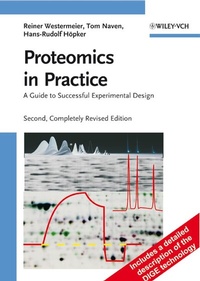
Proteomics in Practice
A Guide to Successful Experimental Design
2nd Edition
Published on 26. March 2008
Book
Hardback
XX, 482 pages
978-3-527-31941-1 (ISBN)
Description
Still the only concise practical guide to laboratory experiments in proteomics, this new edition now also covers DIGE technology and liquid-chromatography, while the troubleshooting section has been considerably extended.
Adopting a practical approach, the authors present the relevant techniques and explain the route to successful experimental design and optimal method selection. They cover such electrophoretic techniques as isoelectric focusing, SDS page, 2-D page, and DIGE, as well as liquid-chromatography techniques, such as ion exchange, affinity chromatography and reversed-phase HPLC. Mass-spectrometric techniques include MALDI, ESI, and FT ICR.
Generously illustrated, partly in color, the book also features updates of protocols as well as animations illustrating crucial methodological steps on a companion website.
Adopting a practical approach, the authors present the relevant techniques and explain the route to successful experimental design and optimal method selection. They cover such electrophoretic techniques as isoelectric focusing, SDS page, 2-D page, and DIGE, as well as liquid-chromatography techniques, such as ion exchange, affinity chromatography and reversed-phase HPLC. Mass-spectrometric techniques include MALDI, ESI, and FT ICR.
Generously illustrated, partly in color, the book also features updates of protocols as well as animations illustrating crucial methodological steps on a companion website.
Reviews / Votes
"This book will be a valuable addition to any laboratory engaged in proteomics and is highly recommended." (Internet Journal of Genomics and Proteomics 2008)More details
Edition
2. vollständig überarbeitete Auflage
Language
English
Place of publication
Berlin
Germany
Publishing group
Wiley-VCH
Target group
Professional and scholarly
Edition type
New edition
Illustrations
210
131 s/w Abbildungen, 28 farbige Abbildungen, 51 s/w Tabellen
Dimensions
Height: 24 cm
Width: 17 cm
Thickness: 3 cm
Weight
1105 gr
ISBN-13
978-3-527-31941-1 (9783527319411)
Schweitzer Classification
Other editions
Additional editions
Reiner Westermeier | Tom Naven | Hans-Rudolf Höpker
Proteomics in Practice
A Guide to Successful Experimental Design
E-Book
09/2008
2nd Edition
Wiley-Blackwell
€106.99
Available for download
Previous edition
Book
06/2002
1st Edition
Wiley-VCH
€89.90
Article exhausted; check for reprint
Persons
Reiner Westermeier gained his doctorate in 1981 at the Technical University of Munich, Germany. There he remained engaged in the development of new electrophoresis systems and applications until 1983, a period that also involved several international collaborations and lecturing tours.
From 1984 to 1987 Reiner Westermeier was employed as an electrophoresis products and applications specialist at LKB Instrument GmbH thereafter until 1990 at Pharmacia Biotech. He founded ETC Elektrophorese-Technik in 1991 for the development of new electrophoresis methods, media, and equipment. From January 1996 to July 1997 he was manager of scientific support Europe at Pharmacia Biotech in Freiburg, Germany. He has been at Amersham Pharmacia Biotech, later GE Healthcare since July 1997, and its Senior Scientist for Proteomics since January 2002.
Reiner Westermeier is the author of several publications and two books, both published by WILEY-VCH.
Tom Naven and Hans-Rudolf Höpker are also working for GE Healthcare as proteomics scientists.
From 1984 to 1987 Reiner Westermeier was employed as an electrophoresis products and applications specialist at LKB Instrument GmbH thereafter until 1990 at Pharmacia Biotech. He founded ETC Elektrophorese-Technik in 1991 for the development of new electrophoresis methods, media, and equipment. From January 1996 to July 1997 he was manager of scientific support Europe at Pharmacia Biotech in Freiburg, Germany. He has been at Amersham Pharmacia Biotech, later GE Healthcare since July 1997, and its Senior Scientist for Proteomics since January 2002.
Reiner Westermeier is the author of several publications and two books, both published by WILEY-VCH.
Tom Naven and Hans-Rudolf Höpker are also working for GE Healthcare as proteomics scientists.
Content
Preface
Foreword
Abbreviations
Glossary of terms
INTRODUCTION
History
Critical points
Hypothesis driven approach vs. High Throughput
Complementarities of workflows
Concept of experimental planning
Success stories, highlights of useful references
PART I: PROTEOMICS TECHNOLOGY
Electrophoresis
Liquid Chromatography
Mass spectrometry
Bioinformatics tools / data mining
Methods under development
PART II. PRACTICAL MANUAL OF PROTEOME ANALYSIS
Strategy where to start
Gel-based workflow
LC-based workflow
Latest trends
Validation with Western blotting
Statistic evaluation
PART III: TROUBLE SHOOTING
Gel-based workflow
LC based workflow
References
Index
Foreword
Abbreviations
Glossary of terms
INTRODUCTION
History
Critical points
Hypothesis driven approach vs. High Throughput
Complementarities of workflows
Concept of experimental planning
Success stories, highlights of useful references
PART I: PROTEOMICS TECHNOLOGY
Electrophoresis
Liquid Chromatography
Mass spectrometry
Bioinformatics tools / data mining
Methods under development
PART II. PRACTICAL MANUAL OF PROTEOME ANALYSIS
Strategy where to start
Gel-based workflow
LC-based workflow
Latest trends
Validation with Western blotting
Statistic evaluation
PART III: TROUBLE SHOOTING
Gel-based workflow
LC based workflow
References
Index