


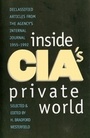
Inside CIA's Private World
Declassified Articles from the Agency's Internal Journal, 1955-92
Published on 30. August 1995
Book
Hardback
512 pages
978-0-300-06026-3 (ISBN)
Description
Since the 1950s the Central Intelligence Agency has published an in-house journal, "Studies in Intelligence", for CIA eyes only. Now the agency has declassified much of this material. This book, which presents the most interesting articles from the journal, provides revealing insights into CIA strategies and into events in which the organization was involved. The articles were selected by H. Bradford Westerfield, who teaches courses on intelligence operations but has never been affiliated with the CIA. Westerfield's introduction sketches the history and structure of the CIA, sets the articles in context, and explains his criteria for selecting them. The articles cover a wide range of intelligence activities, including: the gathering of intelligence data inside the United States; analysis of data; interaction between analysts and policymakers; the development of economic intelligence targeted at friendly countries as well as at foes; use of double agents (the personal memoir of a CIA officer who pretended to the Russians to be their agent); evaluation of defectors (the Nosenko case); and coercive interrogation techniques and how agents can resist them.
More details
Language
English
Place of publication
United States
Target group
College/higher education
Professional and scholarly
Illustrations
26 illustrations, index
Dimensions
Height: 234 mm
Width: 156 mm
Weight
900 gr
ISBN-13
978-0-300-06026-3 (9780300060263)
Copyright in bibliographic data is held by Nielsen Book Services Limited or its licensors: all rights reserved.
Schweitzer Classification
Other editions
Additional editions
Ericksen
Inside CIA's Private World
Declassified Articles from the Agency`s Internal Journal, 1955-1992
E-Book
10/2005
1st Edition
Yale University Press
€104.95
Available for download
Content
Part 1 Imagery Intelligence Collection: DC Power and Cooling Towers; The Unidentifieds. Part 2 Overt Human Intelligence Collection: The Interpreter as Agent; Obstacle Course for Attaches; Soviet Reality Sans Potemkin. Part 3 Clandestine Human Intelligence Collection: Techniques of Domestic Intelligence Collection; The Elicitation Interview; Psychology of Treason; The Practice of Prophet; Catch-as-Catch-Can Operations. Part 4 Humint and its Consumers: The Collector's Role in Evaluation; The Reports Officer: Issues of Quality; Clandestinity and Current Intelligence; The Not-So-Secret War, or How State-CIA Squabbling Hurts US Intelligence; Assessing DDO Human Source Reporting. Part 5 The Analysis Function: What Basic Intelligence Seeks to do; Do You Really Need More Information?; Basic Psychology for Intelligence Analysts; The Hazards of Single-Outcome Forecasting; Bayes' Theorem for Intelligence Analysts; The Sino-Soviet Border Dispute - A Comparison of the Conventional and Bayesian Methods for Intelligence Warning; Factions and Policon: New Ways to Analyse Politics; Scientific and Technical Intelligence Analysis; Economic Intelligence in CIA. Part 6 Analysis and its Consumers: Cognitive Biases: Problems in Hindsight Analysis; Dealing with Intelligence-Policy Disconnects; New Links Between Intelligence and Policy; UNCTAD V: Intelligence Support at a Major International Economic Conference. Part 7 Counterespionage: Nosenko - Five Paths to Judgement; Defence Against Communist Interrogation Organizations; Observations on the Double Agent; The Case of Major X. Appendices: The Next Most Valuable Articles; Abbreviations, Acronyms, and Definitions.